What are a zebra’s stripes for?
The leading theory: to keep blood-sucking horseflies and other biting flies away. It isn’t settled yet.
On the African savanna, a herd of zebras stands out from far away. Among all the brown and gray animals that blend into the grass, those crisp black-and-white stripes look thoroughly out of place.
What are the stripes actually for? Ideas have been put forward since the days of Charles Darwin and his fellow naturalist Alfred Russel Wallace. Only in the last decade or so have scientists come close to an answer.
White on black, or black on white?
First, a common question. Is a zebra white with black stripes, or black with white stripes?
Going by the fur alone, the belly and the insides of the legs are often unstriped and white, so a zebra looks like a white animal with black stripes. Shave off the hair, though, and the skin underneath is dark all over. Which color counts as the “background” depends on what you measure.
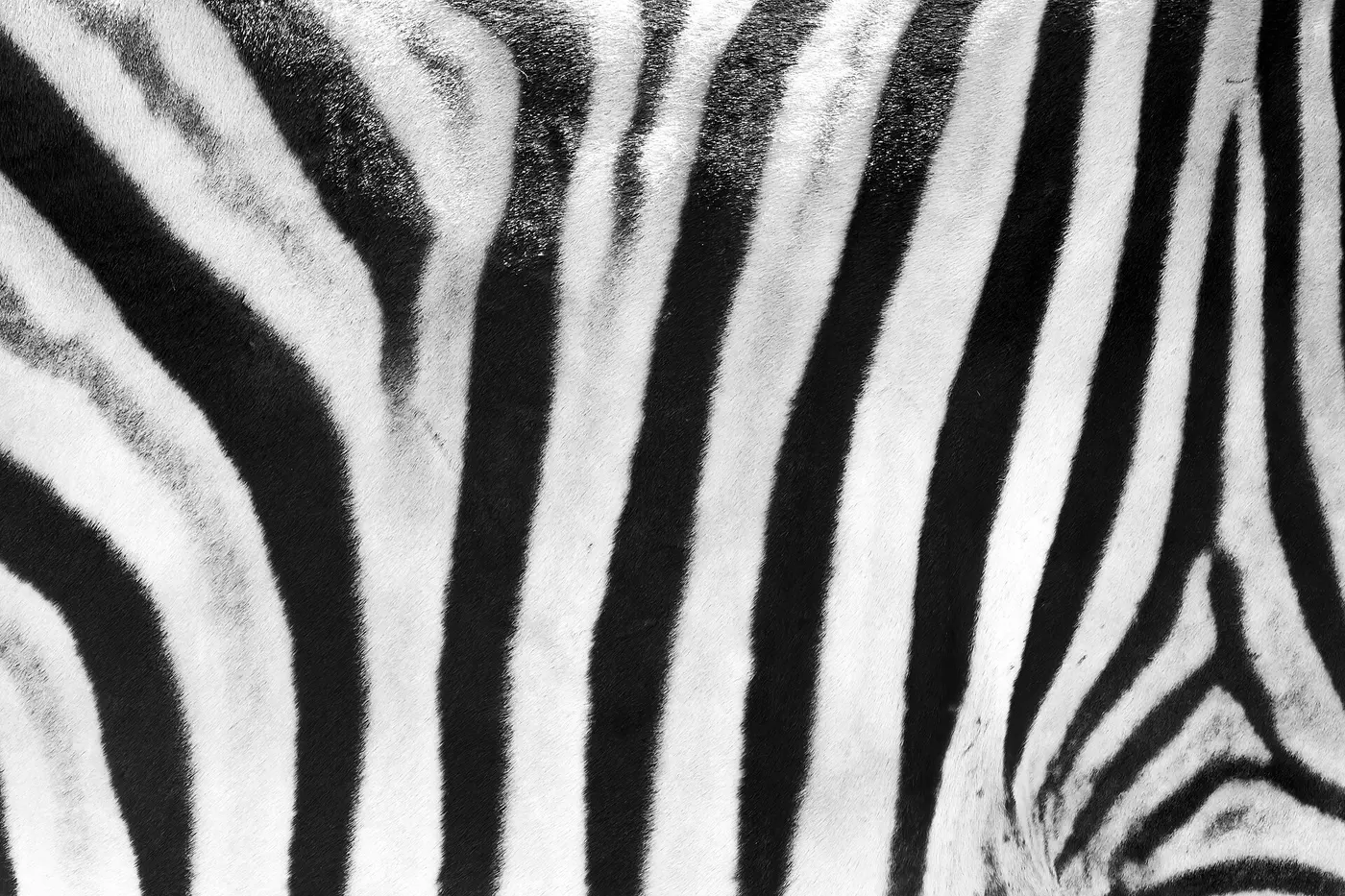
Every zebra’s stripe pattern is different, and the pattern is said to be partly inherited from parent to offspring. Like human fingerprints, the stripes can be used to tell individuals apart.

Hide, dazzle, or cool down?
Over the years, several main explanations have been proposed.
One is camouflage. Zebras, however, live in noisy herds and hardly seem built for staying hidden. A 2014 study found no link between how strongly an animal is striped and whether it lives in places that are good for hiding, such as woodland.
A second idea is that when a herd runs, the flickering stripes confuse lions and other predators. A computer study suggested that such optical illusions could occur, but critics point out that lions get close to zebras and bring them down without much trouble.
A third is that the temperature difference between black and white stripes helps keep zebras cool. One analysis found that zebras in hotter regions tend to have bolder stripes, yet an experiment comparing the temperature of striped containers found no cooling effect. Along with the idea that stripes help zebras recognize one another, none of these explanations proved decisive.
Flies that fail to land
That brought attention to another idea: stripes protect against blood-sucking flies. As early as 1930, a study reported that flies were less likely to settle on striped surfaces than on plain ones. In 2014, Tim Caro of the University of California, Davis, and his colleagues showed that the areas where strongly striped animals live overlap closely with areas full of horseflies and tsetse flies.
One of the most convincing pieces of evidence came from an experiment Caro’s team published in 2019. Watching horseflies around zebras and horses on a farm in England, they saw the flies approach both animals in much the same way. With zebras, however, the flies failed to slow down at the last moment, bumping into the animals or flying past, and rarely managed to land. When the researchers then dressed horses in black, white or striped cloth coats, fly landings dropped sharply only when the horses wore stripes.
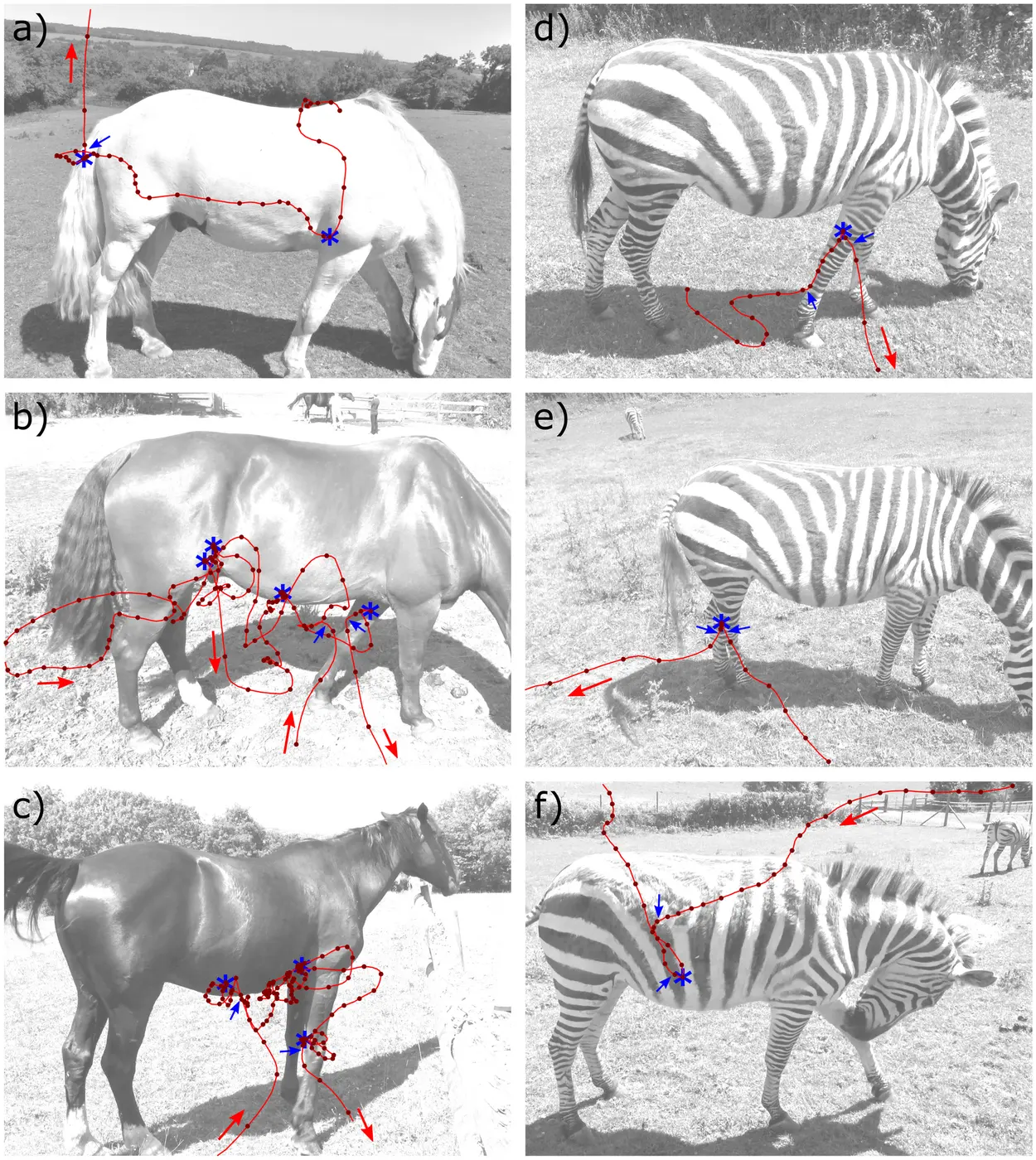

Why stripes confuse the flies is still debated. Perhaps the pattern makes it hard for a fly to read what is in front of it at close range; perhaps the strong black-and-white contrast makes landing difficult. Even so, a 2025 review concluded that the fly-protection hypothesis has more evidence behind it than any other.
Stripes work on cattle, too
A team in Japan put the idea to the test. Tomoki Kojima, then at the Aichi Agricultural Research Center (he is now with Japan’s National Agriculture and Food Research Organization), and colleagues reported in 2019 on Japanese Black cattle painted with white stripes. They compared these cows with unpainted ones and with cows painted with black stripes. The black-striped cows were there to rule out any effect from the smell of the paint.
The number of biting flies on the white-striped cows was about half that on the other cows, and the cows tossed their heads and flicked their tails to drive off insects less often. The research, which could offer a way to repel flies without pesticides, won the 2025 Ig Nobel Prize in Biology, an award for research that “makes people laugh, then think.”
In Africa, horseflies and tsetse flies don’t just drink blood; they can also spread disease. A zebra’s stripes may be a kind of insect repellent it wears on its back.