Can a turtle climb out of its shell?
No. The shell is part of the turtle’s body, fused to its backbone and ribs, so it can never be taken off.
50–60bones
In cartoons and comics, turtles often pop right out of their shells and scamper around in a panic, naked. The shell is treated like a hermit crab’s borrowed home, or a suit of armor that can be put on and taken off.
A real turtle, however, can never slip out of its shell, no matter how much trouble it is in. That is because the shell is part of the turtle’s skeleton.
A shell made of bone
A turtle’s shell has two parts: the carapace on the back and the plastron on the belly, joined along the sides by a bony bridge. The vital organs sit snugly inside this box.
The foundation of the carapace is, remarkably, the backbone and ribs. In other animals the ribs curve around the body like a cage, but in turtles they flatten and spread out, fusing with plates of bone that form in the skin. The whole shell is made up of roughly 50 to 60 bones fitted together. Taking off a turtle’s shell would mean pulling the backbone and ribs out of its body.
The surface of the shell is covered with plates called scutes. These are not bone but keratin, the same protein as our fingernails. Nerves and blood vessels run through the shell, too, so a turtle can feel it when its shell is touched or pressed.
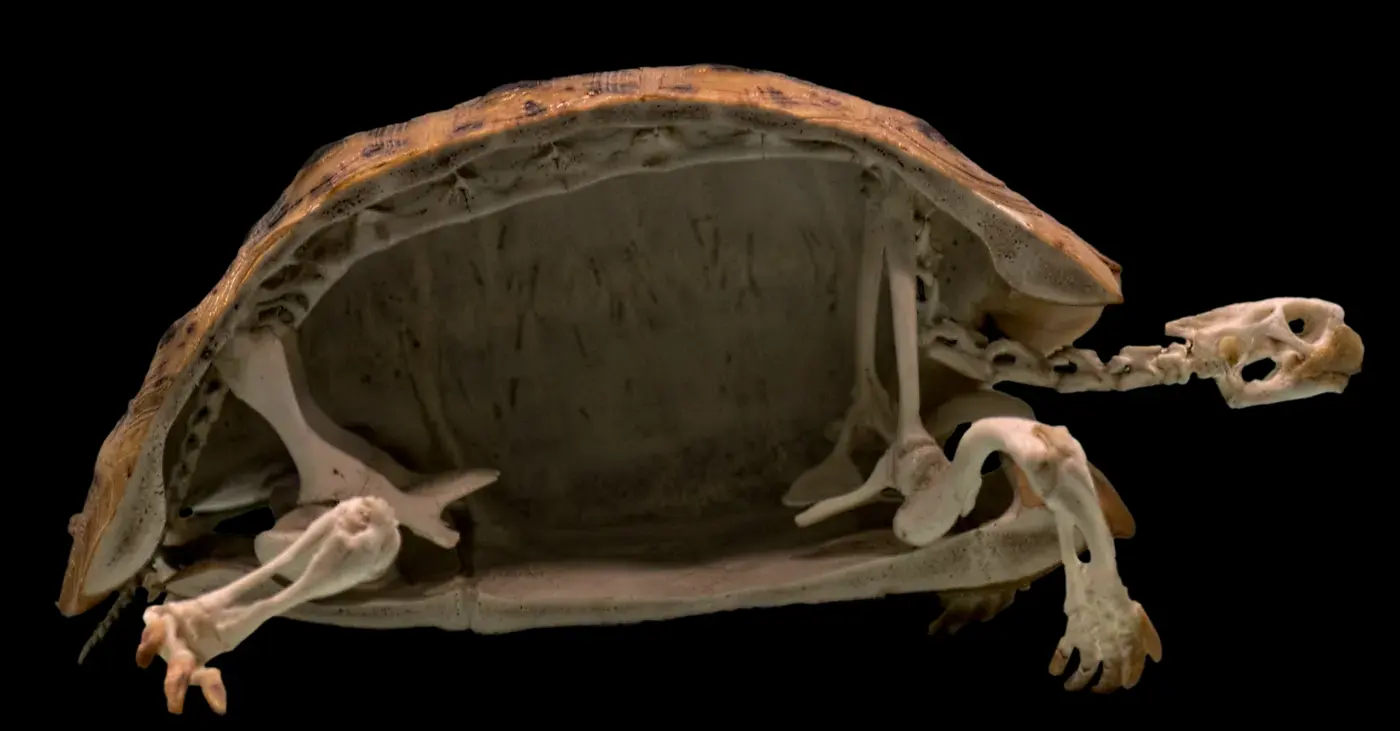

Shoulder blades inside the ribs
Turtles have another strange feature: their shoulder blades sit inside the rib cage. In every other four-limbed animal, humans included, the shoulder blades lie outside the ribs. Turtles are the only group in which this arrangement is reversed.
How does that happen? A research team including Shigeru Kuratani at RIKEN, Japan’s national research institute, studied in detail how turtle embryos develop. In other animals, the ribs grow from the back around toward the belly. A turtle’s ribs, however, stay on the back and fan outward from there. Along the way, the body wall folds over, so to speak, and the ribs end up covering the shoulder blades.
Because the ribs are locked in place, turtles also can’t breathe the way we do, by expanding the chest. Instead, they use their abdominal muscles to push and pull on their internal organs, moving air in and out of the lungs.
How the shell came to be
So how did this extraordinary shell evolve? The clues lie in fossils.
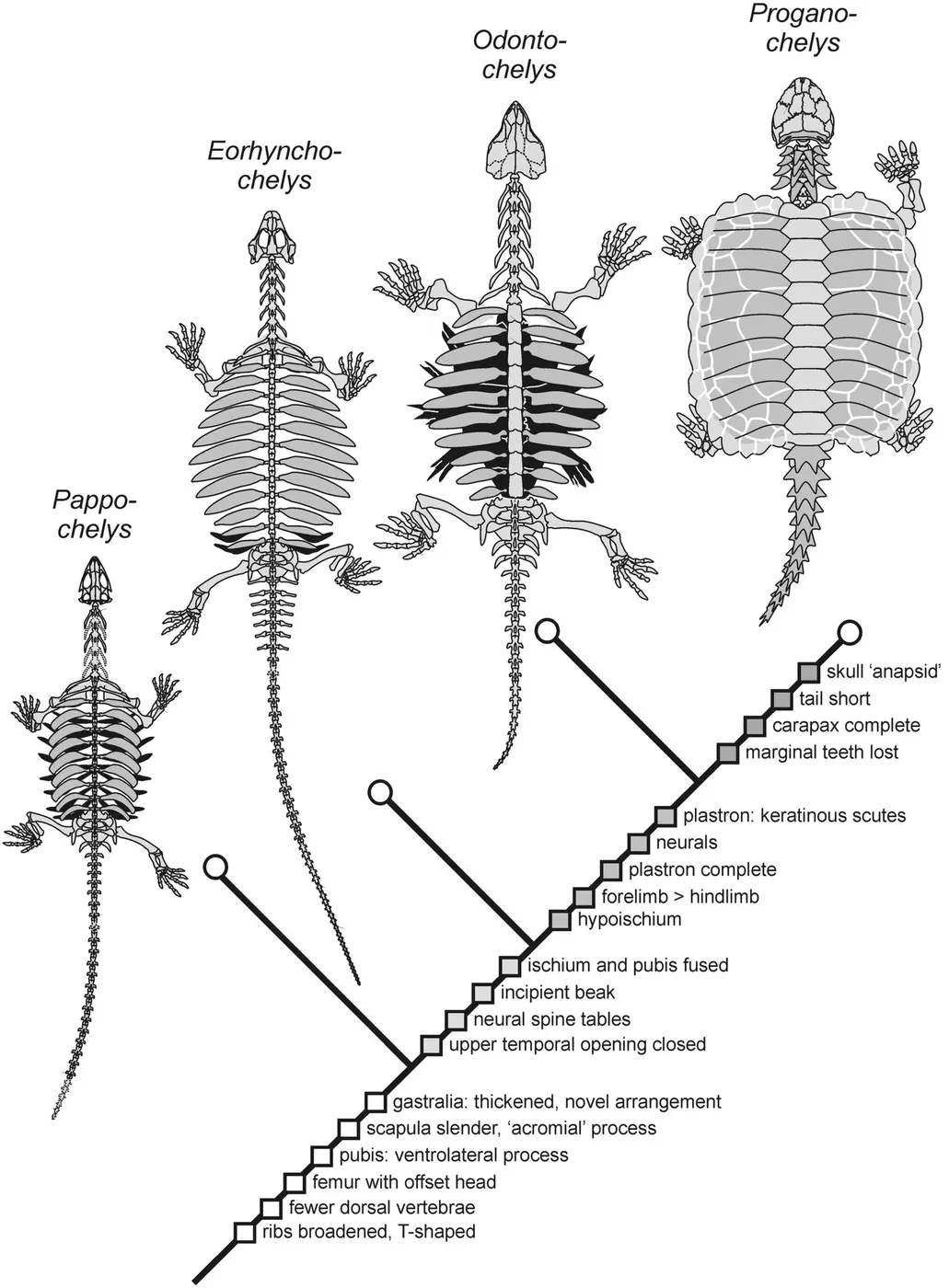
Eunotosaurus, a reptile from about 260 million years ago found in South Africa, had no shell but did have broad, flattened ribs. A 2016 study proposed that these broad ribs were not for protection but served as a stable base for digging with the front legs. Pappochelys, found in rocks about 240 million years old in Germany, also had broad ribs, a kind of rough draft of the shell.
Odontochelys, from about 220 million years ago in China, had a complete plastron on its belly, while its carapace was still incomplete. And by the time of Proganochelys, near the end of the Triassic period, both back and belly were fully covered by shell. The turtle shell did not appear overnight; it is thought to have taken shape gradually over tens of millions of years.

Incidentally, turtles tuck their necks into their shells in two different ways. Most turtles, including Japan’s native pond turtle and the Reeves’ turtle, pull their necks straight back in a vertical S-bend. Side-necked turtles, which live in places such as South America, Africa and Australia, fold their necks sideways along the rim of the shell instead. Sea turtles cannot pull their heads fully into their shells at all.