Why is the sea blue?
Water itself absorbs a little red light, so light that travels deep into the sea and back out looks blue.
On a clear day far from shore, the sea is a deep blue that seems to draw you in. Yet scoop up a glass of seawater and it looks perfectly clear. Why does clear water turn blue when there is a lot of it?
The explanation you hear most often is that the sea is blue because it reflects the blue sky. And it’s true that on cloudy days the sea looks dull and gray. But in the early 20th century, a physicist on a sea voyage called that explanation into question.
A physicist on the Mediterranean
In the autumn of 1921, the Indian physicist Chandrasekhara Venkata Raman was on his way home from England, gazing at the deep blue of the Mediterranean from the deck of his ship. At the time, the view put forward by the British physicist Lord Rayleigh—that the blue of the sea came from reflected skylight—was widely accepted.
Raman had with him a pocket-sized spectroscope and a polarizing prism, which can block reflected light. When he used it to eliminate the glare from the surface, the sea was still blue. If the color came only from reflected sky, removing the reflection should have removed the blue as well. Raman concluded that the color of the sea arises within the water itself, and in November 1921 he reported his observations in the journal Nature.
The interest in water and light that took root on that voyage later led to a major discovery. In 1928, Raman found that when light strikes a substance, a small part of it is scattered with a slightly changed color. For this discovery, now called the Raman effect, he received the Nobel Prize in Physics in 1930, the first Asian to win it.
Water is faintly blue
Today we know that the main reason the sea looks blue lies in the nature of water itself. Water absorbs a tiny bit of red light.
Sunlight contains a mix of colors from red to violet. Water molecules use up a little of the energy of red and orange light to make themselves vibrate. So the farther light travels through water, the more red it loses, and the light that remains looks bluish.
The absorption is very weak, though. You can’t see any color in a glass of water, but even pure water looks faintly blue if you put it in a tube more than a meter long and look through it end to end. In the sea, where light travels tens or hundreds of meters, the effect becomes obvious.
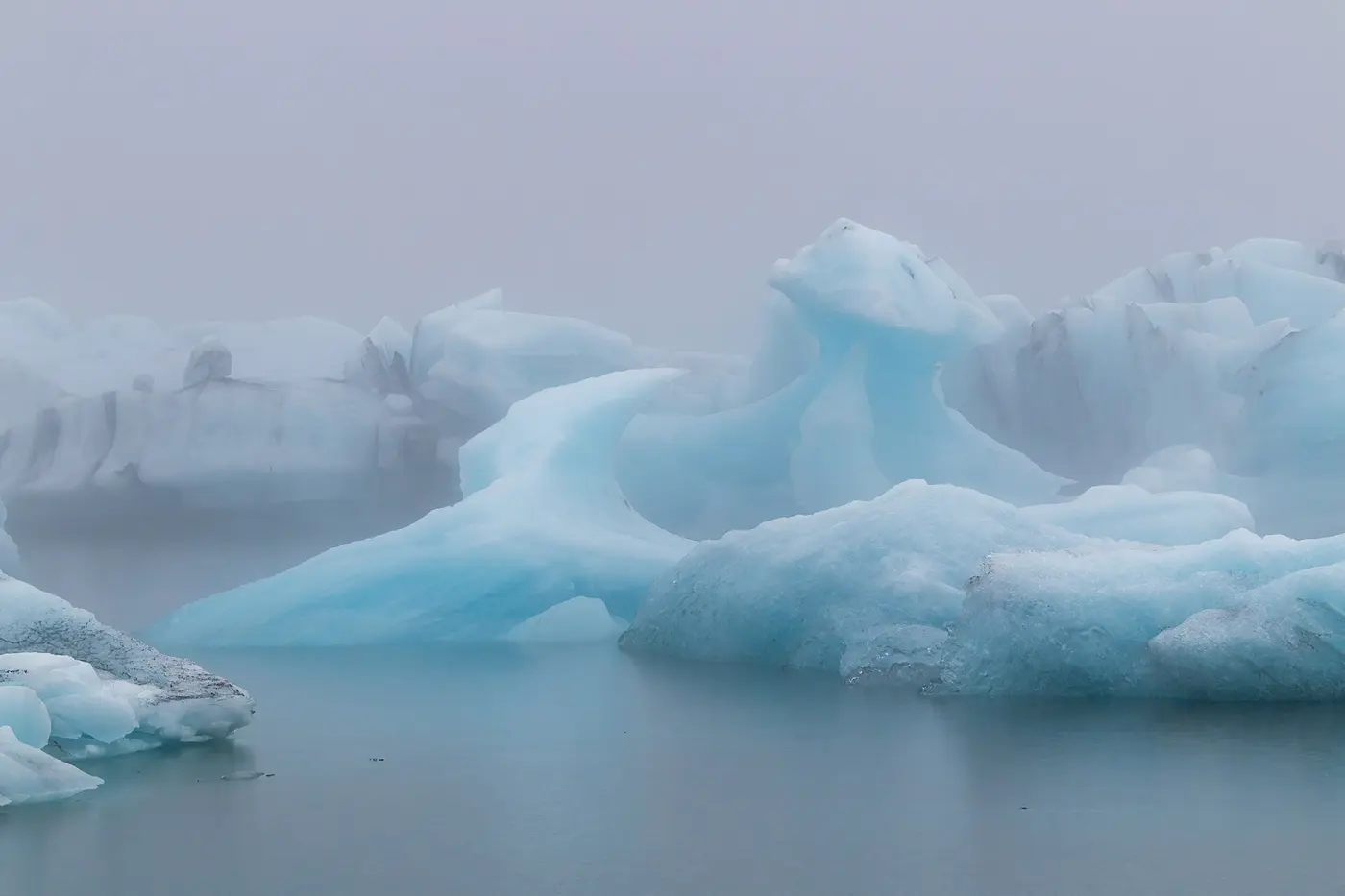

Sunlight entering the sea bumps into water molecules and fine particles and is scattered in all directions. Some of it makes its way back out through the surface. The deeper that light has traveled before returning, the more red has been absorbed and the bluer it becomes. The blue we see is the color of light that has passed through the water and come back out. If there were nothing at all to scatter the light, deep water would look not blue but black.
The same principle explains why, as you dive deeper, everything around you turns more and more uniformly blue. Red light fades considerably within a few meters of the surface, and in deep water red things start to look blackish. That is thought to be why so many deep-sea creatures are red: in the darkness where red light never reaches, red actually becomes an inconspicuous color.
Green seas and brown seas
Still, the world’s oceans aren’t all the same shade of blue. Water near the coast or in nutrient-rich areas often looks greenish.
The main reason is phytoplankton. The chlorophyll they use for photosynthesis strongly absorbs blue and red light but absorbs little green. So water teeming with phytoplankton takes on a greenish tint. Water carrying lots of river mud, or substances leached from fallen leaves and other plant matter, turns yellowish or brown.
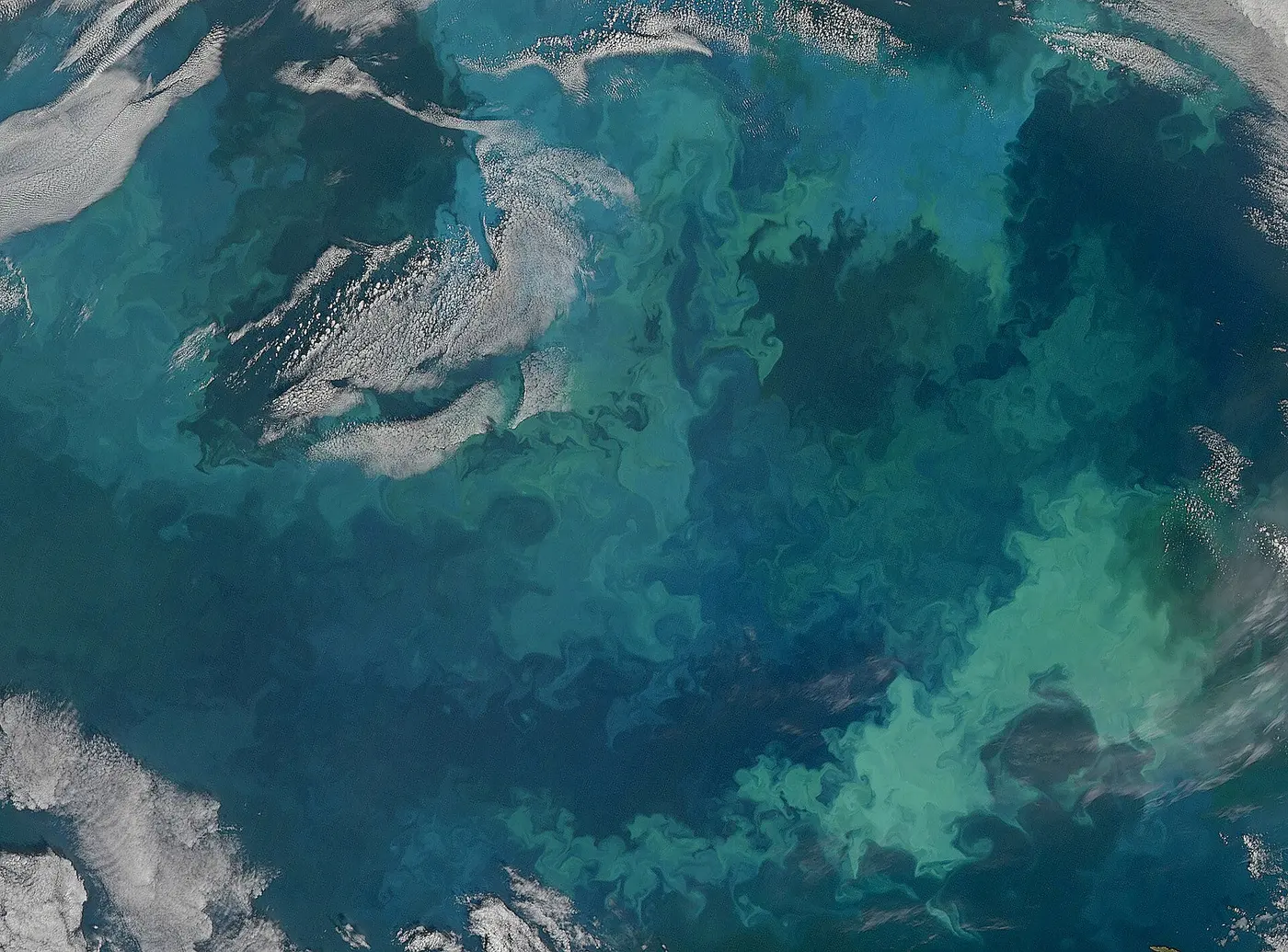

By contrast, open ocean that is poor in nutrients and sparse in plankton is crystal clear and deep blue. The dazzling blue of tropical island waters is, in a sense, a sign that they are an “ocean desert” with little life in them. Scientists take advantage of this by measuring ocean color from satellites to map where, and how much, phytoplankton lives in the world’s seas.