Is it true that no two snowflakes are alike?
Complex crystals are almost never identical, but near-twins have been found among simple shapes.
On a winter day, if you look closely at snow landing on a black glove, you can sometimes see tiny crystals shaped like six-pointed stars. And for as long as anyone can remember, people have said: “No two snowflakes are exactly alike.”
The number of snowflakes that fall is beyond counting. Can every single one really have a different shape? Has anyone actually checked? Follow this simple question and you will find the stories of people captivated by snow, and the astonishingly precise processes hidden inside a single crystal.
The farmer who photographed snow
One of the people who spread the idea that no two snowflakes are alike was Wilson Bentley, a farmer in Vermont. Given a microscope as a boy, he was completely captivated by the beauty of snow crystals. In 1885, by attaching a camera to a microscope, he is said to have become the first person to photograph a snow crystal successfully.
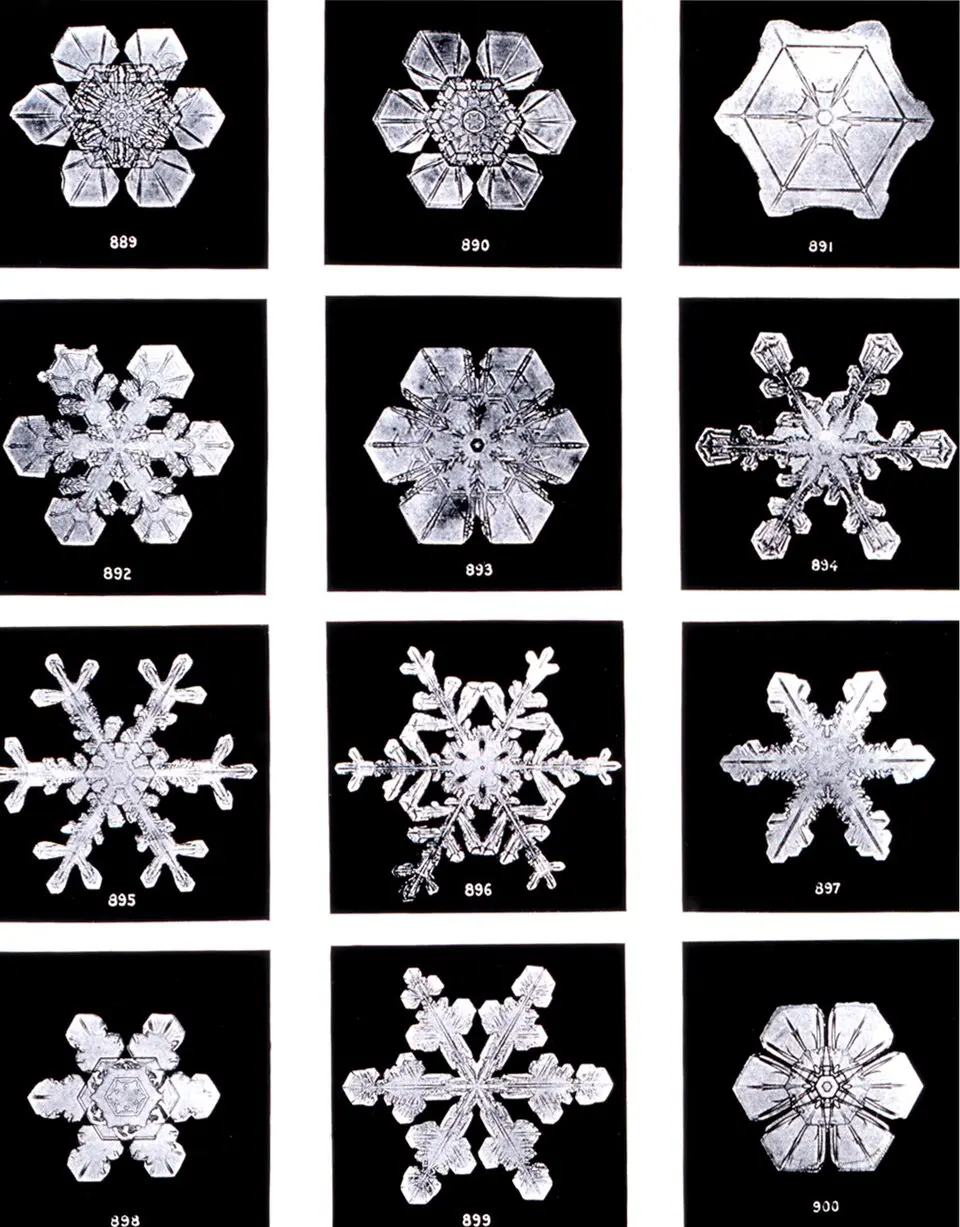

From then until his death in 1931, Bentley photographed more than 5,000 snow crystals. Not one of them, he said, had exactly the same shape as another. His book of photographs drew wide acclaim, and the image of snowflakes as one of a kind spread around the world. Of course, 5,000 photographs, impressive as that is, are only a tiny sample of all the snow that has ever fallen.
Letters sent from the sky
What decides a snow crystal’s shape? The scientist who shed light on that mystery was Ukichirō Nakaya, a physicist at Hokkaido Imperial University (now Hokkaido University) in northern Japan.
Nakaya set out to make snow crystals artificially in a cold laboratory. On March 12, 1936, he became the first person in the world to grow a hexagonal snow crystal, on the tip of a rabbit hair. Through repeated experiments, he showed that a crystal’s shape is determined mainly by the surrounding temperature and the amount of water vapor in the air.
At around −15°C (5°F) with plenty of water vapor, for example, the familiar star-shaped crystals grow, their arms spreading like tree branches. At around −5°C (23°F), crystals take the form of thin needles or columns instead.
In other words, the shape of a snow crystal tells you what temperatures and humidity it passed through up in the sky. Nakaya put this into beautiful words:
Snow crystals are letters sent from the sky.
Every flake takes a different journey
Here we can begin to see why no two crystals are alike. The secret lies in the journey each one takes.
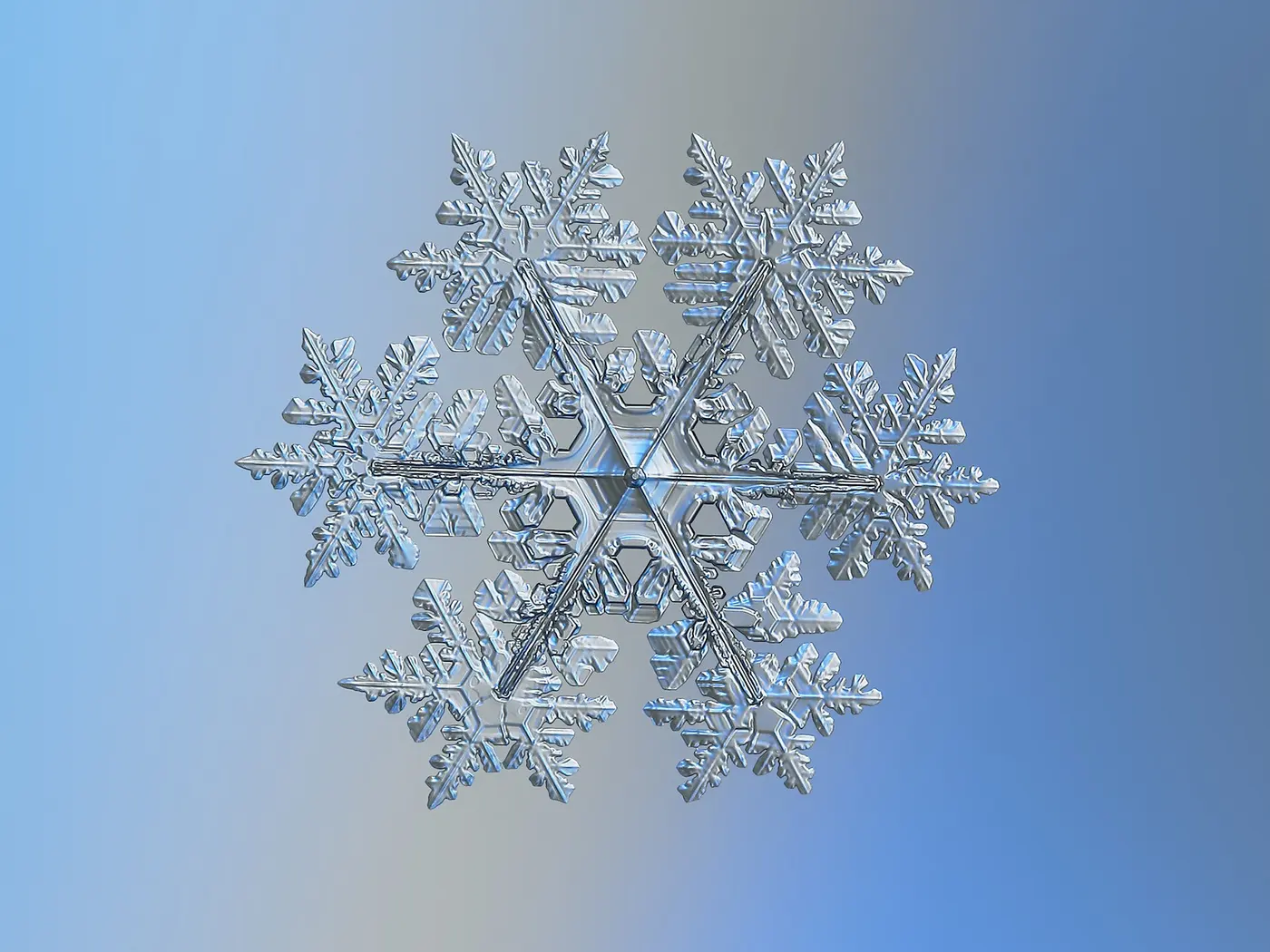
A snow crystal starts out as a tiny grain of ice in a cloud and grows little by little as the wind carries it, rising and falling. The temperature and humidity of the air it passes through change constantly, from place to place and moment to moment. Each time, the crystal changes the way it grows: stretching out its arms, branching, or spreading into a flat plate.
The six arms of one crystal look so alike because, at any given moment, every arm of that crystal is in the same air. But for two different crystals to follow exactly the same path from start to finish is all but impossible. So the more complex a crystal’s branches, the vanishingly smaller the chance of an identical match.

Has anyone found a lookalike?
So is there truly not a single pair of identical crystals anywhere? As it happens, a near-match has turned up, with an important catch.
In 1988, American researcher Nancy Knight reported finding two crystals that looked identical under the microscope, in snow collected by an airplane flying over Wisconsin. They were not stars, however, but simple crystals shaped like hexagonal columns. With simple shapes, near-identical crystals can form by chance.
According to the physicist Kenneth Libbrecht, known for his research on snow crystals, even a small snow crystal contains about a quintillion (10 to the 18th power) water molecules. If you compared them right down to how those molecules are arranged, two perfectly identical crystals almost certainly do not exist. Some may look exactly alike, but none are truly the same. For now, that seems to be the answer.