Why are rainbows round?
Raindrops send light back at about 42° from the point opposite the Sun. A rainbow is really a full circle.
42°
After the rain, a seven-colored bridge floats across the sky. Ask people to picture a rainbow, and nearly everyone imagines an arch curving up from the ground into the sky. In picture books and emoji alike, a rainbow is always a half circle.
But a rainbow isn’t really an arch. It is a circle that loops all the way around. What we normally see is just its upper half, or an even smaller piece. The rest is always hidden below the ground.
Every raindrop is a tiny prism
Rainbows are made by countless raindrops hanging in the air. When sunlight enters a raindrop, it bends at the boundary between air and water, reflects once off the back of the drop, and bends again as it comes back out.
Along the way, light of different colors bends at slightly different angles. Sunlight looks white, but it is actually a mixture of light of many colors. As it passes through a raindrop, each color is sent off in a slightly different direction, exactly the way a glass prism splits light into a rainbow of colors.
The key is that the light returning from raindrops is concentrated at a particular angle. When you stand with the Sun at your back, the point at the top of your shadow’s head is called the antisolar point. Light from the raindrops is brightest at about 42 degrees from this antisolar point. Red light comes back at about 42 degrees, violet at about 40. That is why a rainbow is red on the outside and violet on the inside.
Draw a circle at 42 degrees
So where in the sky is the direction 42 degrees away from the antisolar point?
Picture a circle centered on the antisolar point, opening out at an angle of 42 degrees. Every raindrop on that circle sends light back at the same angle. Drops above, drops to the side and drops below are all in exactly the same situation. So when you join up the glowing raindrops, they naturally form a circle. A rainbow is round not because raindrops are round, but because the angles line up.
The person who set out this idea was the 17th-century French philosopher René Descartes. In a work published in 1637, he explained the angle at which rainbows form by shining light into a large glass sphere filled with water and measuring the angles at which the light came out.


Without the ground, it’s a perfect circle
Then why do we see only part of the circle?
The answer is simple: the ground gets in the way. The antisolar point sits at the top of your shadow’s head, which is below the horizon. A circle centered there has its lower half buried in the ground. The lower the Sun, as in the morning or evening, the closer the antisolar point is to the horizon, and the bigger the arch of the rainbow. Conversely, once the Sun climbs higher than 42 degrees, the rainbow sinks below the horizon and disappears. That is why you almost never see a rainbow at midday in summer.
Look down from somewhere higher than the ground, though, and the hidden part appears. From an airplane window, a high mountaintop or midair during a skydive, if conditions are right, you can sometimes see a rainbow as a full ring, like the one in the photo above.
Incidentally, every viewer sees a different rainbow. You see the raindrops that lie 42 degrees from your own eyes light up, so the rainbow the person next to you sees is made by different raindrops. Everyone gets a rainbow of their own. That is also why, no matter how close you get to the foot of a rainbow, it moves away by just as much.
A second rainbow, and a dark band
If you are lucky, you may see a second, fainter rainbow outside the first. This is called a secondary rainbow, and it forms when light reflects twice inside the raindrops before coming out. The secondary bow appears at about 51 degrees from the antisolar point, and its colors run in the opposite order from the primary bow: violet on the outside, red on the inside.
Look carefully between the two rainbows, and you may notice that the sky there is a little darker than elsewhere. This is called Alexander’s dark band. Little light from the raindrops reaches the area just outside the primary bow or just inside the secondary bow, so the gap between them looks dark. It is named after Alexander of Aphrodisias, an ancient Greek philosopher who described the dark band around 200 CE.
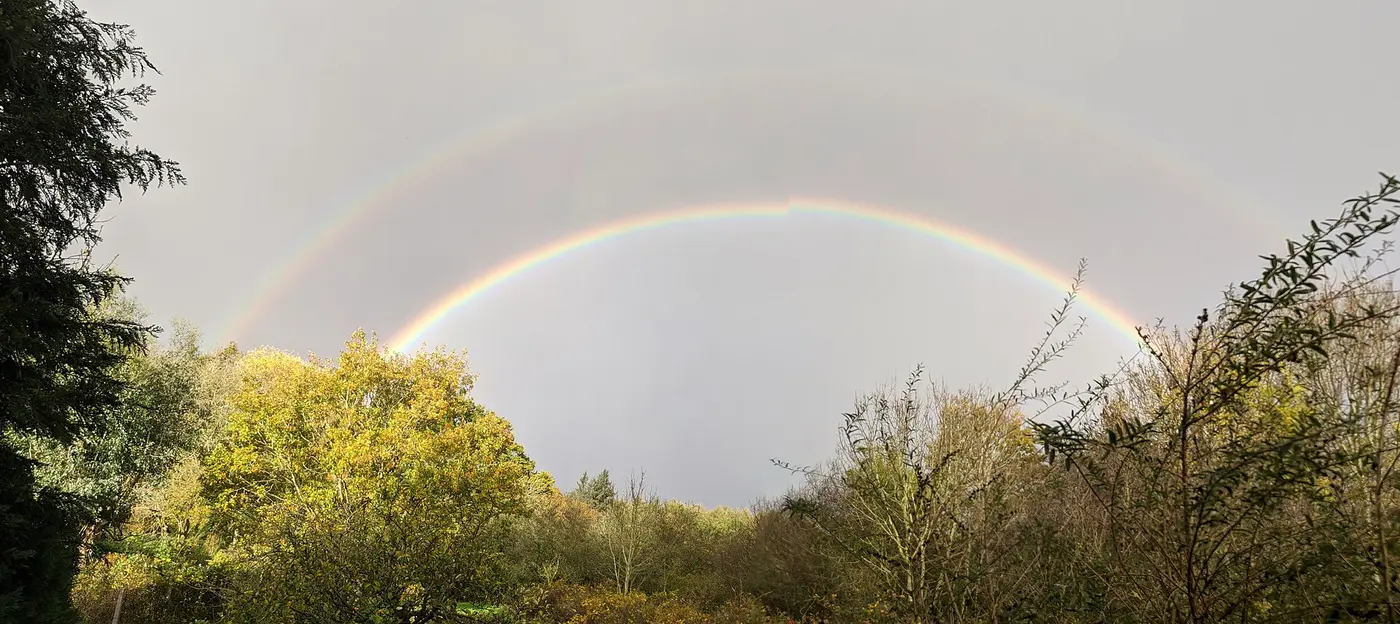

A rainbow is not an arch but a circle. What we see is just the part the ground has left us.