What is the deepest place in the world?
The Challenger Deep, in the Pacific’s Mariana Trench—a little over 10,900 meters down.
10,920m
Most people know that the highest point on Earth is the summit of Mount Everest. But where is the lowest?
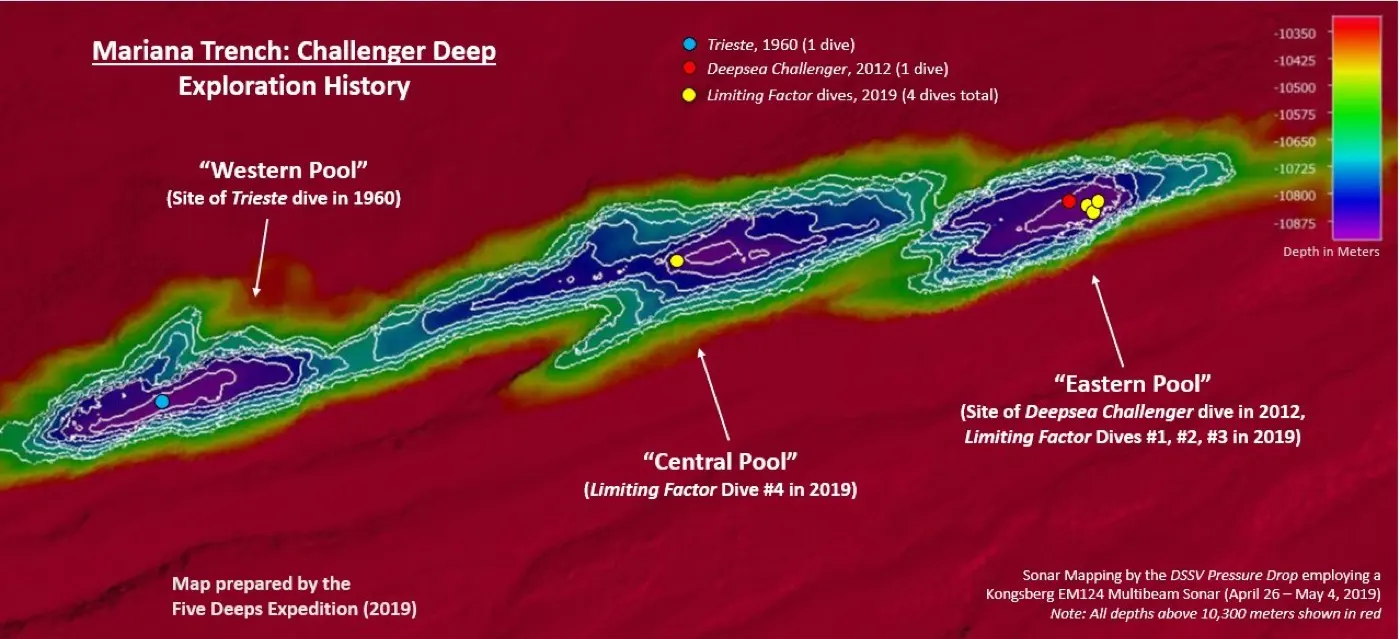
The answer lies at the bottom of the Mariana Trench, which curves in a long arc along the Mariana Islands in the western Pacific. Its deepest part, southwest of Guam, is called the Challenger Deep, and it lies a little over 10,900 meters (about 35,800 feet) below the surface. Beneath the waves, a world of darkness that no sunlight reaches extends for more than ten kilometers.
“10,920 meters” isn’t the final word
In Japan, the figure most often quoted for the Challenger Deep is about 10,920 meters. It is known as the measurement taken in 1984 by the survey ship Takuyō of the Japan Coast Guard.
But this depth has come out a little differently almost every time it has been measured. Readings of 10,911 meters, 10,925 meters, 10,935 meters, and even values above 10,980 meters have all been reported, a spread of several tens of meters depending on when and how the survey was done.
That isn’t because anyone was careless. Ocean depth is usually worked out from how long it takes a sound sent from a ship to echo back. The trouble is that the speed of sound changes with water temperature, salinity, and pressure, and estimating precisely how fast sound travels down and back through ten kilometers of water is extremely difficult. Depth can also be calculated from a submersible’s pressure gauge, but that method needs corrections too. Even today, the exact depth of the deepest place on Earth is a matter of debate within a range of a few tens of meters.

If you sank Mount Everest
To get a feel for a depth of ten thousand meters, compare it with heights on land.
Mount Everest stands about 8,849 meters tall. Lift the whole mountain from its base and drop it into the Challenger Deep, and its summit would still sit more than 2,000 meters below the surface. Stack two Mount Fujis, Japan’s 3,776-meter landmark, one on top of the other, and you would still fall more than 3,000 meters short.
How did such a deep trench form? The Mariana Trench marks a boundary where a heavy plate of Pacific seafloor dives beneath another plate. Old seafloor, cooled and dense, bends downward as it sinks toward Earth’s interior, carving a deep, sharp valley along the seam.
The people who reached the bottom
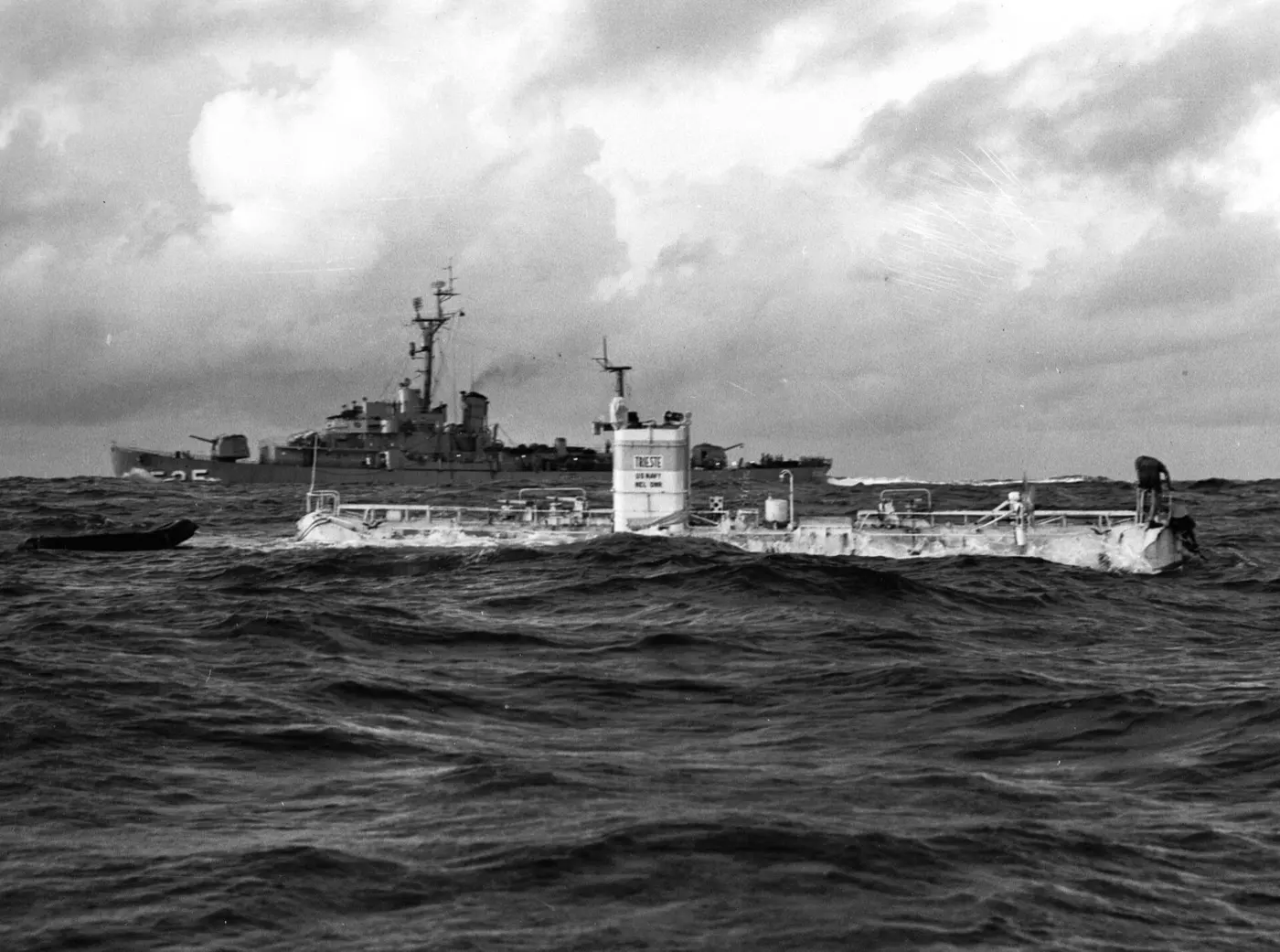
Humans first reached this dark seafloor in 1960. The Swiss scientist Jacques Piccard and Don Walsh of the US Navy climbed into the bathyscaphe Trieste and spent several hours descending. They stayed on the bottom for only about 20 minutes, and the silt they stirred up is said to have left them with almost no visibility.

The next visitor came more than half a century later, in 2012, when the film director James Cameron made a solo dive in a one-person submersible he had helped design. In 2019 the explorer Victor Vescovo reached the bottom in a submersible built to dive again and again, and since then scientists and others have made the trip as well. Even so, the number of people who have been there remains far smaller than the number who have traveled to space.
A tonne on your fingertip
The biggest obstacle to exploring the deep sea has always been water pressure.
For every 10 meters you descend, the pressure rises by roughly one atmosphere. At the bottom of the Challenger Deep, it exceeds 1,000 atmospheres. That works out to more than a tonne pressing down on every square centimeter—an area about the size of a fingertip.
And yet even this extreme world has its inhabitants. Small creatures such as amphipods, tiny shrimp-like crustaceans, have been found on the trench floor. Under a pressure we can scarcely imagine, they quietly go about their lives.