Why is milk white?
It has no white pigment. Tiny particles of protein and fat scatter light of every color, so it looks white.
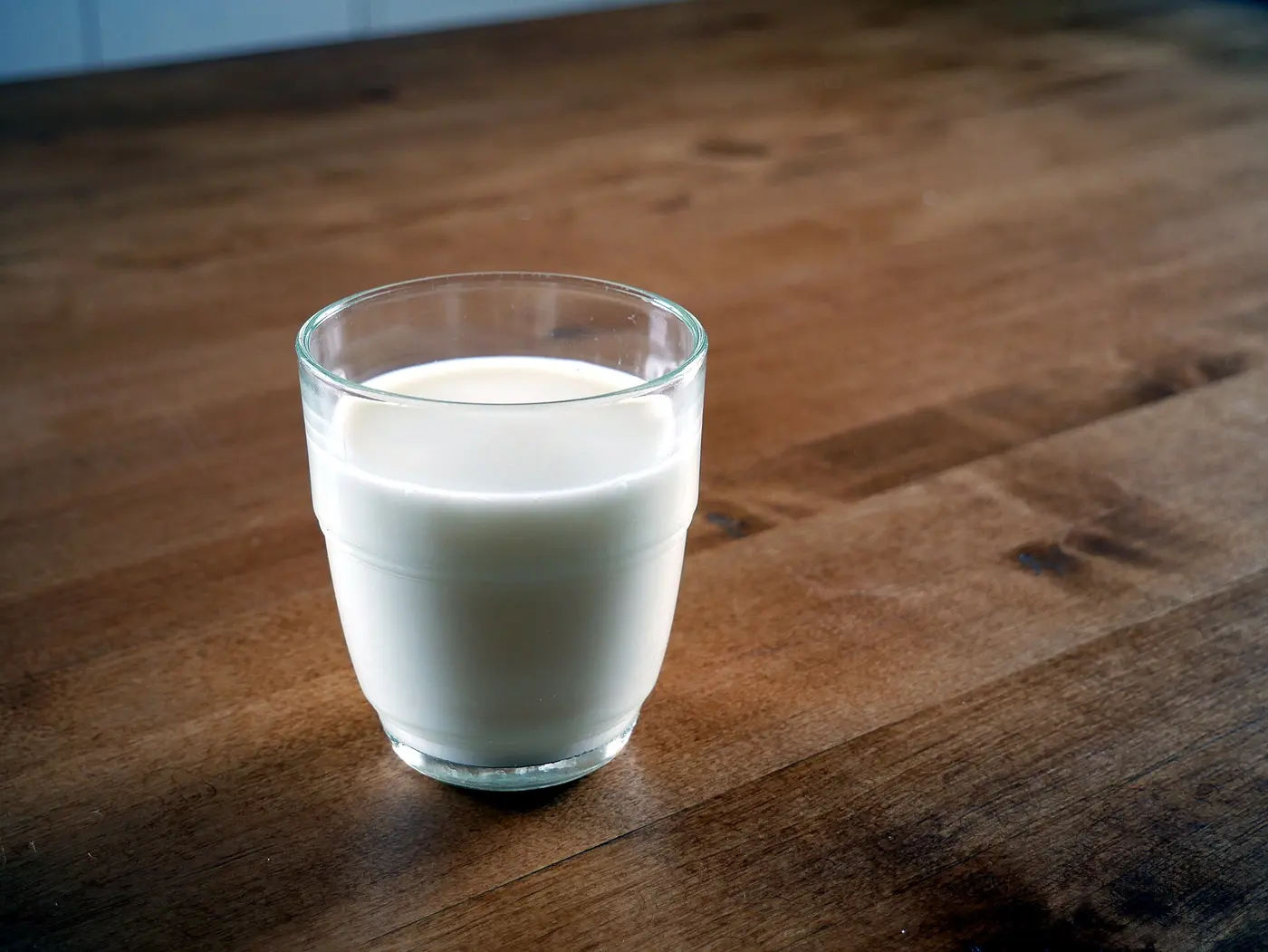
A glass of milk on the breakfast table. It is such a familiar sight that hardly anyone stops to wonder why milk is white. But think about it for a moment and it is rather strange. Milk is about 87 percent water, and the rest is protein, fat, lactose and so on. Water is transparent, and milk doesn’t contain any pigment like white paint.
So where does that whiteness come from? The key lies in particles drifting through the milk, far too small to see.
Milk is “water full of particles”
Milk is a liquid with countless tiny particles dispersed through water. There are two main kinds.
One is fat, in the form of “fat globules.” Milk fat doesn’t dissolve; it floats as tiny balls, each wrapped in a thin membrane. On average they measure about 2 to 4 micrometers across (a micrometer is a thousandth of a millimeter). Most milk sold in stores has gone through a process called homogenization, which breaks the globules up so that they shrink to around 0.4 micrometers.
The other is protein. About 80 percent of the protein in milk is casein, whose molecules gather into roughly spherical clusters called casein micelles. These measure about 0.1 micrometers, even smaller than the fat globules.

Light bounced in every direction
The light our eyes can see consists of electromagnetic waves with wavelengths of roughly 0.4 to 0.7 micrometers. Many of the particles in milk are about the same size as those wavelengths, or a little larger.
When light hits particles of that size, it can’t travel straight on; it is sent off in all directions. This is called scattering. What’s more, particles as large as the wavelength of light or larger scatter every color—red, green and blue—about equally.
Inside milk, this scattering happens over and over, more times than you could count. Light bounces from particle to particle, never getting very deep, and eventually leaves in every direction. Because all the colors reach our eyes evenly mixed together, the milk looks white, and opaque.
Clouds and snow are white for the same reason. Clouds are made of tiny water droplets and snow of ice crystals; each one is transparent on its own, but gathered together in large numbers they scatter light and look white. The whiteness of beer foam and powdered sugar is a related phenomenon.
Take out the fat and it turns faintly blue
Skim milk, with the fat removed, is where things get interesting. Look closely and it can appear slightly bluish compared with regular milk.
In skim milk, almost all the scattering is done by casein micelles alone. Because the micelles are smaller than the wavelength of light, they scatter short-wavelength blue light more strongly than red. As a result, the scattered light contains more blue, giving skim milk a faint bluish-white tint.
This closely resembles the way the sky turns blue. Air molecules are far smaller than the wavelength of light and scatter blue light strongly, which is why the daytime sky is blue.

A sunset in a glass
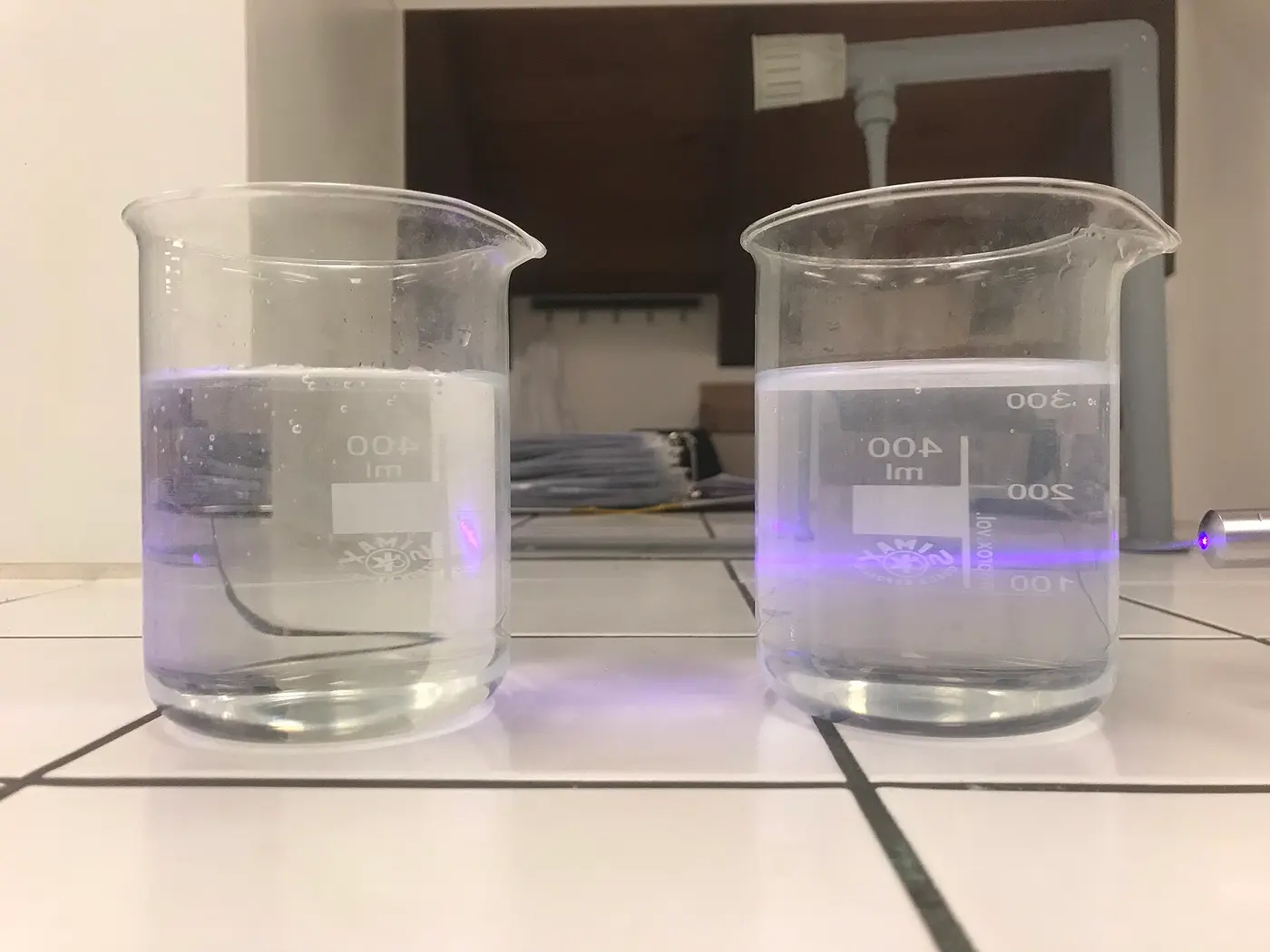
You can see this for yourself at home. Fill a clear glass with water, add just a few drops of milk, and stir well. In a dark room, shine a flashlight through the glass from the side. The path of the light appears in the water, and viewed from the side it looks a little bluish.
Now look through the glass from the opposite side, toward the light source. This time the light should look yellowish or orange. The blue light has been scattered sideways along the way, so the reddish light that remains is what reaches you. It is the same phenomenon that makes sunsets red, recreated in a single glass.
Add more milk and the light is scattered more and more, until the water turns pure white. Whiteness is not the absence of color; it is every color scattered and mixed together.