Did Edison invent the light bulb?
Light bulbs existed before Edison. He made a long-lasting bulb practical, along with a system to power it.
Flip a switch in a dark room, and the light comes on. When people think of who gave us this utterly ordinary scene, most picture Thomas Edison. He is a staple of children’s biographies, and for many people the phrase “the great inventor” brings the light bulb to mind first.
Dig into the history, though, and you find that by the time Edison began working on the light bulb, glowing bulbs had already been built by a number of other people. So what did Edison actually achieve?
Glowing wires before Edison
Attempts to make light from electricity go back to the early 19th century. In Britain, Humphry Davy demonstrated the “arc lamp,” in which a brilliant arc of light leaps between two carbon rods connected to a battery. But arc lamps were far too glaring for lighting a home.
The idea that followed was the incandescent bulb, which runs electricity through a thin wire to heat it until it glows white. The principle is simple, but there was a stubborn problem. A wire hot enough to glow reacts with oxygen in the air and burns out almost instantly. The fix was to pump the air out of a glass bulb, but the technology of the day couldn’t create a good enough vacuum. People kept trying regardless; depending on how historians count, more than 20 people are said to have devised incandescent bulbs before Edison.
Swan in England
The most important of them was Joseph Swan, a chemist from Newcastle in northeastern England. From the 1850s, Swan experimented with filaments made of carbonized paper. When vacuum pumps improved, his research leapt forward, and in December 1878 he showed off a carbon-filament bulb at a local chemical society. In February 1879 he reportedly gave a lecture before an audience of about 700, lighting the hall with his bulbs.
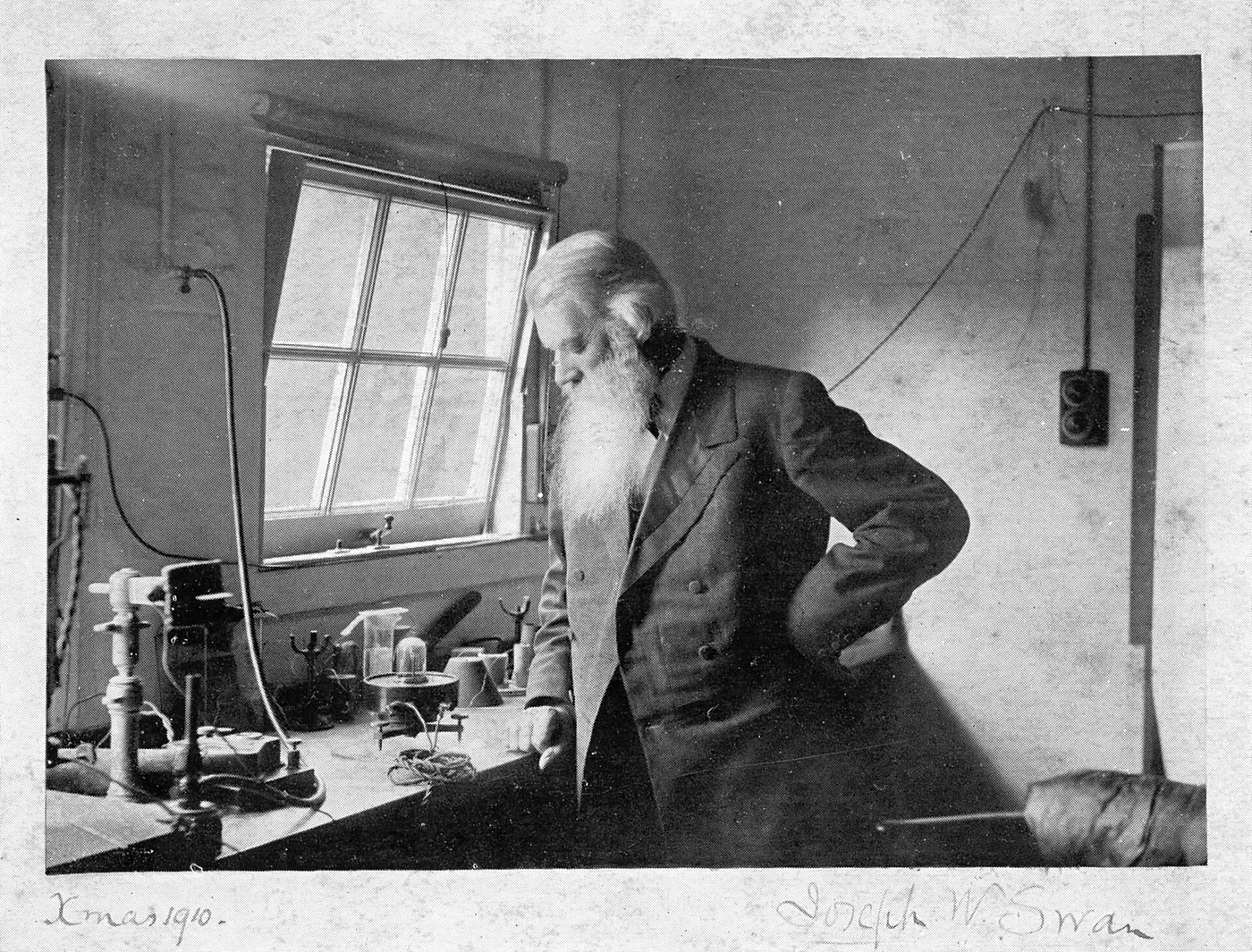

Swan’s home is said to have been one of the first houses lit by electric bulbs. In 1881, the Savoy Theatre in London was lit with Swan’s bulbs; it is also said to have been the first public building lit by electricity.
So what did Edison do?
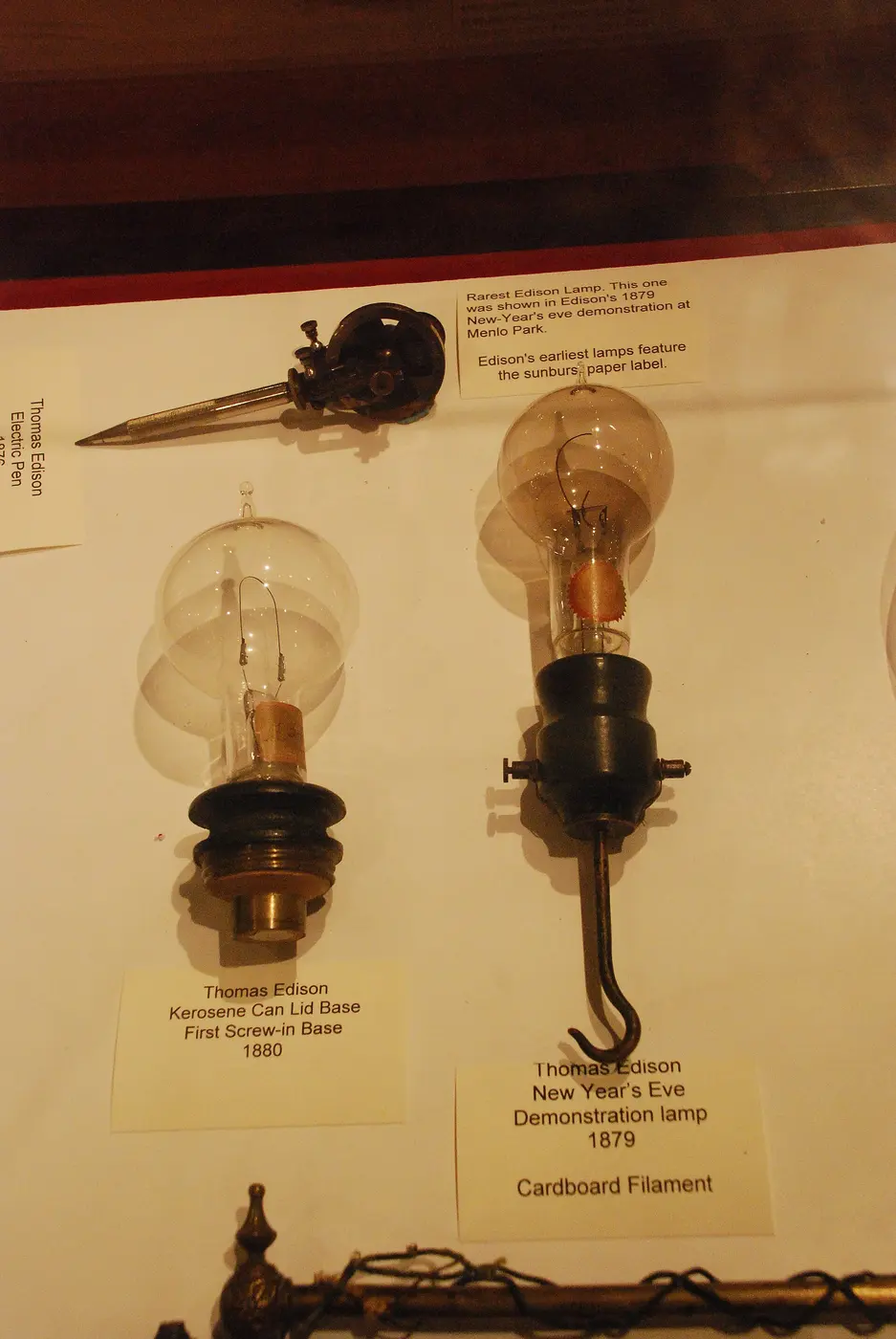
Edison launched into serious work on the light bulb in 1878. In October 1879, he succeeded in making a bulb with a filament of carbonized cotton thread that stayed lit for more than ten hours. On New Year’s Eve that year, he held a public demonstration at his laboratory in Menlo Park, New Jersey, lighting a large number of bulbs.
Edison’s real brilliance showed in what came next. His goal was not to make a bulb glow in the laboratory but to deliver a replacement for gas lighting to homes all across a city. To that end, he insisted on thin, high-resistance filaments, so that electricity could be supplied efficiently even when many bulbs were connected together. And in search of a longer-lasting material, he tested thousands of substances before settling on bamboo.

Of all the bamboo gathered from around the world, one performed especially well: madake bamboo from around Mount Otokoyama in Yawata, Kyoto Prefecture. Filaments made from it are said to have lasted about 1,000 hours, and the bamboo reportedly kept being shipped to Edison’s electric light company for more than a decade afterward. A monument to Edison still stands on the grounds of Iwashimizu Hachimangū, a Shinto shrine on the mountain.
Edison then put together a complete set of generators, power lines, sockets, switches and even meters to measure electricity use, and in 1882 he opened a power station for business in New York. Rather than “inventing” the light bulb, it might be closer to the truth to say he built a whole world in which the light bulb could be useful.
From rivals to partners
With two men making the same thing at the same time, a patent dispute broke out in Britain. But partly because Swan could show that he had been working on the bulb earlier, a long court battle was avoided. In 1883 the two men’s companies merged to form the Edison and Swan United Electric Light Company, and its bulbs were sold under the name “Ediswan.”