Was Gutenberg the first to print with movable type?
No. Movable type appeared in 11th-century China, and a book was printed with metal type in Korea about 78 years before Gutenberg’s Bible.
78years
Make individual pieces of type, one for each character, and arrange them into a page. Ink them, press paper onto them, then break up the page and reuse the type for the next text. That is printing with movable type.
Every world history textbook mentions that Johannes Gutenberg printed a Bible this way in Germany in the mid-15th century, so many people remember him as the inventor of movable type. Yet printing with movable type goes back roughly 400 years further.
Clay type in 11th-century China
The first person known to have made movable type was Bi Sheng, a craftsman in China during the Northern Song dynasty, in the 1040s.
His method was recorded by Shen Kuo, a scholar of the same era, in his collection of writings known as the Dream Pool Essays. Bi Sheng carved each character into a piece of sticky clay and baked it hard in a fire. He coated an iron plate with a mixture of pine resin, wax and paper ash, set the type on it, warmed the plate and pressed the type flat so it stayed in place. He used two plates, setting one while printing from the other, so the work went very quickly. For runs of hundreds or thousands of copies, Shen Kuo wrote, the method was extremely efficient.
Movable type never became the main way of printing in China, though. Chinese has thousands of characters, which made assembling a full set of type a huge job. For centuries afterward, woodblock printing, with a whole page carved into a single block, remained the norm.
The oldest surviving book printed with metal type is Korean
One of the earliest places to use metal type was Goryeo, the kingdom then ruling the Korean Peninsula. The oldest surviving book printed with metal type is a Buddhist text printed at Heungdeok Temple in Cheongju in 1377. Its full title is long, so it is usually called simply the Jikji.
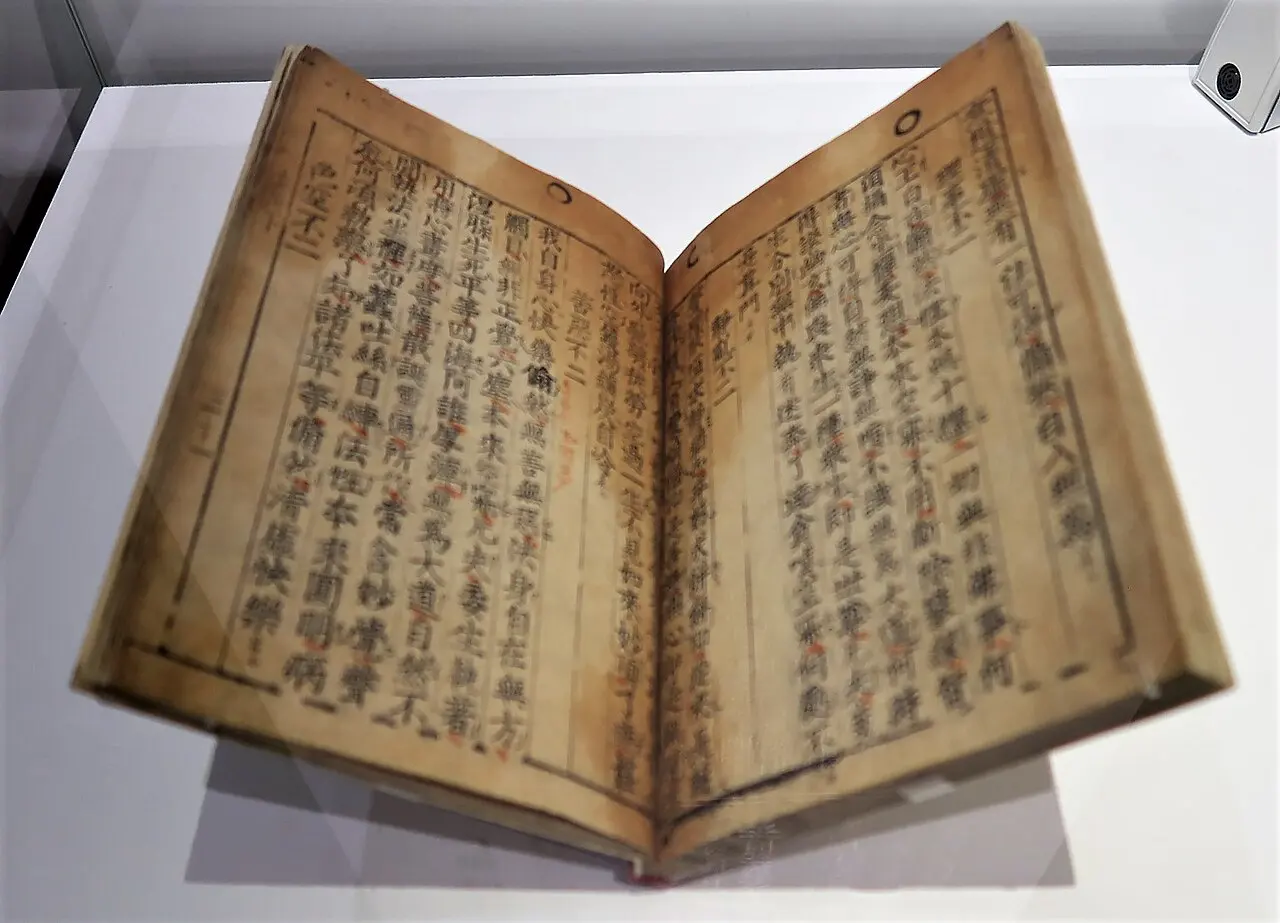

Of its two volumes, only the second survives. A French diplomat posted to Seoul in the late 19th century took it to France, and today it belongs to the National Library of France. In 2001 it was inscribed on UNESCO’s Memory of the World Register, recognized as the oldest surviving book printed with metal type, about 78 years older than the Gutenberg Bible.
So what did Gutenberg do?
None of this makes Gutenberg’s achievement any smaller. Born around 1400 in Mainz, Germany, he pulled together a complete system for making type in large quantities and with great precision.
A hand mould that could cast any number of identical letters. An alloy of lead, tin and antimony that melted easily and set hard. An oil-based ink that clung well to metal type. And a screw press that pressed the paper down evenly. By combining them, he turned printing with movable type into a technology for mass production.
The Latin alphabet, with its small number of letters, also suited movable type. Even so, to print the Bible handsomely, he is said to have used about 290 different pieces of type, including joined letters and abbreviations.
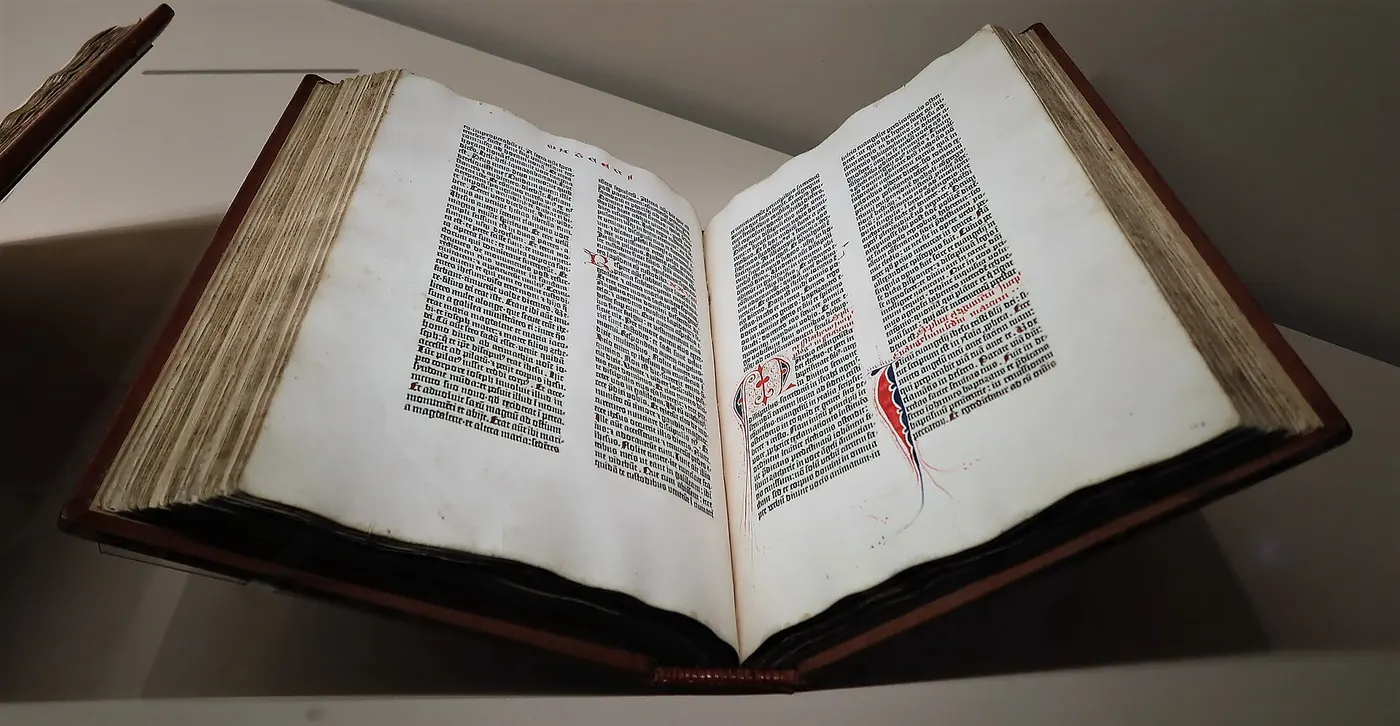

The Bible, completed around 1455, is thought to have been printed in about 180 copies, and 49 survive today. Within a few decades, printing had spread across Europe. Whether any knowledge of East Asian movable type had reached Europe by then remains unclear.
Japan got type from both directions
Movable type reached Japan by two routes. One came from the West. In 1590, the Jesuit missionary Alessandro Valignano returned to Japan with the Tensho embassy, a group of young Japanese envoys who had traveled to Europe, and brought a Gutenberg-style press with him. From about the following year, books known as Kirishitan-ban (“Christian editions”) were printed in Kyushu.
The other was copper type from the Korean Peninsula. Late in life, the retired shogun Tokugawa Ieyasu had copper type made on the Korean model, and in 1616 it was used in Sunpu (today’s Shizuoka) to print a collection of Chinese texts on government. This set, known as the Suruga copper type, is designated an Important Cultural Property of Japan and is now kept at the Printing Museum in Tokyo.