How do airplanes fly?
Wings bend the air downward; the reaction to that, together with a pressure difference above and below, creates lift.
1903
A large passenger jet loaded with passengers and fuel can weigh several hundred tonnes. And yet something that heavy, simply pushed forward by its engines, slips smoothly up into the sky. No matter how many times you fly, it is a strange sight when you stop to think about it.
Airplanes fly because their wings produce an upward force called lift. That much is common knowledge. But how is lift actually produced? If you think back to the explanation you heard as a child, a famous misconception is lurking there.
“Meeting at the back at the same time” is wrong
The explanation that has long made the rounds goes like this. A wing’s cross-section bulges on top, so the air passing over it has to travel farther than the air passing underneath. For air that splits at the front edge to rejoin at the back edge at the same moment, the air on top has to move faster. And the faster air flows, the lower its pressure (Bernoulli’s principle), so the wing is sucked upward.
It sounds logical, but there is no physical basis for the “rejoin at the same moment” part. A parcel of air has no reason to wait at the back for the partner it parted from at the front. Professor Holger Babinsky of the University of Cambridge in Britain filmed smoke flowing around a wing and showed that the air passing over the top reaches the back edge much sooner than the air underneath. The air on top flows far faster than the story needs it to.
What’s more, if that explanation were true, symmetrical wings, or wings as thin as flat boards, would produce no lift at all. Yet in reality, paper airplanes with flat wings fly perfectly well.
Wings bend the air downward
So what is really going on? The key is that the wing meets the air tilted slightly upward (the angle of attack), and that, together with the wing’s shape, this bends the surrounding airflow downward.
Air that has passed a wing flows, overall, down and backward. Push air down, and in reaction the wing is pushed up. That is how it works when you think in terms of Newton’s laws of motion. Meanwhile, as the flow is bent, the pressure drops above the wing and rises below it. Seeing that pressure difference as what pushes the wing up is the explanation that uses Bernoulli’s principle.
“Because the wing pushes air down” and “because there is a pressure difference above and below” are not rival theories. They are two views of the same phenomenon from different angles.
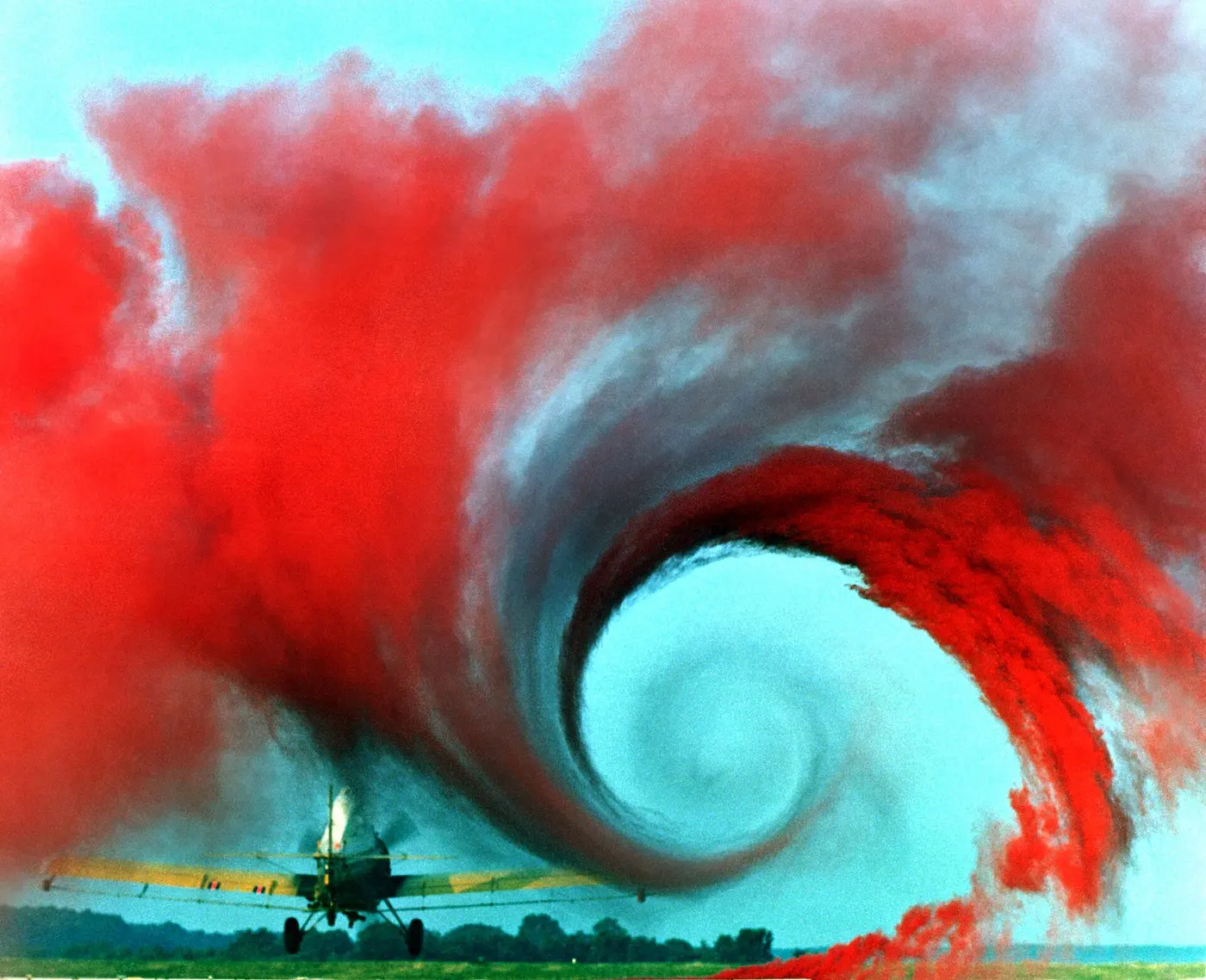

That said, experts are still debating how best to explain, without equations, exactly why the air bends that way. Lift can be calculated with great accuracy, and aircraft designers have no trouble at all. Even so, lift is a force that resists being summed up “in a nutshell.”
Why planes can fly upside down
Aerobatics show just how important the angle of attack is. Aerobatic planes can fly straight and level while flipped upside down, a maneuver called inverted flight. If lift could only come from a wing that bulges on top, that would be impossible.
In inverted flight, the pilot points the nose slightly skyward so that air still strikes the upside-down wing from below. As long as the wing is angled correctly, it bends the air downward and generates the force that holds the plane up. That is also why many aerobatic planes use wings whose cross-sections are nearly symmetrical top to bottom.
Of course, the bulge on top of an airliner’s wing is there for a reason. It is a design that produces lift efficiently with little drag. It may help to think of it this way: shape governs efficiency, and angle governs how much lift you get.
It started with 12 seconds and 36 meters
Research on lift had advanced considerably during the 19th century, but the people who turned it into piloted, powered flight were America’s Wright brothers. On December 17, 1903, on the sand dunes near Kitty Hawk, North Carolina, the Wright Flyer, piloted by the younger brother, Orville, flew for about 12 seconds and covered roughly 36 meters (120 feet). They flew four times that day, and the last flight, by the older brother, Wilbur, lasted 59 seconds and covered about 260 meters.
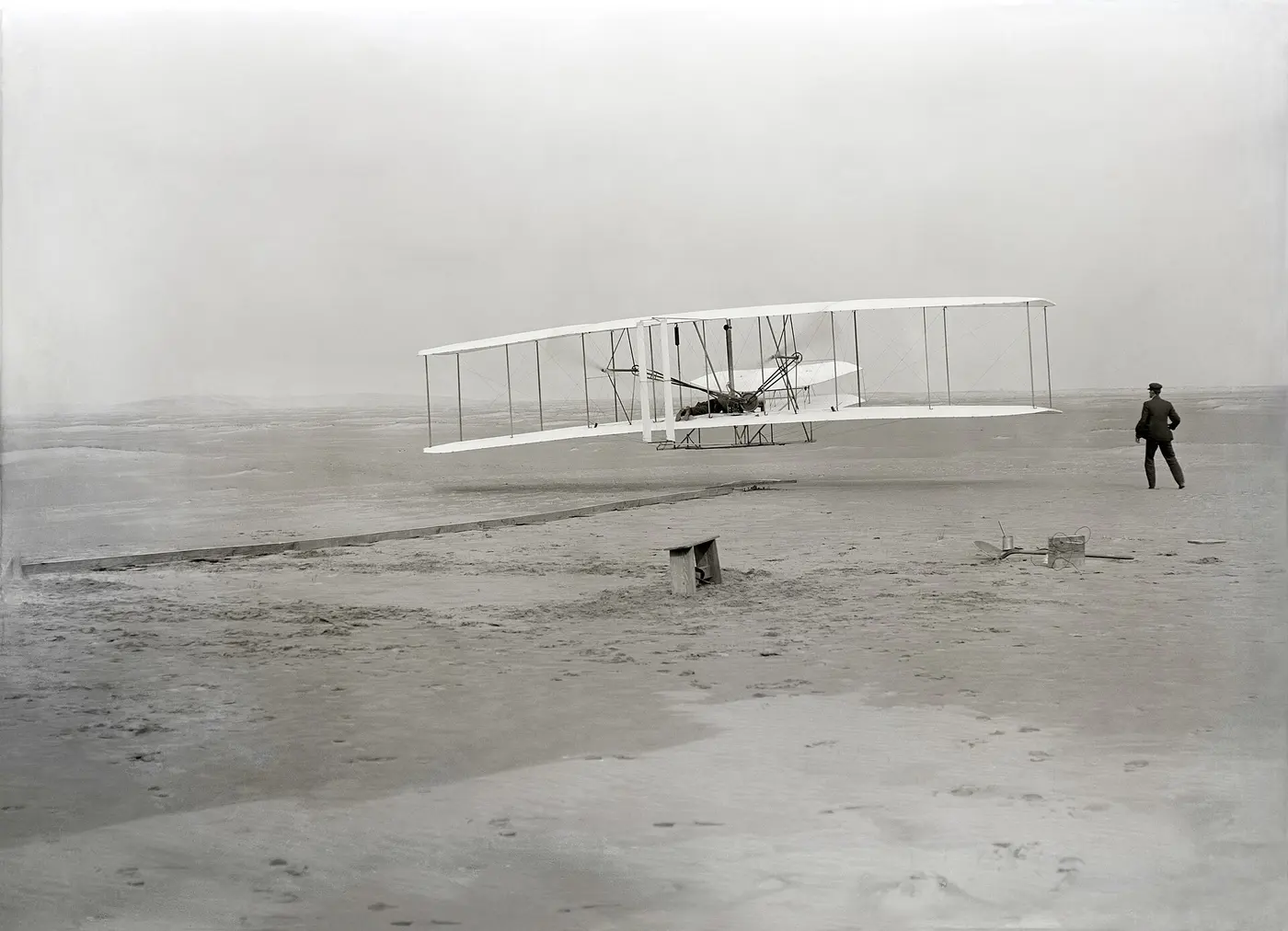

Behind the brothers’ success lay painstaking experiments with a homemade wind tunnel. Realizing that their predecessors’ lift data contained errors, the two reportedly tested and remeasured around 200 model wings. They also devised a way to twist the wings to control the plane’s bank, making it possible not just to float in the air but to steer.