When was the bicycle invented?
It is said to begin in 1817, with Karl Drais’s two-wheeler in Germany, pushed along by kicking the ground.
1817
We ride bicycles to work and to school, to the shops, and just for fun. They are so much a part of everyday life that we rarely stop to think that somebody, at some point, had to invent one.
Yet when you think about it, the idea is remarkably bold: line up two wheels, one behind the other, put a person on top, and have them keep their balance while moving forward. When was this machine born, and what set it in motion?
A “running machine” with no pedals
The bicycle’s story is usually traced to a vehicle devised by Karl Drais, a civil servant and inventor in the German state of Baden. On June 12, 1817, Drais is said to have ridden it from the town of Mannheim along a road about 7 kilometers (4 miles) each way, making the round trip in a little over an hour. Covering roughly 14 kilometers in just over an hour, he was reportedly faster than the mail coaches of the day.
The machine had a wooden frame with two wheels, front and back, and the front wheel could be steered with a handlebar. What it did not have was pedals. The rider sat astride the saddle and pushed off the ground with both feet. Picture the pedal-free balance bikes that small children ride today, and you are not far off.
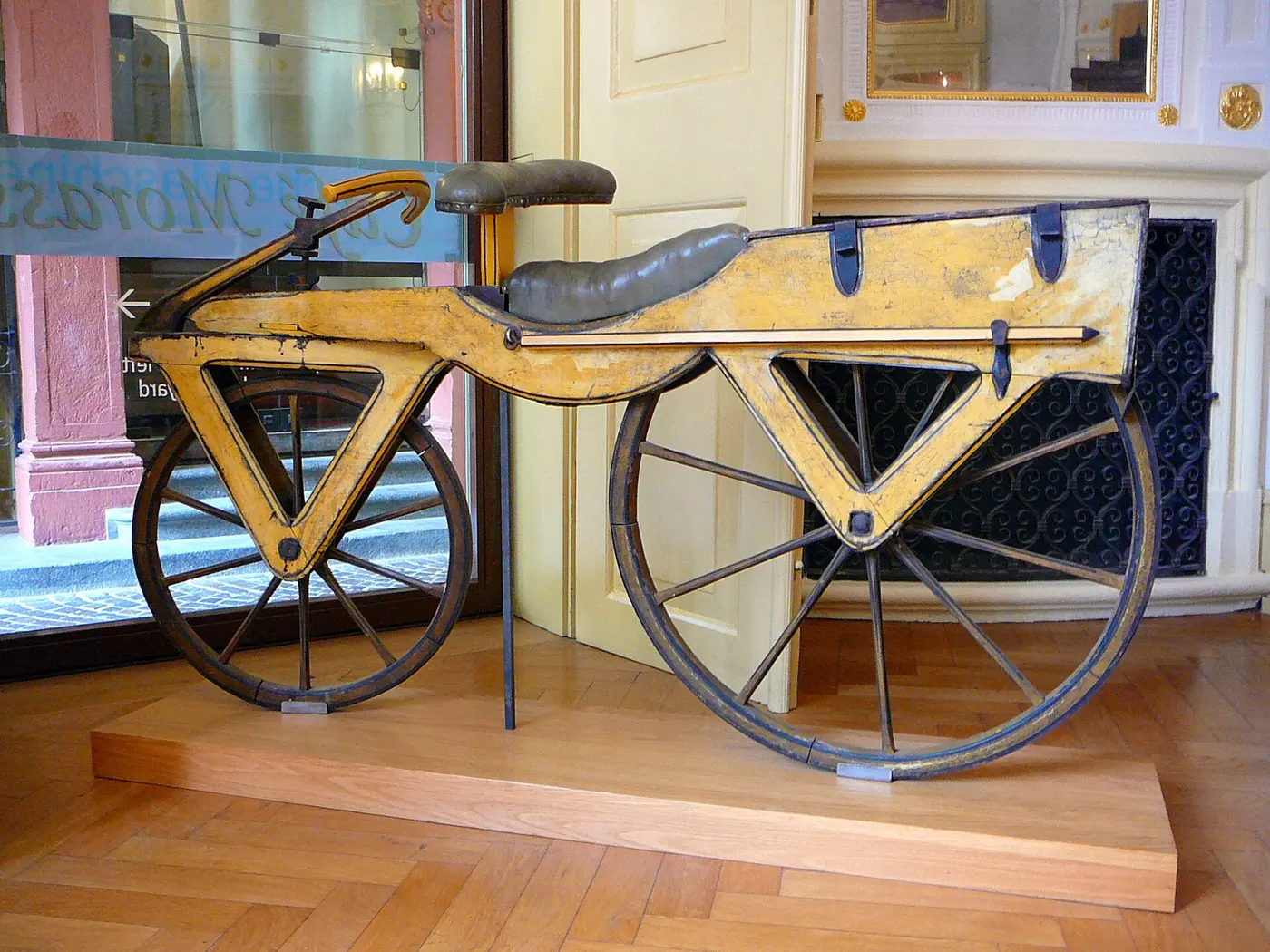

Drais himself called it the Laufmaschine, or “running machine,” and after its inventor it also became known as the draisine. It caused a stir across Europe, and in Britain it picked up the nickname “dandy horse.”
Born of a volcanic eruption?
One theory links Drais’s invention to an unexpected event. In 1815, Mount Tambora in Indonesia erupted on a colossal scale, spreading enormous amounts of volcanic ash around the globe. The following year, 1816, Europe and North America were hit by unusual cold, and harvests failed so badly that it came to be called “the year without a summer.”
With fodder in short supply, many horses starved or were put down, creating demand for a way to get around without them. Hans-Erhard Lessing, a researcher known for his work on Drais, believes this was what sparked the invention. There is no conclusive record to prove it, however, so it is best taken as one strong theory rather than settled fact.
Pedals, giant front wheels, and finally the chain
Pedals arrived in France in the 1860s, when they were added to these kick-along machines. They were fixed directly to the front wheel, and with iron tires on wooden wheels, the ride was so rough that the machines earned the name “boneshakers.”
When the pedals turn the front wheel directly, one turn of the pedals means just one turn of the wheel. To go faster, front wheels grew bigger and bigger, and by the 1870s the “penny-farthing,” with a front wheel about 1.2 to 1.5 meters (4 to 5 feet) across, had become popular. Riders, however, kept getting pitched headfirst from their lofty seats.
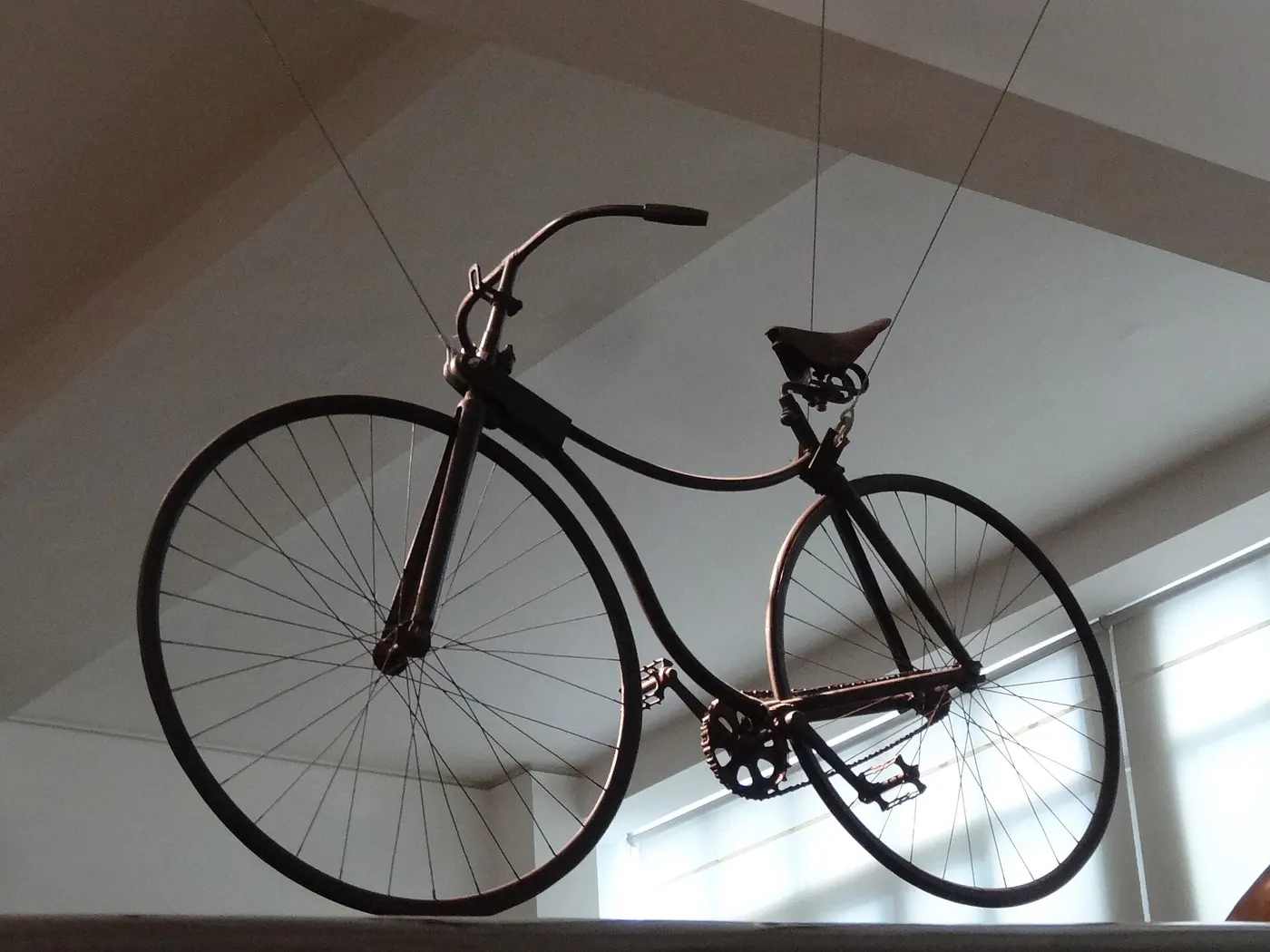

The turning point came in 1885, when John Kemp Starley in England began selling the Rover safety bicycle. Its front and rear wheels were close in size, and a chain transferred the force of the pedals to the back wheel. This is said to be the moment the basic form of the modern bicycle was complete. In 1888, John Boyd Dunlop developed a practical air-filled tire, and the ride became far more comfortable.
Did Leonardo da Vinci really draw a bicycle?
You may have heard that Leonardo da Vinci was the first person to think up the bicycle. In the 1970s, it was announced that a sketch of a bicycle-like machine, complete with a chain, had been found during restoration of one of his manuscripts.
Later research, however, has pointed out that the drawing was very likely added by someone in a later period. At the very least, there is no solid evidence that Leonardo ever designed a bicycle.