Why are traffic lights red, yellow and green?
The colors were inherited from railway signals. And Japan’s “blue” light is really a kind of green.
1930
Japanese drivers call the “go” signal ao shingō, the “blue light.” Yet anyone waiting at a crossing in Japan may find themselves thinking that it looks green, no matter how you squint. Some Japanese people feel oddly unsettled to learn that in English it is simply called a green light.
Red for stop, yellow for caution, and green (or “blue”) for go. This color scheme is shared by almost every country in the world. But it was not set in stone from the start. Trace the history of signal colors, and you find they began not with cars, but with railways.
It started with railway signals
As railways spread across nineteenth-century Britain, signals were needed to tell trains when to stop and when to go. Early railway signals are said to have often used a red lamp for stop, green for caution, and white (clear) for go.
Red is commonly explained as having been chosen for “stop” because it had long been used as a warning of danger, and because it stands out well even from a distance.
White for “go,” however, had a hidden flaw. If the red lens cracked and fell out, a signal that should mean “stop” could show white light—in other words, “go.” White lamps were also hard to tell apart from city lights. So from around the end of the nineteenth century, green came to be used for “go,” and the role of “caution” is said to have eventually passed to yellow.
The first traffic light ran on gas
The first signal used on a road went up in London in December 1868. Designed by the railway engineer John Peake Knight, it was installed at an intersection in front of the Houses of Parliament. By day it signaled with the angle of semaphore arms, and by night with red and green gas lamps. It was operated by hand by a police officer.
The colors meant the same as on the railways. Notices from the time show that red meant “stop,” while green meant not “go” but “proceed with caution.”
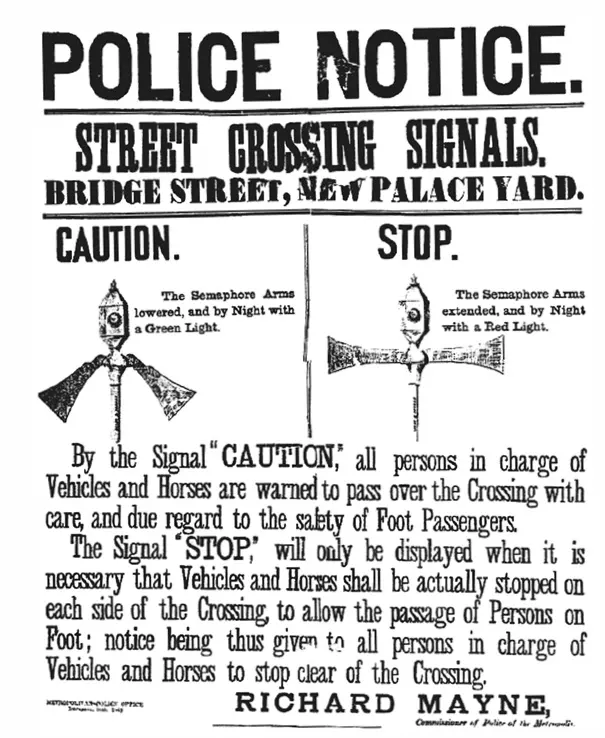

Just a month or so after it was installed, in January 1869, the signal exploded because of a gas leak, seriously injuring the police officer operating it. The history of road signals got off to a turbulent start.
The first electric signal with all three colors—red, yellow and green—is said to have been one devised in 1920 by William Potts, a police officer in Detroit. Potts’s signal was shaped like a tower, with lamps facing all four directions of the intersection. The addition of a yellow “caution” light meant drivers could tell in advance that the signal was about to change, giving them time to stop safely.
It’s green, so why “blue”?
Japan’s first automatic traffic light was an American-made unit installed at an intersection in Hibiya, Tokyo, in 1930. The laws of the time described its color as “green.”
Among the public, however, the name ao shingō, “blue signal,” caught on. Japanese had long had the habit of calling some green things ao (青), “blue,” as in aoba (fresh green leaves) and ao-ringo (green apples). Old Japanese is thought to have had only about four basic color words—red, black, white and ao—with ao covering a broad range of colors that included green. That linguistic sense, helped along by the usage of newspapers and others, seems to have made “blue signal” stick. In the end, in 1947, the law itself was changed to say “blue.”
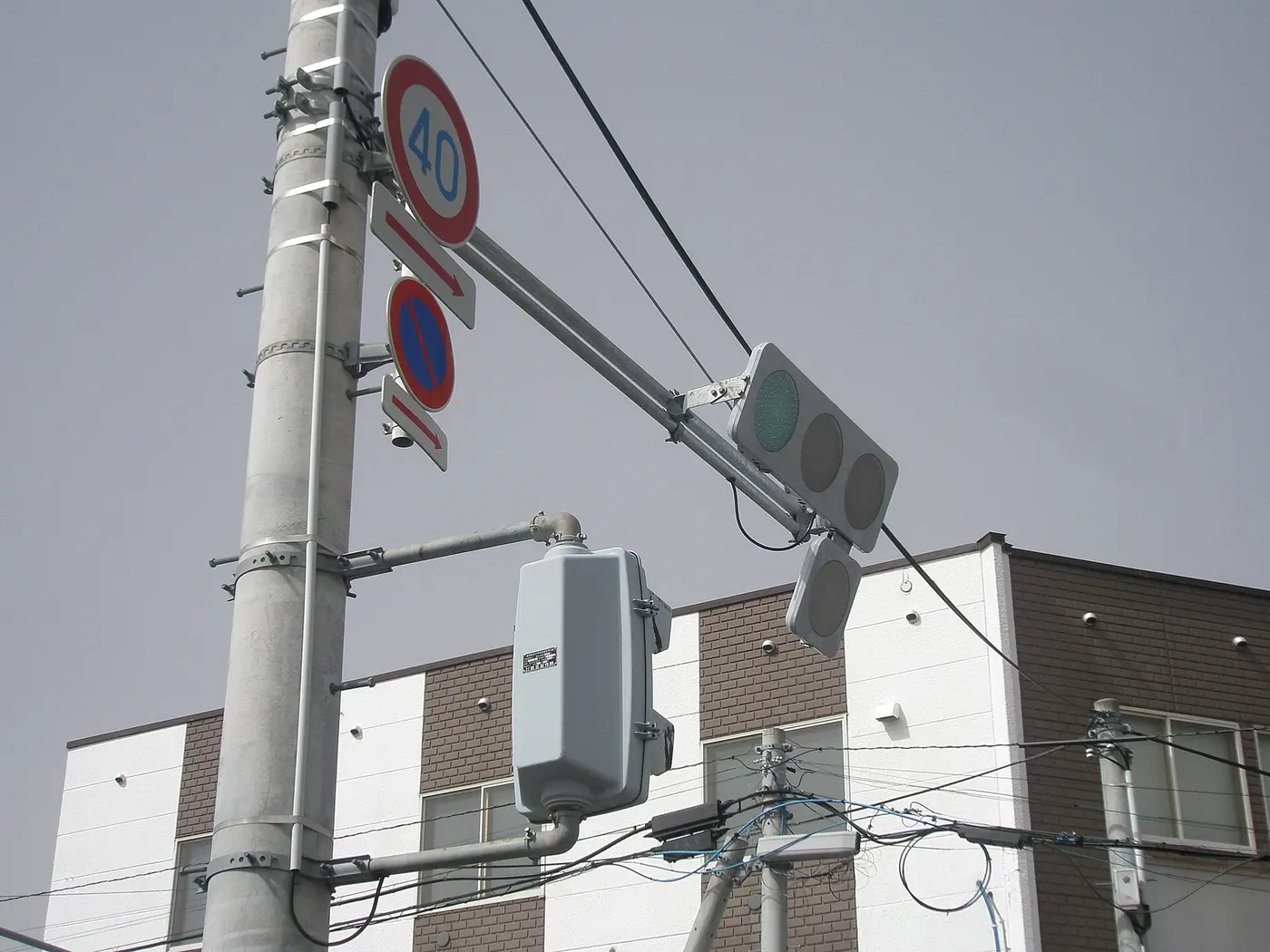

Still, making the signal truly blue would have broken with international agreements. So in the 1970s, Japan began using a color as close to blue as possible while staying within the range internationally defined as “green.” That is why Japanese “go” lights look a little bluer than those in other countries. The color itself moved a little closer to match the name.