Was “escalator” originally a brand name?
Yes. It was a registered trademark of the Otis Elevator Company until 1950, when it was cancelled as a generic word.
1950
Beside the stairs at a train station, in the atrium of a department store, we step onto escalators without a second thought. The word is as ordinary as “elevator,” and it has even been borrowed into Japanese, where it sits comfortably alongside the native vocabulary.
Yet “escalator” started life as the name of one company’s product. Becoming an everyday word took a few twists and turns.
The race to build a moving staircase
The idea of moving stairs dates back to the mid-19th century. In 1859, an American named Nathan Ames patented “revolving stairs,” but his design was never built.
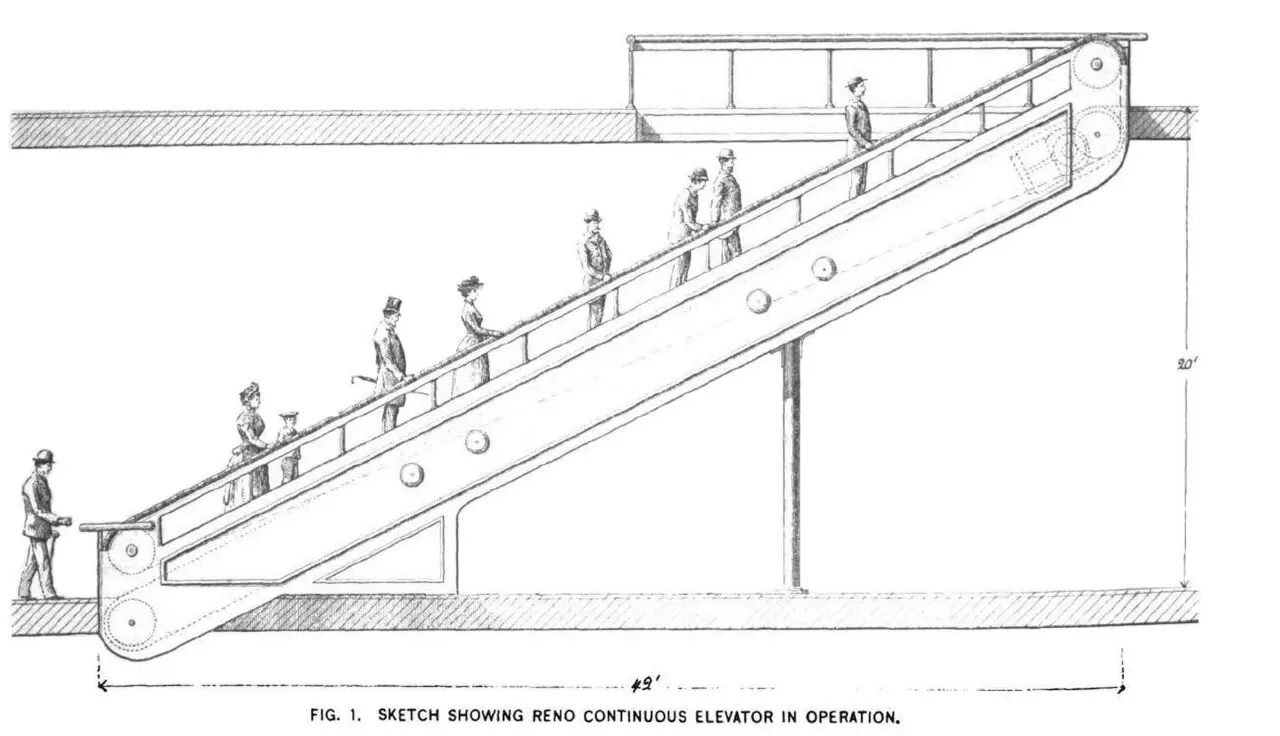
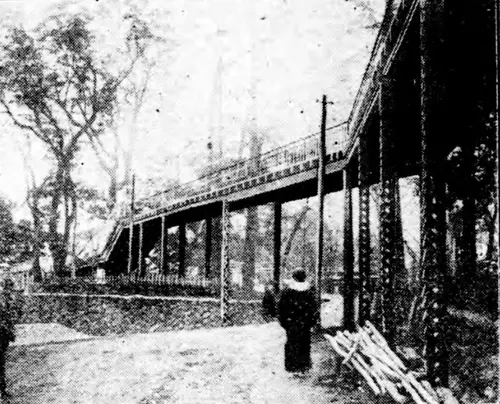
Things got moving in the 1890s. In 1892, the American inventor Jesse Reno patented an “endless conveyor or elevator.” It had no steps; riders stood on a belt that climbed a gentle slope, like an inclined elevator. In 1896, one was installed on a pier at Coney Island, the seaside resort in New York.

In the same year, 1892, George Wheeler patented a staircase with flat moving steps and a handrail that moved along with them. It was closer to the escalators we know today, but Wheeler never built it himself.
The man who named it
Wheeler’s patents were bought by another American, Charles Seeberger. Teaming up with the Otis Elevator Company, he completed a moving staircase with steps in 1899.
The name Seeberger came up with was “Escalator,” a coinage blending scala, Latin for a ladder or flight of steps, with “elevator.” An Escalator exhibited at the 1900 Paris World’s Fair won first prize.
Seeberger registered the name as a trademark in 1900 and later assigned it to Otis. In other words, “Escalator” was a brand name belonging to Otis, one that other companies were not free to use.
A name that became too famous
But as moving staircases spread around the world, people began using “escalator” for any moving staircase, whoever had built it.
A rival elevator maker, the Haughton Elevator Company, asked the US Patent Office to cancel the trademark registration, and in 1950 the request was granted. The public, the decision found, understood “escalator” not as the name of one company’s product but as the name of the thing itself. What sealed it was that Otis had itself used the word as an ordinary noun in its own patents and advertising.
When a brand becomes so famous that it turns into a common noun and loses its protection as a trademark, the result is sometimes called genericide. The escalator is still one of the most often cited examples.
Arriving in Japan in 1914
The first escalator in Japan appeared in 1914. At the Tokyo Taisho Exposition, held in Ueno, Tokyo, from March to July that year, an escalator linked two of the fair’s sites. It moved at one shaku (about 30 centimeters, or a foot) per second, and a ride cost 10 sen.

That autumn, another escalator was installed in the new building of the Mitsukoshi store in Nihonbashi, Tokyo, the forerunner of today’s Mitsukoshi department store. The Japan Elevator Association presents this one as Japan’s first. The answer depends on whether you count a temporary machine at a fair or a permanent one in a building. The Mitsukoshi escalator was destroyed in the Great Kanto Earthquake of 1923.