Were sticky notes born from a failure?
Yes. A weak adhesive, made by accident in research aimed at a strong one, later became the Post-it Note.
1980
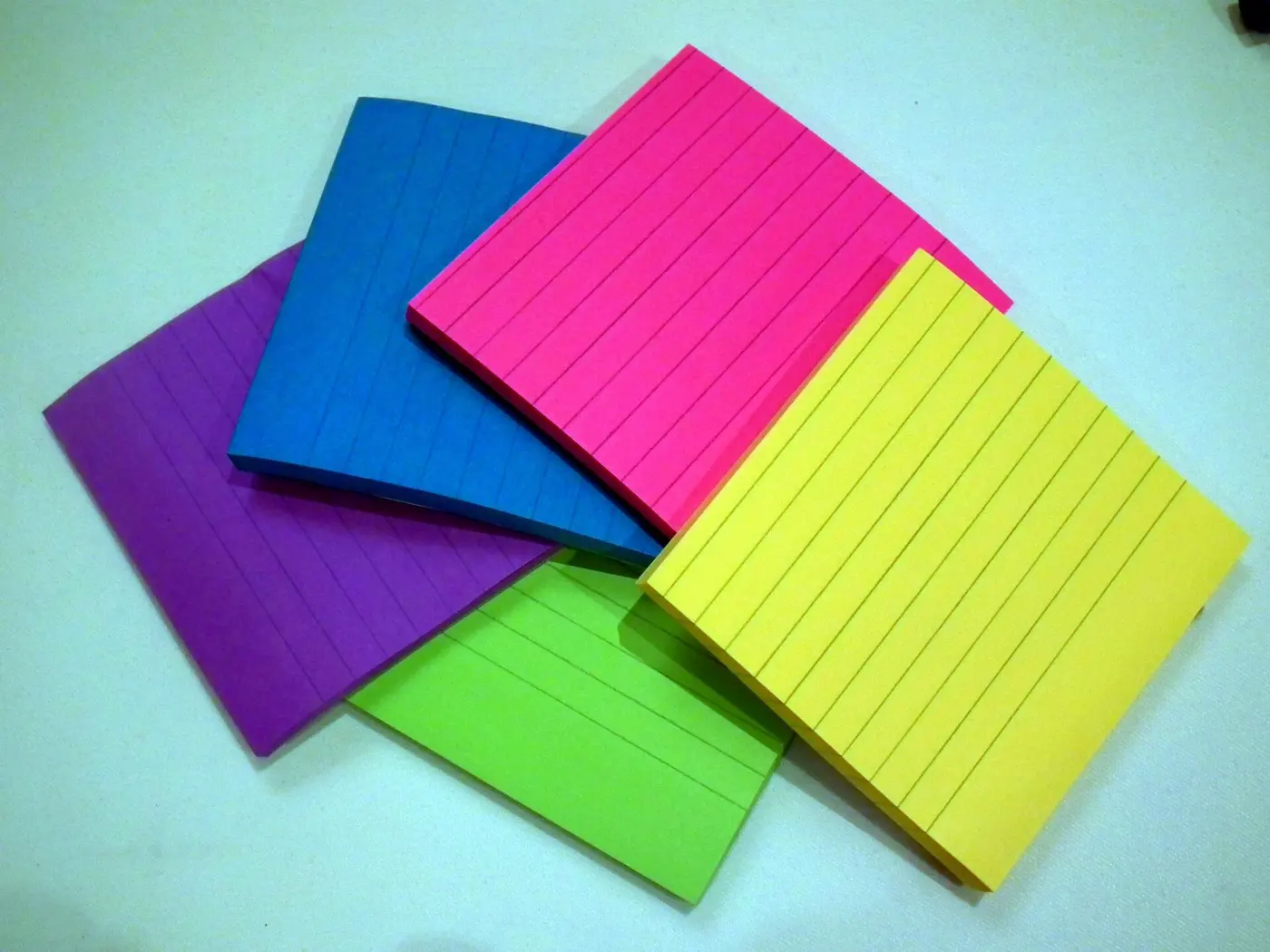
On the edge of a computer screen, between the pages of a textbook, on the refrigerator door. You jot down a quick note, press it in place, and peel it off when you are done. Sticky notes, and especially the Post-it Note, the brand that has become almost synonymous with them, are now about as standard as office supplies get.
Yet this handy little tool began as an experiment that did not go the way one researcher had planned. And before it became a product, a detour of more than ten years lay ahead.
An adhesive that sticks, but lets go easily
In 1968, at a lab run by 3M, the American chemical company known for adhesive tapes, a chemist named Spencer Silver was working on a stronger adhesive. What his experiments produced, however, was an adhesive with exactly the opposite qualities.
It was made of particles so tiny they were invisible to the eye. Because only part of each particle touched the surface it was stuck to, its grip was weak, and it could be peeled away with little effort. On top of that, it left almost no residue and could be restuck again and again. For research aimed at strength, it was a “failure,” but Silver felt sure this curious property must be good for something.

“An invention with no use”
For years afterward, Silver went around showing off the adhesive at internal seminars and elsewhere in the company. He even proposed a bulletin board coated with it, so that papers could be put up and taken down without thumbtacks. But a truly compelling use never seemed to materialize. Silver later recalled that because he kept pitching it without giving up, colleagues started calling him “Mr. Persistent.”
A solution with no problem to match it: inside the company, that was how things stood for a long time.
A bookmark that kept falling out of a hymnal
The turning point came in 1974. Art Fry, who worked in product development at 3M, sang in his church choir. His nagging problem was that the paper slips he used to mark his place in the hymnal kept fluttering out every time he turned a page.
Then Fry remembered the “weak adhesive” he had heard about at one of Silver’s seminars. Coat a slip of paper with it, and wouldn’t it make a bookmark that stayed firmly in place without damaging the book, then peeled away cleanly when no longer needed?
As he used his prototypes, Fry realized there was a much bigger opportunity. In one well-known anecdote, he stuck one of these slips on a report, wrote a note on it and passed it to his boss, who wrote a reply on the same slip and sent it back. This was not just a bookmark. It could be a message tool you could stick on and peel off. Even so, working out how to manufacture it, with adhesive spread evenly over just part of each sheet, took still more trial and error.
A failed test launch, and a comeback
In 1977, 3M began test-marketing the product in four American cities under the name “Press ’n Peel.” The result was a flop. People who had never used one simply could not see what the paper was for.
So in 1978, in Boise, Idaho, the company tried handing out huge numbers of free samples to offices and other workplaces. Once people actually used the notes, their reaction changed completely, and many said they would buy them again. The campaign has come to be known as the “Boise Blitz.” Finally, in 1980, the product went on sale across the United States as Post-it Notes, a full 12 years after Silver’s discovery.


As for the familiar canary yellow, 3M explains that it was chosen simply because the lab next door to the development team happened to have some scraps of yellow paper lying around.