What was Vermeer’s blue made from?
Ultramarine, a pigment ground from lapis lazuli mined in Afghanistan. At times it was as costly as gold.
In the light from a kitchen window, a woman quietly pours milk. In The Milkmaid, painted by the Dutch artist Johannes Vermeer around 1658, her blue apron is what catches the eye first.
In Japan this deep blue is affectionately known as “Vermeer blue.” It comes from a paint called ultramarine. Trace it back to its source, and you end up far from the Netherlands where the picture was painted, deep in the mountains of Central Asia.
A blue from “beyond the sea”
Ultramarine is made from a blue stone called lapis lazuli. In seventeenth-century Europe there was, in practice, only one source of it: the mines around Sar-e-Sang in the mountains of Badakhshan, in what is now northeastern Afghanistan.
The stone reached Europe after a long journey over land and sea. The name ultramarine comes from a Latin word meaning “beyond the sea”: a blue shipped in from distant lands.
One of the earliest known uses of lapis lazuli as a paint is in sixth- and seventh-century wall paintings in Buddhist cave temples in Afghanistan, thought to be near the famous site of Bamiyan.
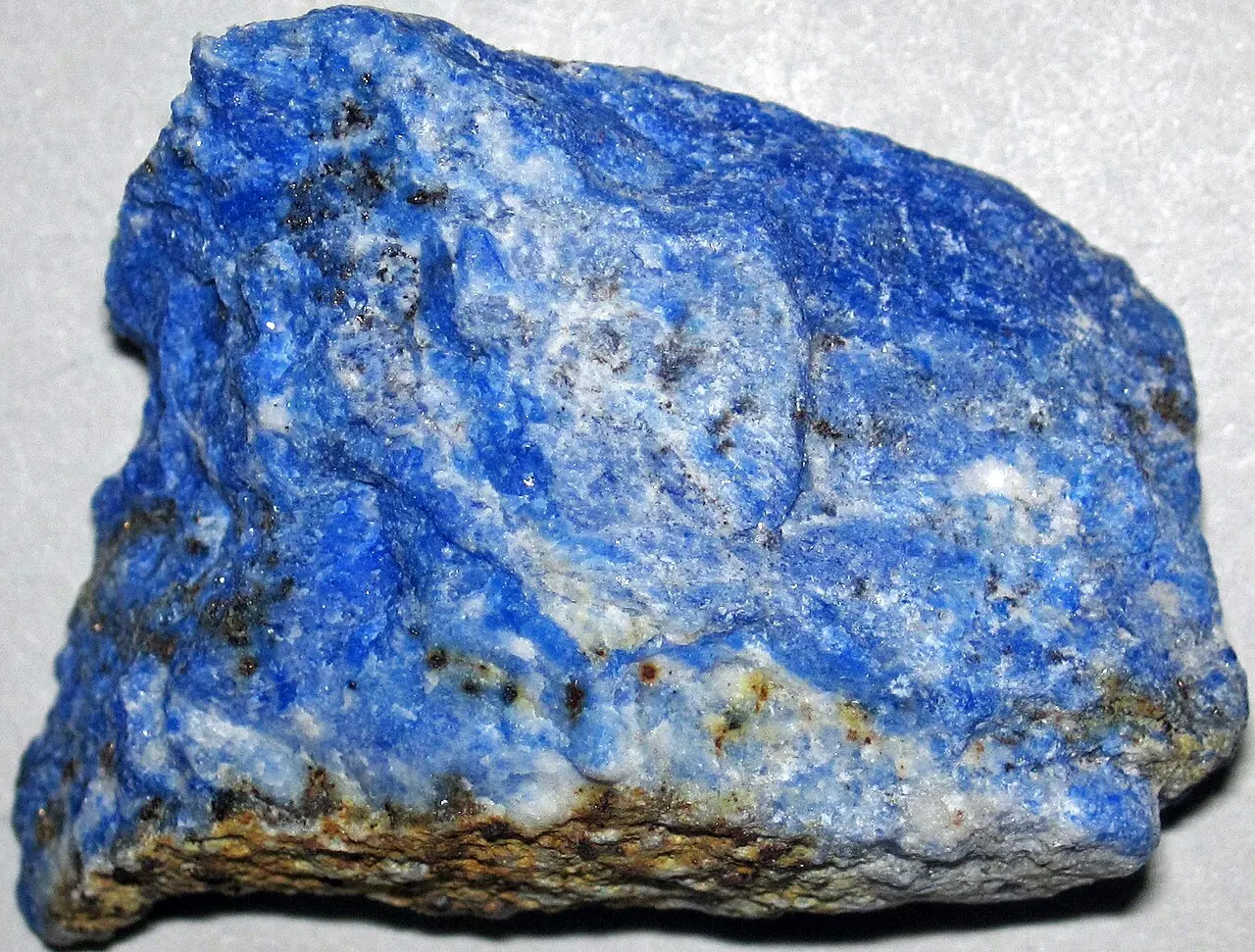
_(Sar-e-Sang_Deposit,_Sakhi_Formation,_Precambrian,_2.4-2.7_Ga_(%3F);_Sar-e-Sang_Mining_District,_Hindu-Kush_Mountains,_Afghanistan)_21.jpg)
Crushing it isn’t enough
Simply grinding lapis lazuli into powder gives only a dull, grayish blue, because the stone contains a lot of white calcite and other minerals besides the blue lazurite.
So it had to be laboriously refined. In the method recorded by the fifteenth-century Italian painter Cennino Cennini, the powdered stone is mixed with wax, resin and oil into a dough, which is then kneaded in a weak alkaline solution made from wood ash. Only the blue particles wash out into the liquid. The first particles to come out were the deepest blue and considered the finest.
A huge amount of stone yielded only a little pure blue. Ultramarine was so expensive that in Europe it was at times valued as highly as gold.
Blue even in the shadows
Vermeer used this costly paint generously. In the apron of The Milkmaid, thick, transparent layers of ultramarine lie over a quickly painted underlayer of lights and darks. Like stained glass, the layers let light through, which is what gives the blue its depth. The blue jacket in Woman in Blue Reading a Letter is also painted with ultramarine.
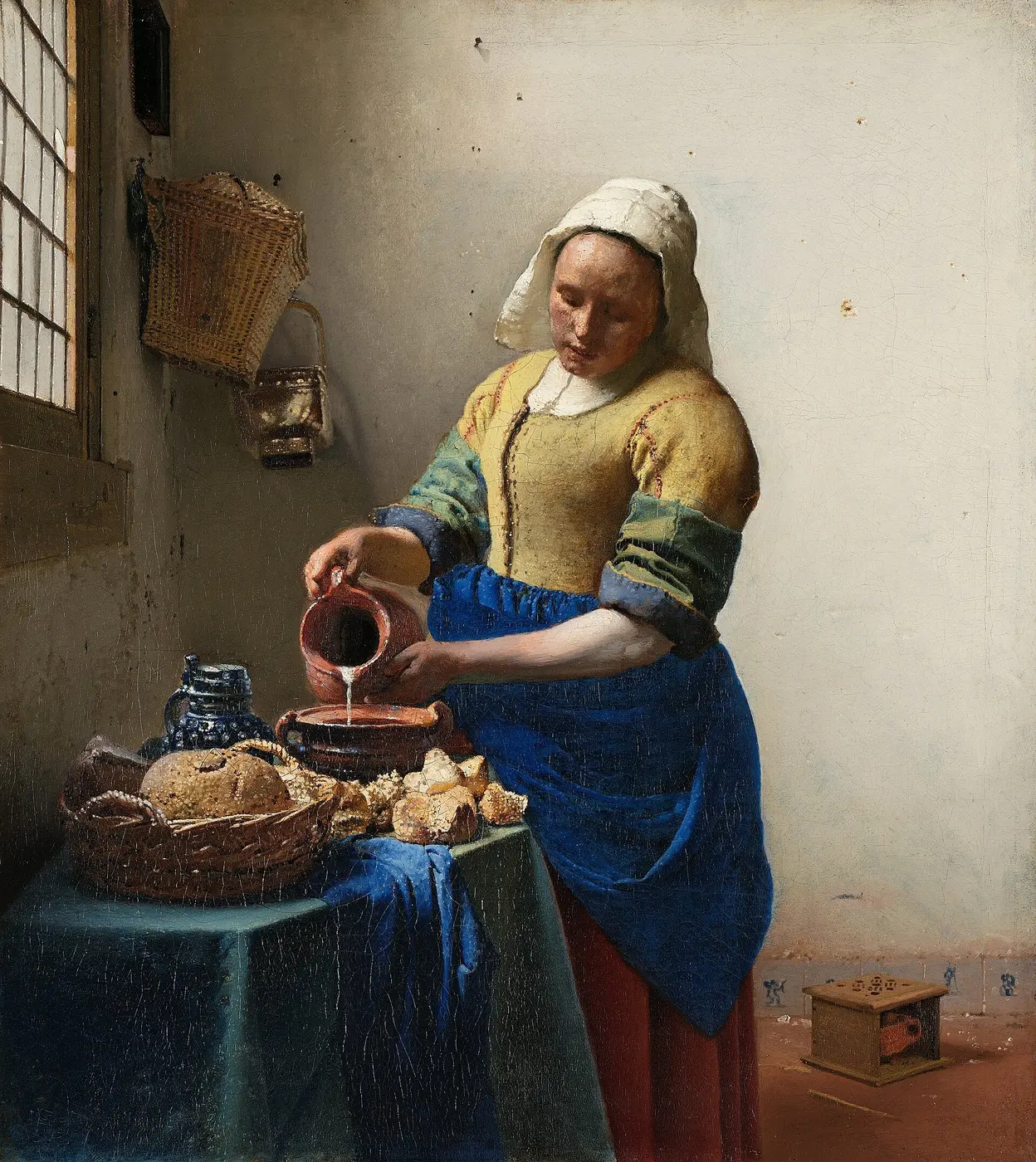

And that’s not all. Vermeer mixed ultramarine into the shadows of white cloth, and in The Glass of Wine even into the shadows of a woman’s reddish gown. He was quietly using it in places that don’t look blue at all.
That does not mean Vermeer lived in comfort. When he died in 1675, his widow was left with heavy debts. The unpaid bill at the baker’s alone came to just over 617 guilders, about three years’ worth of bread, and she handed two of her husband’s paintings over to the baker. The Netherlands had been dragged into war with France, and in his last years, she said, Vermeer had been unable to sell any paintings at all.
The birth of synthetic ultramarine
This costly blue only became affordable in the nineteenth century. In 1824 a French society for the encouragement of industry offered a prize of 6,000 francs to anyone who could make ultramarine artificially. In 1826 the Frenchman Jean-Baptiste Guimet found a way, and in 1828 the German chemist Christian Gmelin published a method of his own.
Nearly all the “ultramarine” sold in art shops today is this synthetic pigment. Natural ultramarine made from lapis lazuli has become a luxury reserved for special uses.