Where do the names “do, re, mi” come from?
From the opening syllables of lines in a medieval hymn. The first note wasn’t “do” at all, but “ut.”
Do, re, mi, fa, sol, la, ti, do. It is one of the first things we learn in music class, and it is so familiar that few people ever stop to wonder what it means. “Do” and “re” are not numbers or letters, and on their own they don’t sound as if they mean anything at all.
In fact, these seven syllables have a very real origin. Their roots reach back about 1,000 years, to a monastery in Italy.
The first syllables of a hymn
The man credited with inventing do-re-mi is Guido of Arezzo, an 11th-century Italian monk. While teaching choirboys to sing, Guido was looking for a way to help them learn new chants more quickly. In an age before recorded music, every melody had to be passed on by ear and memory, and that took a long time.
His solution centered on a Latin hymn in praise of John the Baptist, known by its opening words, “Ut queant laxis.” The hymn asks Saint John to heal the singers’ ailing voices, and its text is attributed to Paul the Deacon, an eighth-century monk.
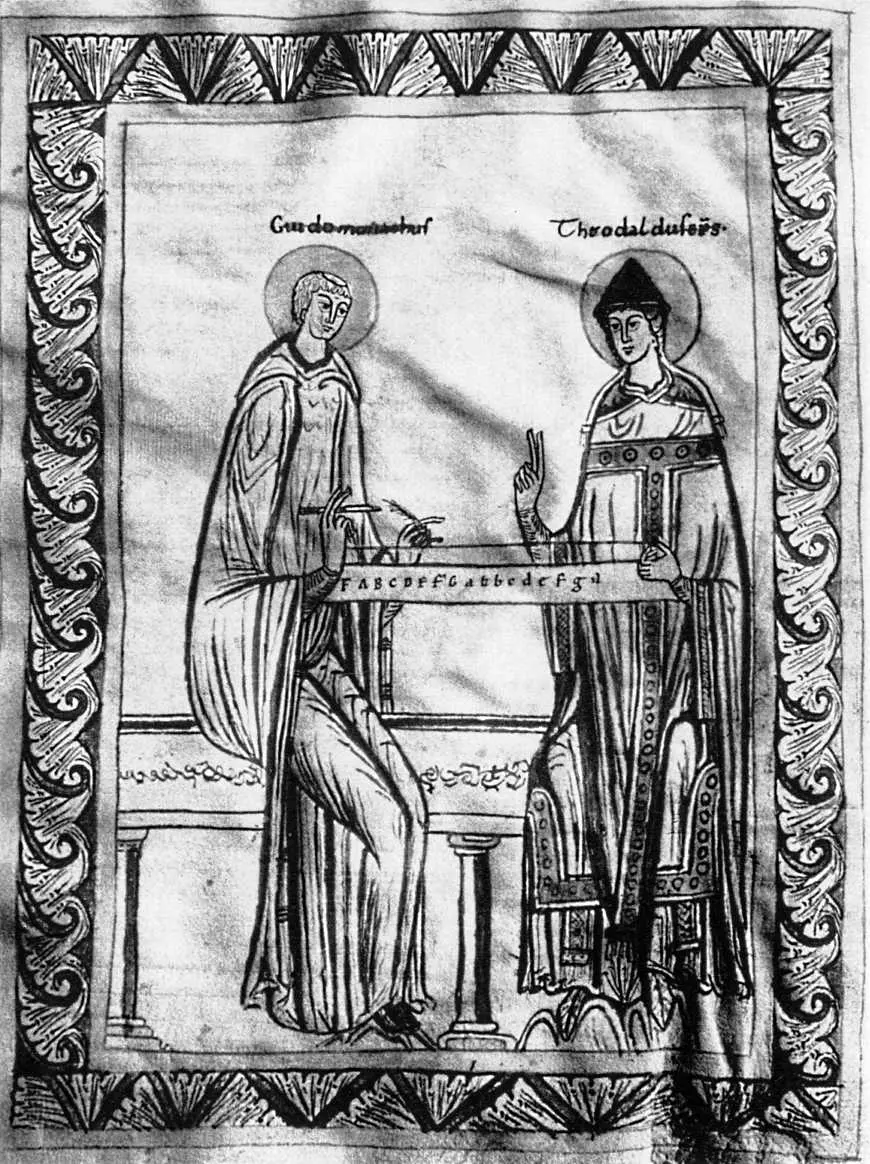

The hymn’s melody had a curious feature. With each new phrase of the text, the opening note climbed one step higher. Line up the first syllable of each phrase and you get ut, re, mi, fa, sol, la. Guido used these syllables as landmarks for pitch. If a singer linked a note to “the re in that hymn,” they could sing a melody they had never seen before. Some even suggest that Guido composed the melody himself.
How “ut” became “do”
As you may have noticed, in Guido’s time there were only six note names, and the first one was “ut,” not “do.”
The seventh syllable, “si,” was added much later. It is said to combine S and I, the initials of Sancte Iohannes, Latin for “Saint John,” which appear at the end of the hymn. The name is said to have spread from around the end of the 16th century.
Meanwhile, “ut” was an awkward syllable to sing, since it ends abruptly in a closed sound. In the 17th century, the Italian music scholar Giovanni Battista Doni proposed replacing it with the more open-sounding “do.” Some say he took “do” from Dominus, Latin for “Lord”; others say he took it from his own surname, Doni. Accounts differ. Even so, the name “ut” is reportedly still used in France today.
The palm of your hand as sheet music
Guido’s name is linked to another teaching tool as well: the “Guidonian hand,” which assigned note names to the joints and tips of the fingers. A teacher would point to a spot on their own palm, and the students would sing the note that belonged there. In an era when written sheet music was a precious thing, it was a portable textbook that went everywhere the teacher did.
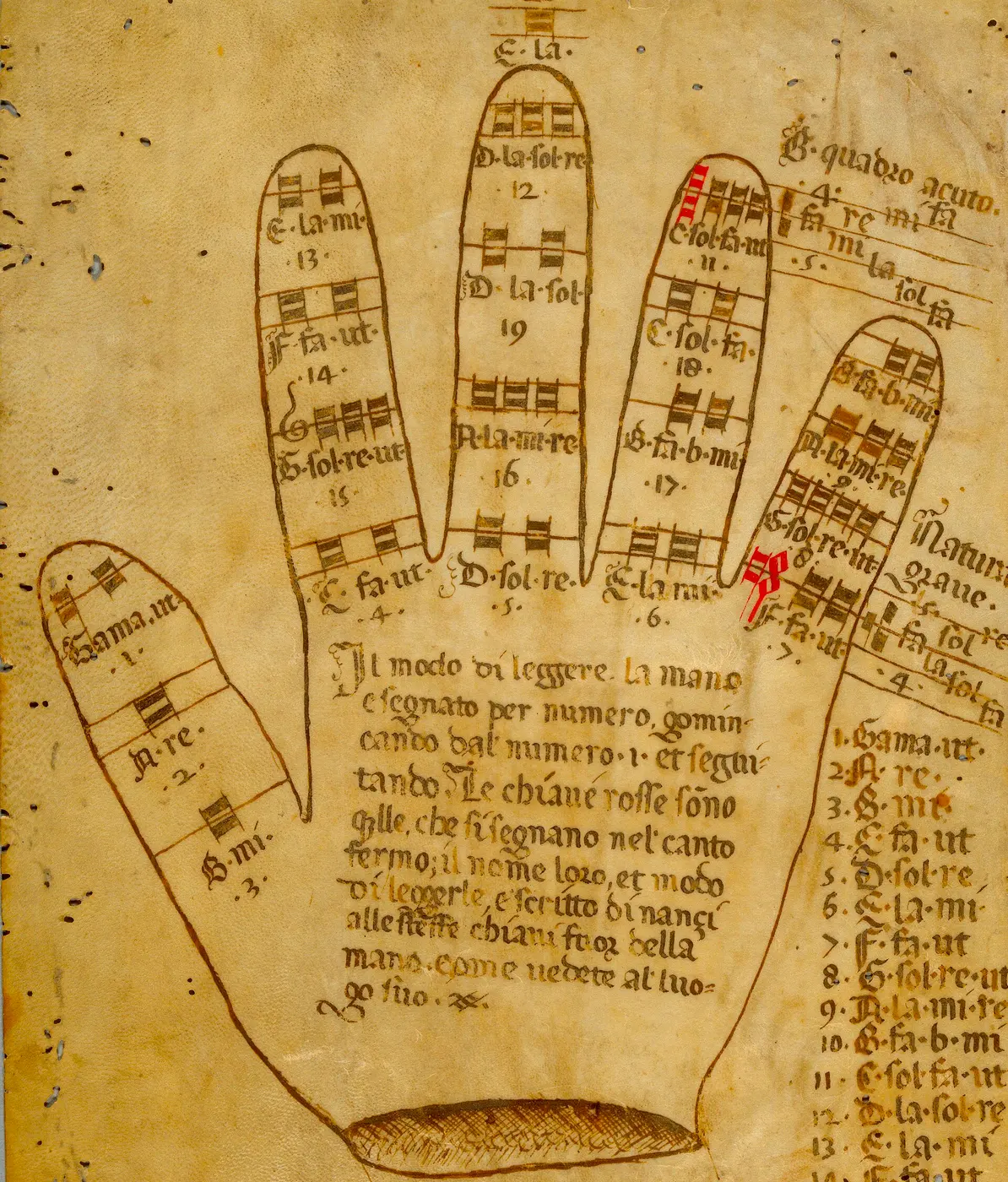

That said, it is not clear whether Guido himself devised this method; it may be that later generations simply attached his name to it. Either way, there is no doubt that his ideas—giving notes names, and making them something you could learn with your eyes and body—had a lasting influence on music education in Europe. Guido is also known for refining the way music was written down, using lines to show the pitch of notes, an ancestor of the staff we read today.
Every country has its own note names
Do-re-mi is not universal. In the English-speaking world, the same notes are called by the letters C, D, E, F, G, A and B, and in 19th-century Britain the sung syllable “si” was changed to “ti.” This is said to have been done so that it would not share an initial letter with “sol.”
In Japan, when Western music was adopted in the Meiji era (1868–1912), people created a set of note names by swapping the letters for the opening kana of the iroha, a classical poem traditionally used to order the Japanese syllabary: ha, ni, ho, he, to, i, ro. Because A, B and C became i, ro and ha, the note C—the equivalent of “do”—ended up as “ha.” That is why the Japanese term for C major is ha-chōchō (ハ長調), and the treble clef, which marks the note G, is called the to-onkigō (ト音記号), or “to clef.”