What is Rodin’s “Thinker” thinking about?
He began as the poet Dante imagining his Divine Comedy, gazing at human fate from atop the Gates of Hell.
Seated on a rock, back bent, chin resting on his right hand, perfectly still. Auguste Rodin’s The Thinker has become shorthand for “deep in thought,” imitated countless times in cartoons and commercials. Few sculptures anywhere are as instantly recognizable.
He might be wrestling with a hard philosophical problem, or he might be trying to decide what to have for dinner. So what is he really thinking about? To find out, we need to know where he was originally sitting, because he was not always alone on a pedestal.
At the top of the Gates of Hell
In 1880, the French government commissioned Rodin to make a pair of bronze doors for the entrance of a museum of decorative arts planned for Paris. For his subject, Rodin chose the Inferno, the journey through Hell that opens the Divine Comedy, the epic poem by the 14th-century Italian poet Dante Alighieri. The result was the design known as The Gates of Hell.
Across the surface of the doors, Rodin modeled some 180 figures writhing in torment. And directly above the doors, looking down over the whole gateway, he placed a seated man a little over 70 centimeters (about 28 inches) tall. Rodin called this figure “The Poet.” It was not yet the solitary statue we know today, but one figure among many in a vast, crowded composition.
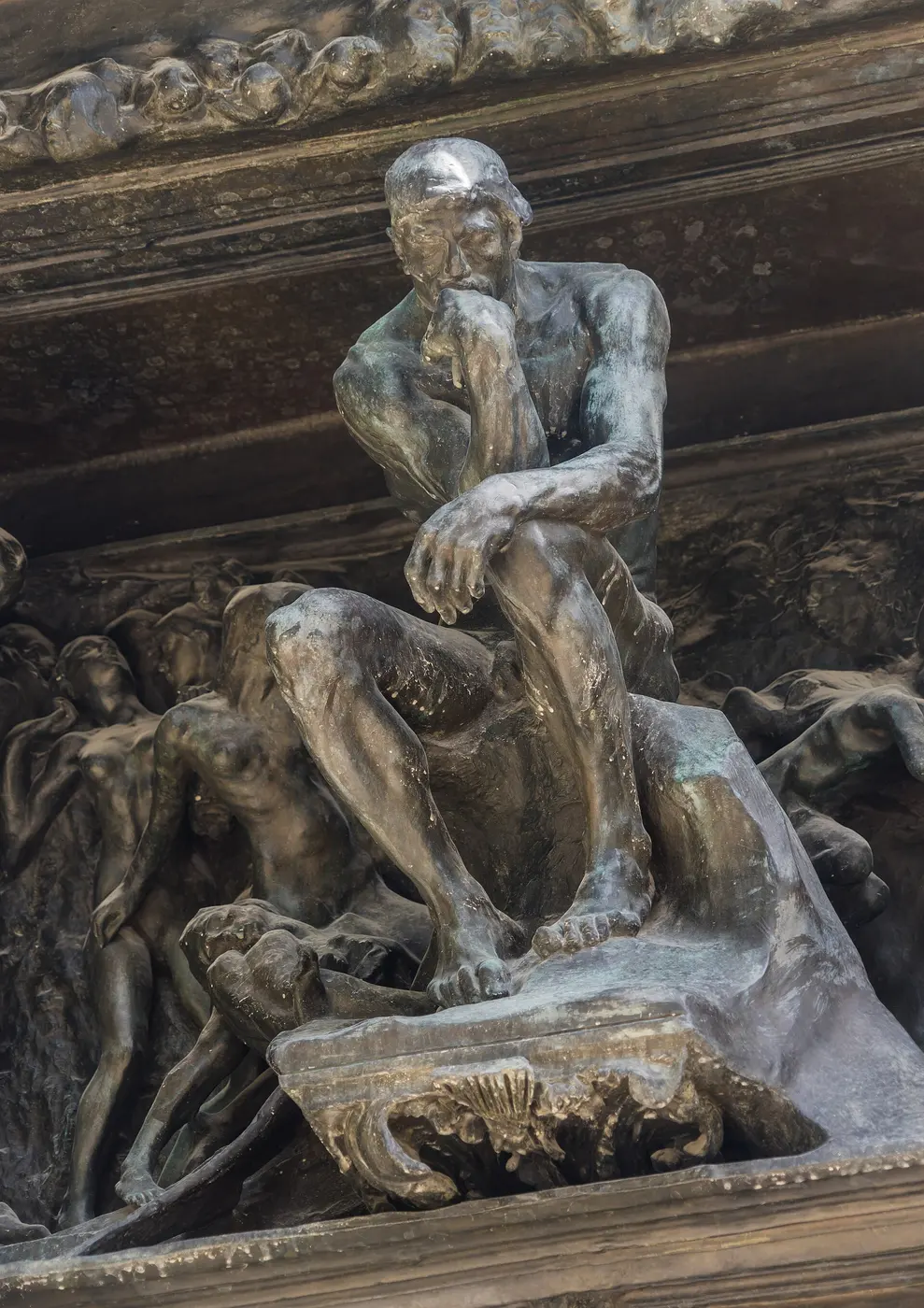

He was Dante
This “Poet” is thought to be Dante himself, the author of the Divine Comedy. Sitting atop the gateway, he gazes down at the scenes of Hell spread out below him, at people who have sinned and are being punished, while he composes his poem. That was the original Thinker: not an idle daydreamer, but a writer brooding over the fate of humanity.
Rodin did not, however, make the figure as a portrait of the historical Dante. Dante is usually pictured as a lean man in long robes. Rodin’s figure is a naked, powerfully muscled man who looks nothing like the familiar image of the poet. Rodin later explained, in effect, that he had first had Dante in mind, but went on to imagine a naked man seated on a rock, lost in thought, in whose mind ideas slowly take shape: no longer a dreamer, but a creator.
In other words, the figure was both a particular person and something larger: the human being who thinks and strives to create.
Named by the foundry workers?
The name The Thinker is said not to have come from Rodin himself. According to the usual account, the workers at the foundry that cast the figure thought it resembled Michelangelo’s statue of Lorenzo de’ Medici in Florence, and started calling it after that statue’s nickname. The name stuck, and it is the one the whole world now knows.
Rodin later detached the figure from the gateway, and from around 1902 he enlarged it to more than 180 centimeters (about 6 feet) tall. When it was shown at the Paris Salon in 1904, it caused a sensation, and a cast paid for by public donations was installed in front of the Panthéon in Paris. That statue was moved to the Musée Rodin in 1922, and it still greets crowds of visitors in the museum’s garden today.
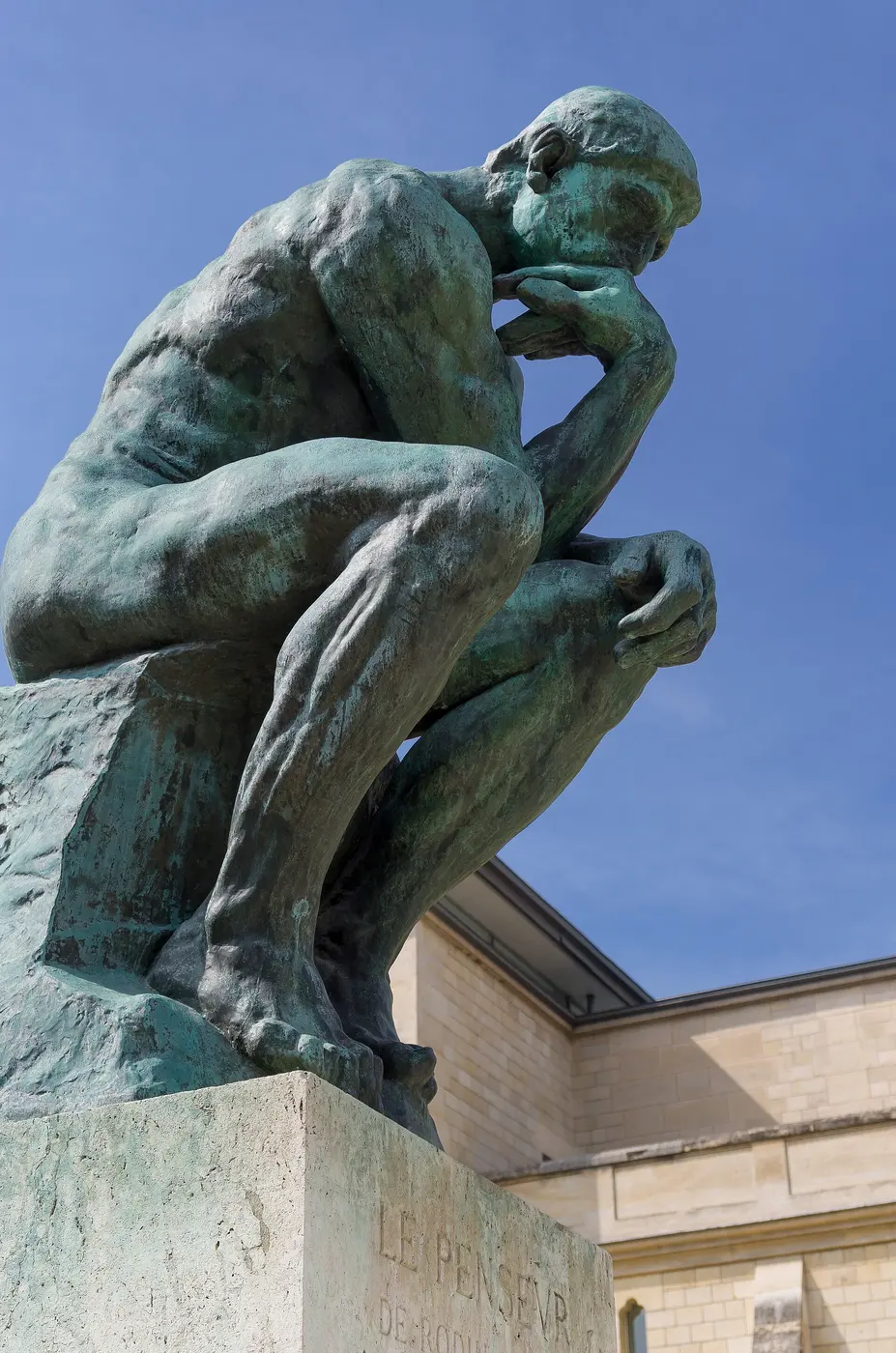

A pose that’s harder than it looks
Try copying the pose yourself and you will find it is more awkward than you expected. The statue’s right elbow rests not on his right knee but on his left thigh. You can only hold that position by twisting your upper body sharply and tensing muscles all over.
He isn’t relaxing while he mulls something over. His whole body is taut as he strains to bring something into being. Look at him that way, and a surprising heat seems to radiate from the quiet statue. Here, thinking looks like hard physical work.
The Gates of Hell, meanwhile, was never cast in bronze during Rodin’s lifetime, partly because the museum that had commissioned it was never built. Rodin is said to have kept working on it for more than 30 years, until his death in 1917. In the front garden of the National Museum of Western Art in Ueno, Tokyo, you can see both The Gates of Hell and an enlarged Thinker.