Did Picasso really have an extremely long name?
Yes. His baptismal name strings together many saints and relatives. “Picasso” was his mother’s surname.
Pablo Picasso. Or simply “Picasso.” The name of the most famous painter of the 20th century is short, crisp and impossible to forget. The “Picasso” signature in the corner of a canvas has the power, all by itself, to multiply a painting’s value.
Yet the name he was given at birth was nothing like it, and far, far longer. What’s more, “Picasso” wasn’t even his father’s surname.
A long name in the church records
Picasso was born on October 25, 1881, in Málaga, a port city in southern Spain. His father, José Ruiz y Blasco, was an art teacher; his mother was María Picasso y López. On November 10 of the same year, little Pablo was baptized in the nearby church of Santiago.
In the form given in sources such as the catalogue raisonné of his works, the name he received that day was:
Pablo Diego José Francisco de Paula Juan Nepomuceno María de los Remedios Cipriano de la Santísima Trinidad
Then come his father’s and mother’s surnames: “Ruiz y Picasso.” Written out in full in Japanese katakana, dots between the names included, it runs to more than 80 characters.
The name differs slightly from source to source, however. The birth registration and the baptismal record spell it differently, and in some sources “Cipriano” appears instead as “Crispiniano” or “Crispín Crispiniano.” Which version is his “true” full name isn’t actually clear.

The people inside the name
The long name wasn’t strung together at random. In Catholic families in Spain at the time, it was common to give a child a stack of names honoring saints, relatives and godparents.
“Diego,” for example, is said to honor his paternal grandfather, and “Francisco de Paula” his maternal grandfather. “Juan Nepomuceno” and “María de los Remedios” are the names of his godfather and godmother, who stood with him at the baptism. The final “de la Santísima Trinidad” means “of the Most Holy Trinity.”
There is a reason, too, for the appearance of “Crispín” and “Crispiniano.” Picasso’s birthday, October 25, is the feast day in the Catholic calendar of Saints Crispin and Crispinian, a pair of brothers. Including the name of the saint of one’s birthday was a common custom.
Choosing “Picasso” over “Ruiz”
In Spain, people customarily carry both their father’s and their mother’s surnames. In Picasso’s case, his father’s surname was “Ruiz” and his mother’s was “Picasso.” By rights, it would have been natural for him to be known as Pablo Ruiz.
And in fact, as a young man, he signed himself “Pablo Ruiz Picasso.” He signed his paintings that way from around 1898, then shortened his father’s name to an initial, “Pablo R. Picasso,” and from around 1901 began to sign simply “Picasso.” The year 1901 was when he held an exhibition at the Paris gallery of the dealer Ambroise Vollard and began painting the works later known as his “Blue Period.” Just as he was stepping out into the world as a painter, his name, too, was reborn in a shorter form.
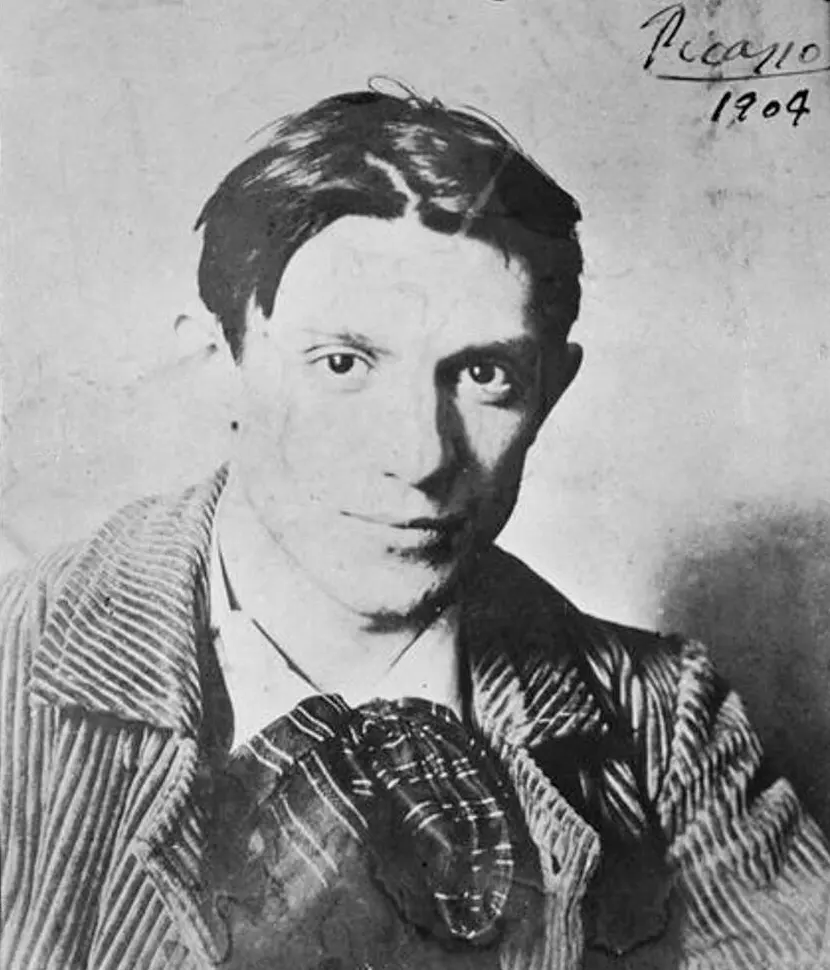

One trigger, it is said, was that the Catalan friends he made in Barcelona always called him by his mother’s surname. “Ruiz” is an extremely common surname in Spain, while “Picasso” was far rarer. It wasn’t a falling-out with his father; rather, he is thought to have wanted to stand out as someone unlike anyone else.
And so the boy Pablo Ruiz, with his long baptismal name, became known to the world as a painter called simply “Picasso.”