Can a Venus flytrap count?
In a sense, yes. It shuts its trap after two touches and ramps up digestion after five or more.
2touches
When an insect wanders between its leaves, which lie open like the shell of a clam, they snap shut in an instant and trap it inside. The Venus flytrap, a carnivorous plant native to North America, is famous for moving with a speed you would never expect from a plant. Charles Darwin, of evolutionary theory fame, was one of many who fell under its spell. In his 1875 book Insectivorous Plants, he wrote:
This plant, commonly called Venus’ fly-trap, from the rapidity and force of its movements, is one of the most wonderful in the world.
Nearly 150 years later, researchers are uncovering an even more astonishing ability. The plant, it seems, “counts” how many times it has been touched by its prey.
A trap that won’t shut after one touch
Inside each Venus flytrap trap, there are usually about three fine hairs on each of the two lobes. These are trigger hairs, which sense the movements of prey.
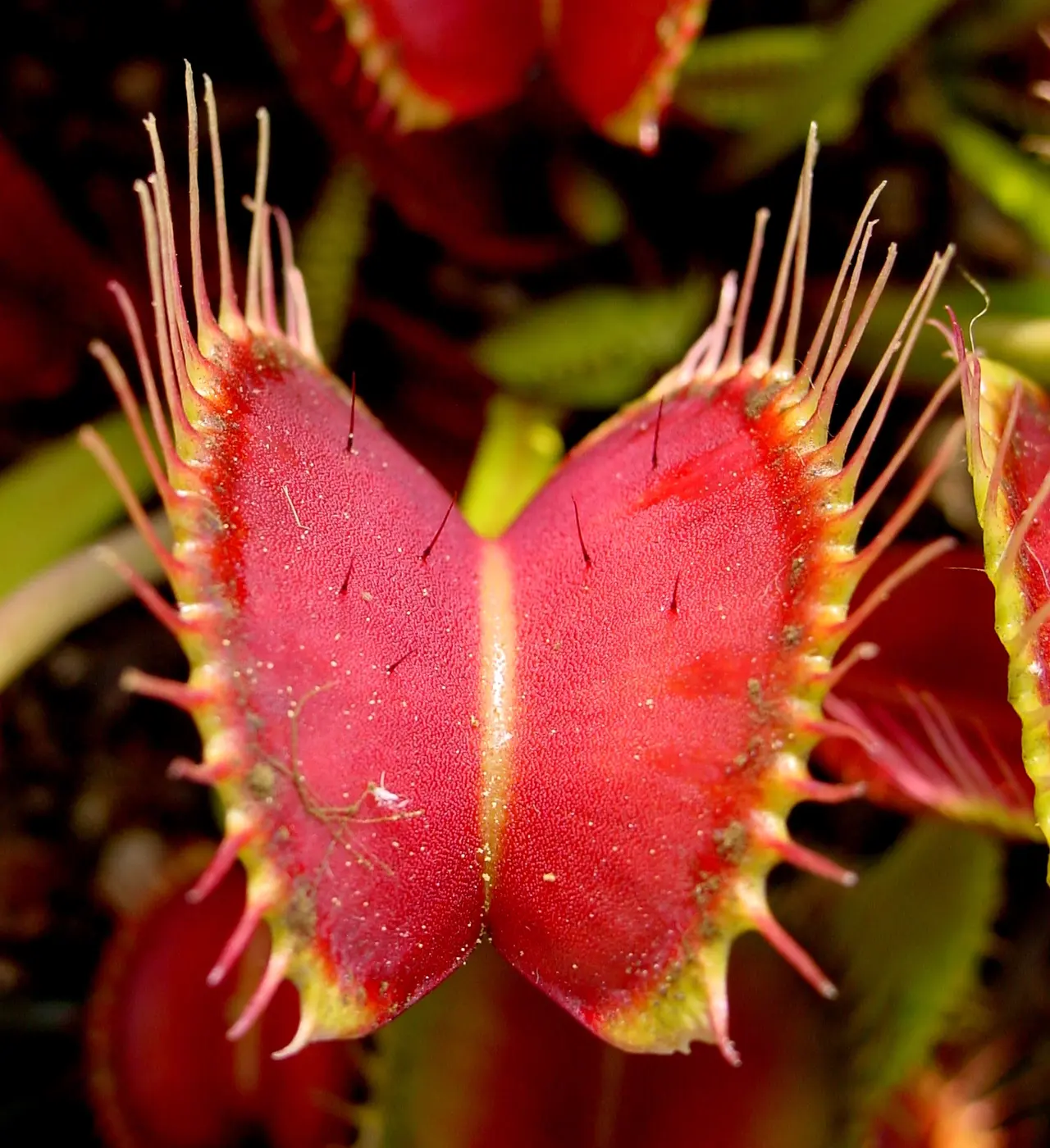

Curiously, touching one of these hairs a single time usually does not make the trap close. Only when it is touched again within about 30 seconds does it snap shut. It doesn’t matter whether the same hair is touched twice or two different hairs are touched once each.
This is thought to be a way of avoiding wasted effort. Closing a trap and opening it again takes a lot of energy, and each trap is said to be able to open and close only a limited number of times. Snapping shut every time a raindrop or a bit of debris happened to brush against it would not pay off. Two touches in quick succession, on the other hand, suggest that something alive and moving is probably inside.
How the plant “remembers” the first touch
So how does a plant remember the first touch?
When a trigger hair bends, an electrical signal similar to those in animal nerves spreads through the leaf. In 2020, a research team including scientists at Saitama University in Japan created Venus flytraps carrying a protein that glows when it binds to calcium, making what happens inside the leaf visible. They found that the first touch raised the calcium concentration in the leaf’s cells, the second touch added to it, and the trap closed when the level crossed a certain threshold. Because the calcium concentration falls over time, the “memory” fades if too much time passes between touches. This is thought to be what lies behind the time limit of about 30 seconds.
There are exceptions to the rule, however. In 2020, a Swiss research team reported that when a trigger hair is bent slowly, even a single touch can generate two electrical signals’ worth and cause the trap to close. The researchers suspect this may help the plant avoid missing slow-moving prey such as larvae or snails.
Past five, the digestion switch flips on
The counting doesn’t stop once the trap closes. In 2016, a research team including scientists at the University of Würzburg in Germany reported that even after closing, the flytrap’s response changes step by step depending on how many times it is stimulated.
As a trapped insect struggles, it touches the trigger hairs again and again. As the touches add up, the activity of plant hormones involved in digestion increases, and the trap seals itself more and more tightly. Then, once the trap has been stimulated more than five times, genes for making digestive enzymes, and for proteins that absorb sodium and other nutrients from the prey’s body, become active.
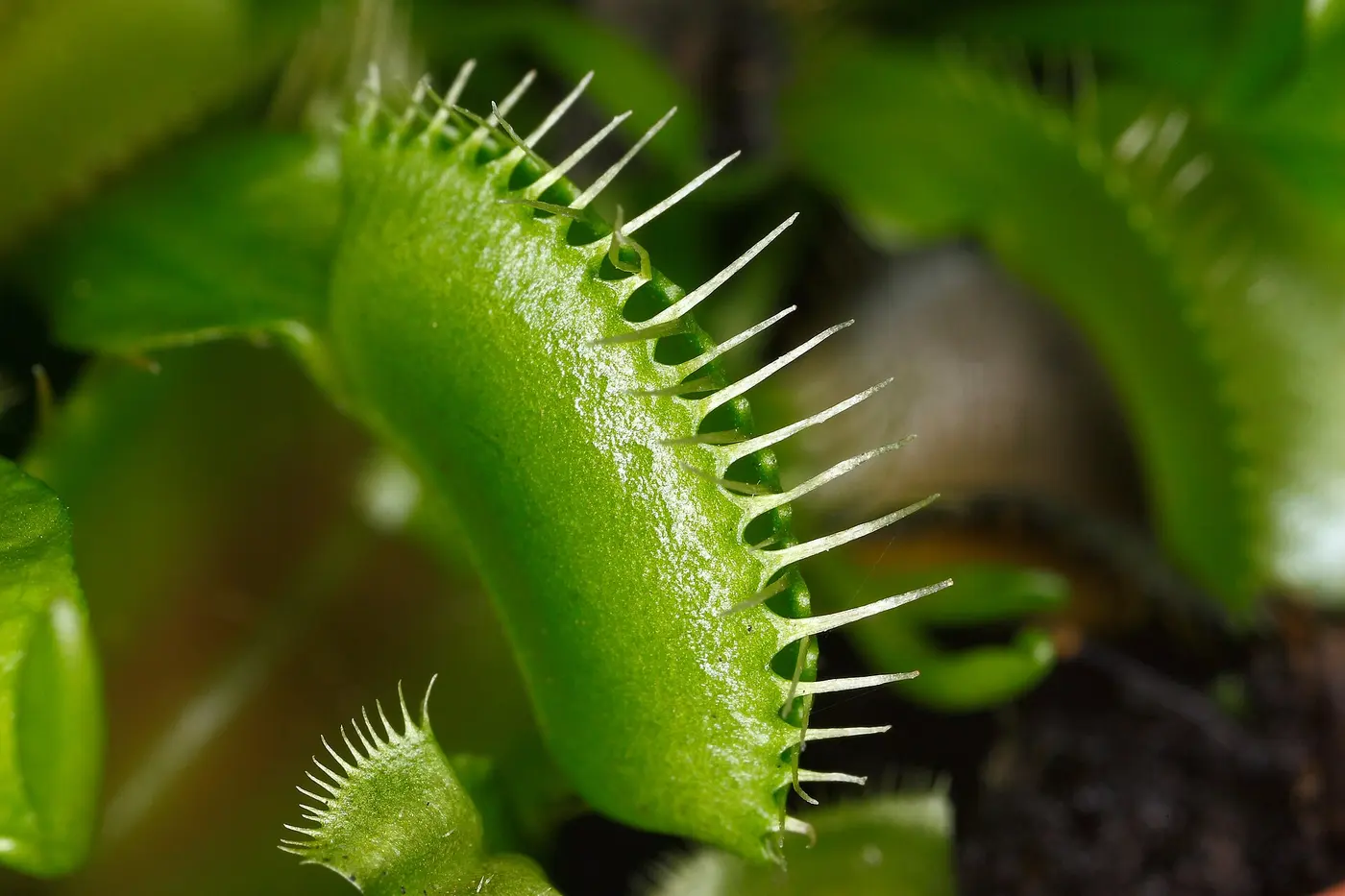

If the trap has caught a motionless bit of debris, or a small creature that quickly runs out of strength, the touches stop there. The plant uses the number of struggles to judge whether its prey is worth an expensive investment in digestive juices.
Of course, a Venus flytrap is not counting “one, two, three” the way we do. Each touch builds up the state inside its cells, and when that buildup crosses a set threshold, the next response kicks in. That is the sense in which it “counts.” Even so, the fact that a plant with no brain and no nerves can process information so skillfully may be even more remarkable than the speed that so amazed Darwin.