Is the ginkgo really a “living fossil”?
Yes. Its lineage goes back more than 200 million years, and of all its relatives only this one species survives.
1896
In autumn, ginkgo trees turn avenues golden and drop their seeds, known in Japan as ginnan, a roasted snack. Planted at schools, at shrines and along streets, the ginkgo is one of the most familiar trees in Japan.
Yet in the world of botany, the ginkgo is a genuine rarity. It is a “living fossil,” the lone survivor of a group whose other members have all vanished. And its body hides a surprising mechanism that ordinary trees lack.
The last of its line
The ginkgo group has a long history. Its origins are thought to reach back more than 200 million years, to a time before the dinosaurs appeared. During the Mesozoic, when dinosaurs flourished, many kinds of ginkgo relatives spread across the world. Fossil leaves closely resembling those of today’s ginkgo have been found in rocks about 170 million years old.
After that, however, the ginkgo’s relatives died out one after another. The only one still alive is the ginkgo we know. In plant classification, this single species makes up an entire major group of its own, the division Ginkgophyta. It is a plant with not a single relative left in the world.
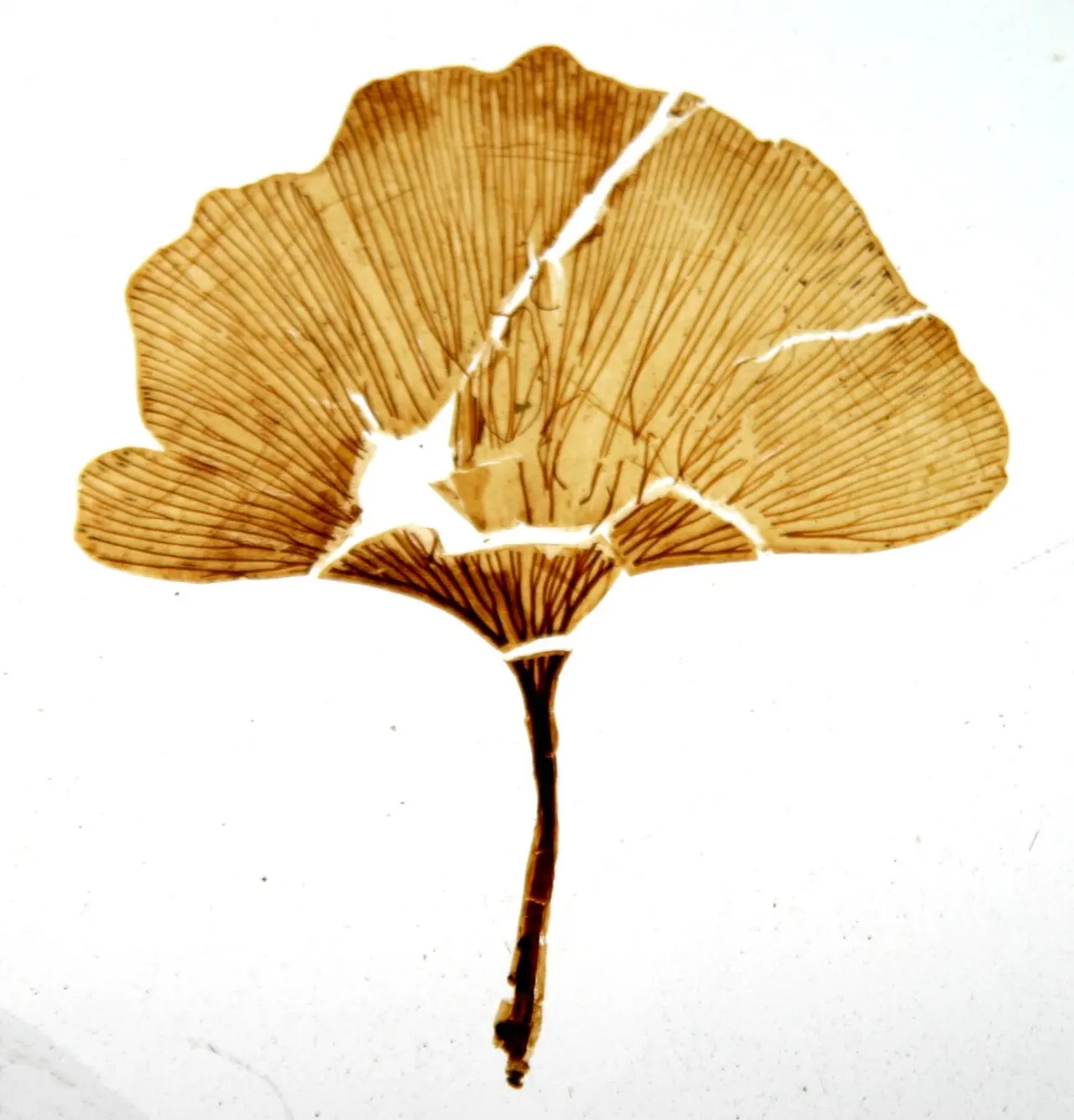

Living things that preserve the features of ancient life and have few or no close relatives are called “living fossils.” The term is said to have been first used by Charles Darwin, of evolution fame. The ginkgo is almost always named as a prime example. Wild ginkgos were once thought to be extinct, but some populations in the mountains of southwestern China may be wild survivors.
Swimming sperm, found by an illustrator
Another thing that makes the ginkgo special is its sperm. In the flowering plants we usually see, pollen grows a tube that delivers its cells to the egg. In the ginkgo, though, sperm emerge from the pollen and swim to the egg on their own. That is a trait of older types of plants such as ferns and mosses, and a sign of how ancient the ginkgo is.
The first person in the world to see these sperm was Japanese: Hirase Sakugorō, from Fukui. Hirase had not been hired as a scientist. He worked at the Imperial University (today’s University of Tokyo) as an illustrator who drew plants for the College of Science. Later promoted to technician, he patiently collected the parts of ginkgo trees that develop into seeds from a tree at the Koishikawa Botanical Garden in Tokyo and studied them one after another.
In September 1896, he finally saw sperm burst from the tip of a pollen tube and swim about vigorously. The discovery that a seed plant has sperm astonished botanists around the world. That same year, Ikeno Seiichirō, a botanist at the Imperial University, discovered sperm in cycads as well. In 1912, the two men jointly received the Imperial Prize of the Imperial Academy. The ginkgo tree Hirase studied still stands in the Koishikawa Botanical Garden.
The ginkgos that survived the atomic bomb
The ginkgo’s toughness shows in Hiroshima’s hibaku jumoku, or “A-bombed trees.” On August 6, 1945, an atomic bomb was dropped on Hiroshima. Even within 1 to 2 kilometers of the hypocenter, in an area reduced to scorched ruins, a number of ginkgo trees survived.
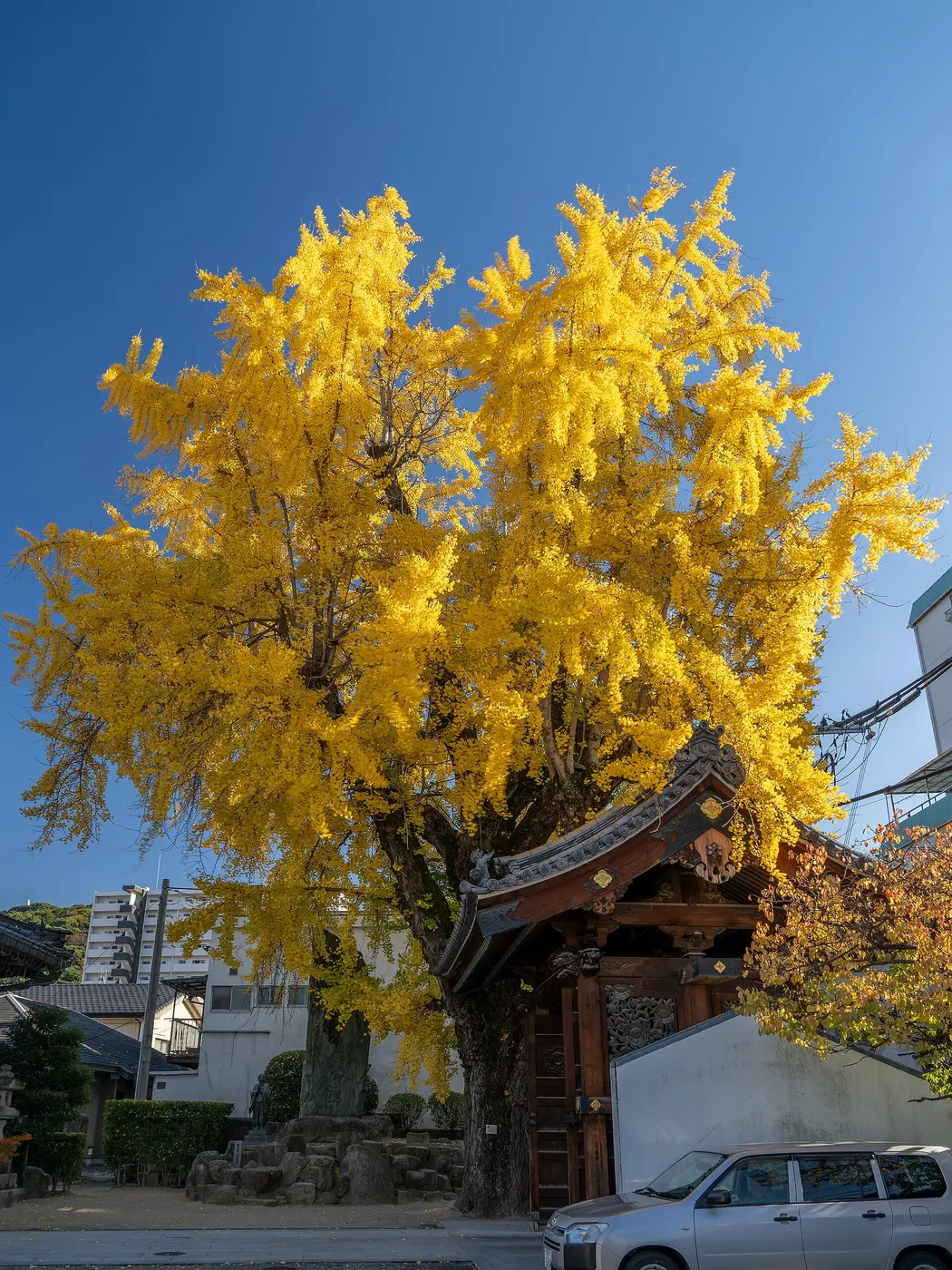

The ginkgo at Anraku-ji, a temple in Hiroshima’s Higashi Ward, was hit by the bomb about 2.2 kilometers from the hypocenter. According to someone who saw it at the time, the tree was smoldering and giving off white smoke; not a single leaf remained, and charred black branches had broken off and fallen. Yet the following year it sent out new shoots and came back to life. Later, when the temple built a new gate, it chose not to cut the tree down, designing the gate with a large hole in its roof so the trunk could pass straight through.
Hiroshima City has registered 159 trees that were exposed to the bombing within roughly 2 kilometers of the hypocenter and are still alive (as of April 2025). The ginkgo is among the best known of them.