How much can bamboo grow in a day?
One Japanese timber bamboo grew 121 centimeters in 24 hours—about 5 centimeters an hour.
121cm
In spring, bamboo shoots poke up out of the ground in bamboo groves. In Japan, where the young shoots, called takenoko, are a seasonal delicacy, people say that if you miss the moment to dig them up, they turn tough and inedible in no time. No wonder: takenoko shoot upward at a speed you can practically see.
Just how fast? Japan holds some truly astonishing records for plant growth.
121 centimeters in 24 hours
According to Japan’s Forestry Agency, the record for growth in a single day (24 hours) is 121 centimeters for madake, or Japanese timber bamboo, and 119 centimeters for moso bamboo. The madake record is said to have been published in 1963 by Dr. Kōichirō Ueda of Kyoto University, a renowned bamboo researcher.
That is about 4 feet, roughly the height of a six- or seven-year-old child. It works out to about 5 centimeters (2 inches) an hour, or roughly 0.8 millimeters a minute. If you stared long enough, you might actually see it grow.
Guinness World Records lists bamboo as the fastest-growing plant, noting that certain species can grow 91 centimeters in 24 hours. Japan’s madake record goes even further.
Growing at every joint
The secret to bamboo’s speed lies in how it grows.
An ordinary tree adds cells at growing points at the tips of its trunk and branches and extends upward bit by bit. Bamboo, by contrast, has a growing zone at each of its joints, or nodes. Just above every node is a band of growing tissue, and that is where the section between nodes lengthens.
What’s more, when a shoot first emerges, all the nodes of the future stalk are already in place inside it. Cut a shoot lengthwise and you will see short segments stacked tightly together. Starting from the bottom, many sections between the nodes stretch out at the same time, so the shoot grows far faster than if only its tip were growing. Picture a collapsed telescope being pulled out, section by section.


A lifetime of height in three months
This furious growth doesn’t last long. It is said to take about 100 days, roughly three months, for a shoot to become a full-grown stalk.
And once it has finished growing, a bamboo stalk never gets any taller or any thicker. A tree adds growth rings and slowly widens year after year, but a bamboo’s thickness is essentially set when the shoot first breaks the surface. Thick shoots become thick stalks, and thin shoots become thin ones. Having gained a lifetime’s height and girth in those first few months, a stalk of one of the larger species is said to live about 20 years.
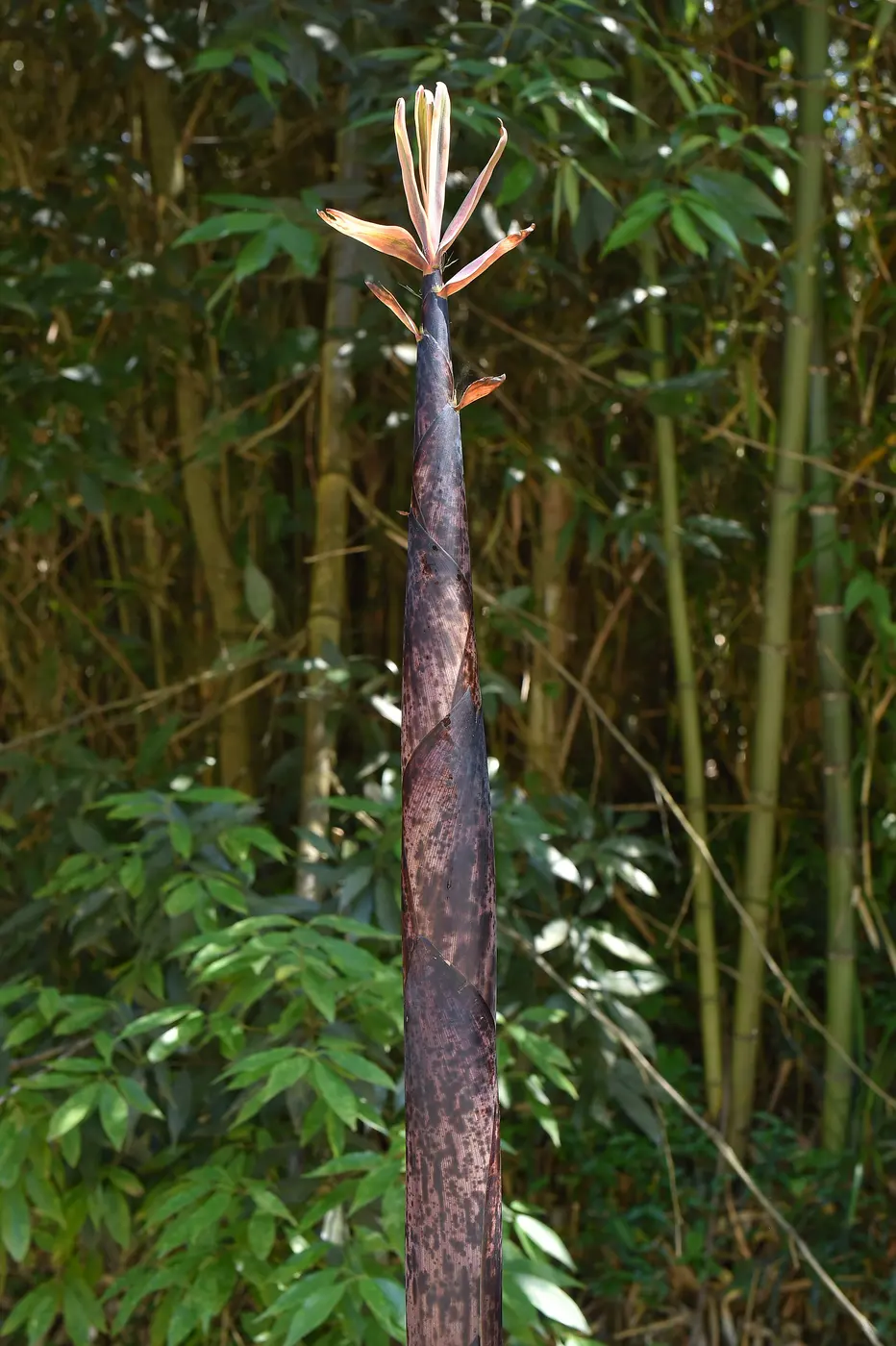

Building so much body so quickly takes a huge supply of nutrients. That supply comes from the network of underground stems, or rhizomes. The shoots are thought to grow by drawing nutrients from the mature stalks around them, all linked through the rhizomes. The rhizomes themselves have been recorded growing 5 meters in a single year. Behind the visible speed of bamboo lies the power of an underground network.
Speed written into a character
In Japanese, takenoko is written with the kanji 筍. Under the bamboo radical at the top sits 旬, a character that originally meant a period of ten days. One well-known explanation is that the character was chosen because a shoot turns into bamboo in about ten days.
There are several theories about how the character came to be, but people long ago were clearly amazed by how fast bamboo shoots grow. And since 旬 also means “in season,” it suits a food that tastes best freshly dug.