Was hook-and-loop fastening inspired by a plant?
Yes. A Swiss engineer got the idea from burdock burrs stuck to his clothes and his dog, after studying them under a microscope.
Children’s shoes, wallets, backpack straps, the cuff of a blood pressure monitor at the doctor’s. Fasteners that stick when you press them together and tear apart with a rasping sound when you pull are all around us.
Many people call it Velcro, but that is a brand name; the generic term is hook-and-loop fastener. In Japan, people tend to say “Magic Tape,” which is also a trademark, held by the Japanese company Kuraray. Either way, this handy fastener began with some small seeds an engineer brought home from the countryside.
Burrs in a dog’s coat
The inventor was the Swiss engineer George de Mestral. Born in 1907 in a village near Lausanne, he studied at the engineering school in Lausanne that is now the Swiss Federal Institute of Technology.
According to Velcro, the company that grew out of his invention, in 1941 de Mestral took his dog hunting in the Alps (some sources give the year as 1948). When he got home, his trousers and his dog’s fur were covered in prickly burrs, the kind of seed heads that hitch a ride on anything that brushes past.
They were burrs of burdock. In Japan, burdock is a familiar vegetable eaten for its long root, called gobo, but once its flowers fade, the plant produces round seed heads covered in fine spines.


Why did they cling so stubbornly? Curious, de Mestral looked at them under a microscope and found that the end of every spine was bent into a tiny hook, which snagged on the loops of thread in fabric and on animal hair. Put hooks and loops together, he realized, and you might have a fastener that could be stuck and unstuck again and again.
About ten years in the making
Turning the idea into a product was not easy. De Mestral looked for help in Lyon, the French city famous for weaving, and the first prototypes were made of cotton. But cotton hooks soon wore out.
So he turned to nylon, then still a fairly new synthetic fiber. He found that if small loops woven from nylon thread were set with heat and then cut on one side, they made tough little hooks. Getting machines to weave the material in quantity took many more years, and the whole process is said to have taken about a decade.
De Mestral filed for a Swiss patent in 1951, and by the mid-1950s he held patents in Switzerland and the United States. He named his invention Velcro, combining the French words velours (velvet) and crochet (hook).
Countless hooks and loops
A hook-and-loop fastener is made of two strips of fabric. One is lined with rows of tiny nylon hooks; the other is thick with fine loops of thread. Press them together and countless hooks catch in the loops. Pull hard, and the hooks flex and slip out of the loops one after another, which is what makes the tearing sound.
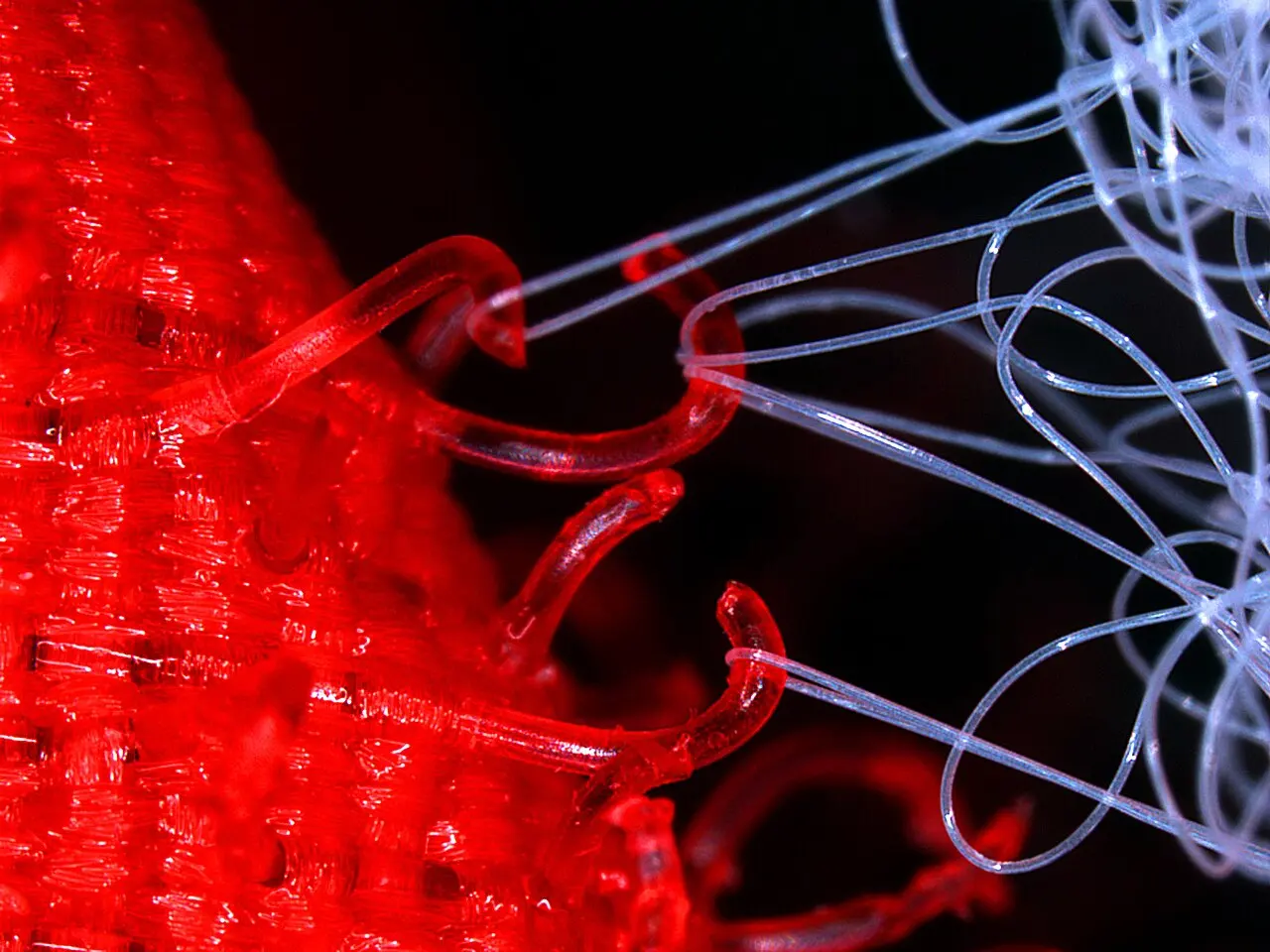

Designing tools by copying the shapes and mechanisms of living things is called biomimicry, and the hook-and-loop fastener is one of its most often cited examples.
The fastener is also sometimes thought to be a NASA invention, but that is a myth. NASA did use it, on Apollo 11 in 1969 among other missions, to hold tools and equipment in place so they would not float away in zero gravity. The inventor, though, was de Mestral.
In Japan, it took off on the bullet train
In Japan, the textile maker Kuraray brought in the technology and began making and selling the fastener under the name Magic Tape in 1960. The name was meant to suggest two pieces of cloth that stick together and come apart as if by magic.
Its big break came in 1964 with the opening of the Tokaido Shinkansen, the first bullet train line, which used it for the headrest covers on its seats. After that, its uses spread widely, to blood pressure cuffs, sneakers, clothing, medical supplies and car parts.