How many Sunflowers paintings did Van Gogh make?
He painted seven sunflowers in a vase, six of which survive, plus four paintings of cut sunflowers in Paris.
7paintings
Yellow background, yellow vase, yellow sunflowers. Vincent van Gogh’s Sunflowers is probably the first work that comes to mind at the mention of his name.
Yet there is a very similar Sunflowers at the National Gallery in London, another at the Van Gogh Museum in Amsterdam, and another at the SOMPO Museum of Art in Tokyo. Sunflowers is not the name of a single painting but of a series Van Gogh painted again and again. So how many are there?
Paris: sunflowers lying down
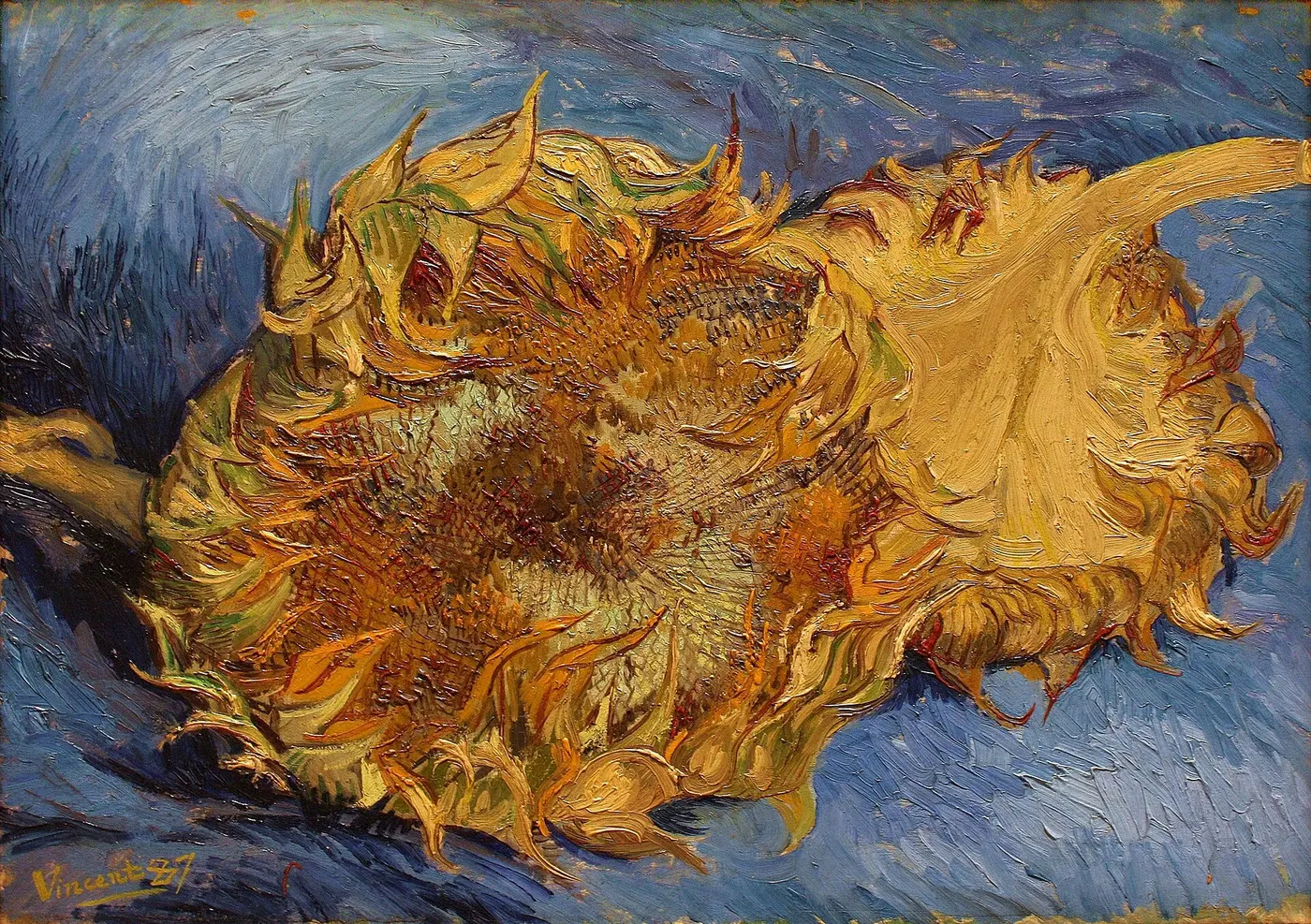
Van Gogh first painted sunflowers intensively in 1887, while living in Paris. These sunflowers are not arranged in a vase. Instead, cut flowers are shown lying as if on a tabletop. The close-ups of wilting petals and seed-packed flower heads feel very different from the bright Sunflowers that came later.
Four main paintings of sunflowers from his Paris period are known. Today they belong to the Metropolitan Museum of Art in New York, the Kunstmuseum Bern in Switzerland, the Kröller-Müller Museum in the Netherlands, and the Van Gogh Museum. Paul Gauguin, the painter with whom Van Gogh would later live, acquired two of them.

Arles: four paintings, then three more
The familiar sunflowers in a vase were born in Arles, in the south of France. In the summer of 1888, Van Gogh was preparing for Gauguin’s arrival. He began the sunflower series to decorate Gauguin’s room in the “Yellow House” where the two would live together. In a letter to his brother Theo, Van Gogh wrote that he was painting with the gusto of a man from Marseille eating bouillabaisse.
These four were painted that August of 1888.
The first shows three sunflowers against a turquoise background; it is now in an American private collection. The second shows five sunflowers against a deep blue background. The third, with twelve sunflowers against a blue-green background, is in the Neue Pinakothek in Munich. And the fourth, with fifteen sunflowers against a yellow background, is the painting in London’s National Gallery.
Then, between December 1888 and January 1889, Van Gogh painted three “repetitions” based on the third and fourth versions. The one based on the twelve-flower painting is in the Philadelphia Museum of Art; the two based on the fifteen-flower painting are in the Van Gogh Museum and the SOMPO Museum of Art.
Van Gogh did not think of the sunflowers only as stand-alone works. In a letter of January 1889, he described a plan to hang sunflower paintings on either side of his portrait La Berceuse (“the lullaby”), a woman rocking a cradle, like “torches or candelabra.” He imagined the sunflowers as part of a decoration for a whole room.
That makes seven paintings in all of sunflowers in a vase. But only six of them can be seen today.
The “phantom Sunflowers” lost in Ashiya
The missing painting is the second one, with five sunflowers against a deep blue background. It was, in fact, in Japan.
Around 1920, the businessman Koyata Yamamoto bought the painting for a museum planned by the writer Saneatsu Mushanokōji and his fellow members of the Shirakaba (“White Birch”) literary circle. The museum never materialized, however, and the painting was kept at Yamamoto’s home in Ashiya, Hyogo Prefecture.
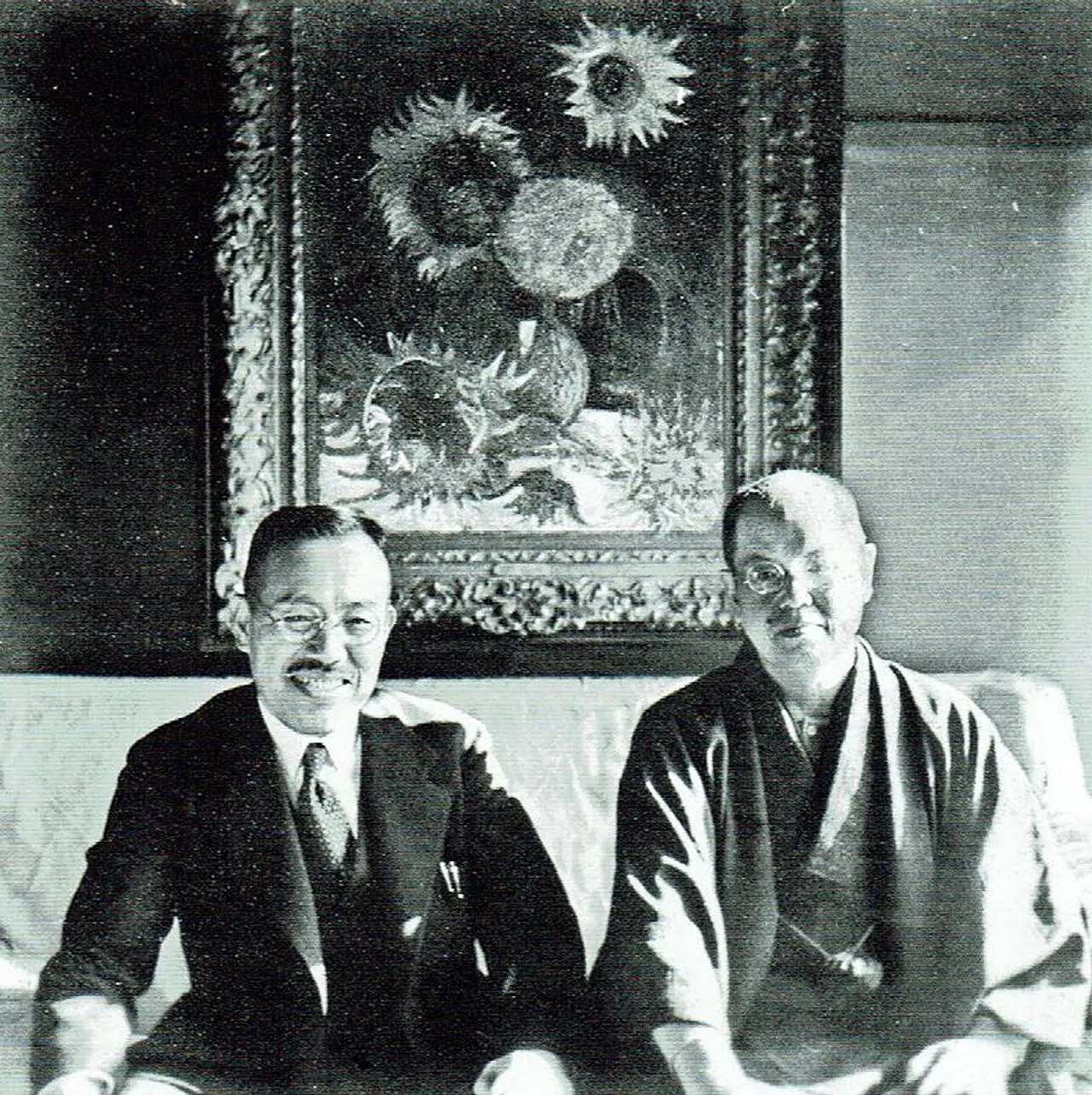

Then, on August 6, 1945, an American air raid burned down Yamamoto’s house, and the painting was lost with it. It was the same day the atomic bomb was dropped on Hiroshima. The work is still known as the “Ashiya Sunflowers,” and its appearance survives through the photographs that remain.