What is the figure in Munch’s “Scream” screaming about?
Not the figure but nature. The figure is said to hear a scream passing through nature and cover its ears.
4versions
A swirling sky of red and orange, a dark blue fjord. On a road lined with a railing, a figure with its hands pressed to its cheeks, eyes and mouth wide open. The Scream by the Norwegian painter Edvard Munch has become an emoji and the subject of endless parodies; even people who have never set foot in a museum know it.
What is that figure screaming so desperately about? Read the words Munch himself left behind, and an answer emerges: the one screaming isn’t the figure at all.
A scream heard on an evening walk
Munch wrote about the experience behind the painting many times. A note dated January 22, 1892, says roughly the following.
One evening I was walking along a path. On one side lay the city, and below, the fjord. I felt tired and ill. I stopped and looked out over the fjord; the sun was setting, and the clouds were turning blood red. I sensed a scream passing through nature. It seemed to me that I heard the scream.
In a later version, he writes that he was walking with two friends, that they walked on ahead, and that he stood there trembling with anxiety. And once again he writes that he sensed “an infinite scream passing through nature.”
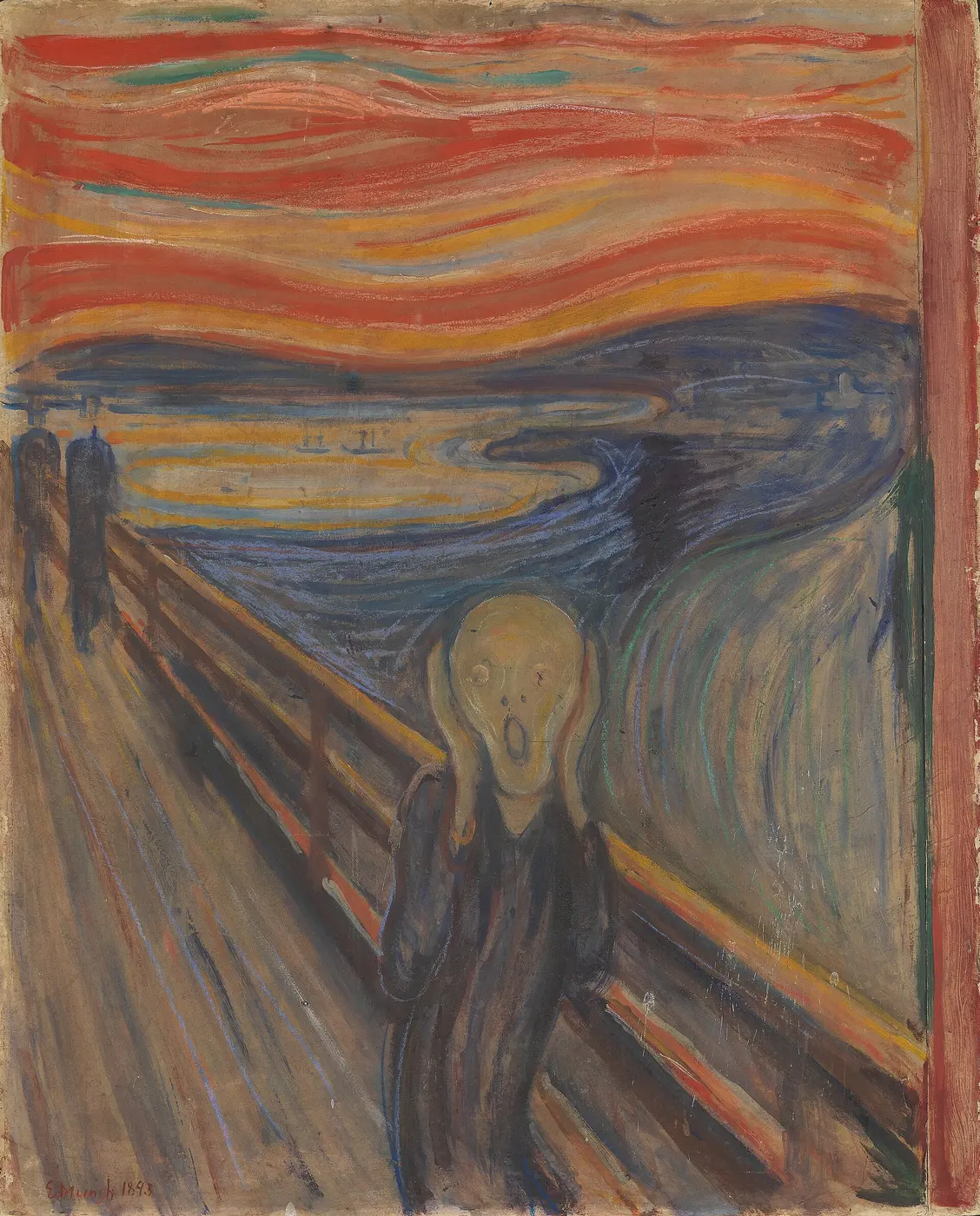

The one screaming is nature
Following this text, the scream comes not from the figure but from the nature all around it. The figure hears a scream that shakes the sky and the sea, and, unable to bear it, covers its ears. That reading is said to be the one most faithful to Munch’s own words.
Indeed, when Munch first exhibited the work, the German title he gave it was Der Schrei der Natur, “The Scream of Nature.” The Norwegian title Skrik (“Scream”) on its own makes it sound as though the figure is screaming, but the original title made the source of the scream perfectly clear.
The scene is thought to be modeled on a road on Ekeberg hill, overlooking Oslo (then called Kristiania) and the Oslofjord. As for that red sky, one theory holds that it reflects Munch’s memory of the strangely red sunsets seen around the world after the great eruption of Krakatoa in 1883; another suggests he painted nacreous clouds, a rare kind of cloud seen in northern Europe.
More than one Scream
The Scream is not, in fact, a single picture. There is the 1893 work in oil, tempera and pastel (National Museum, Oslo); a second version from the same year, 1893 (Munch Museum); a pastel from 1895; and a tempera painting from around 1910. That makes four versions in paint or pastel alone, plus a lithograph made in 1895.
On the 1895 pastel, Munch himself wrote the poem on the frame. That version was auctioned in New York in 2012 and sold for about $120 million, at the time the highest price ever paid for a work of art at public auction.
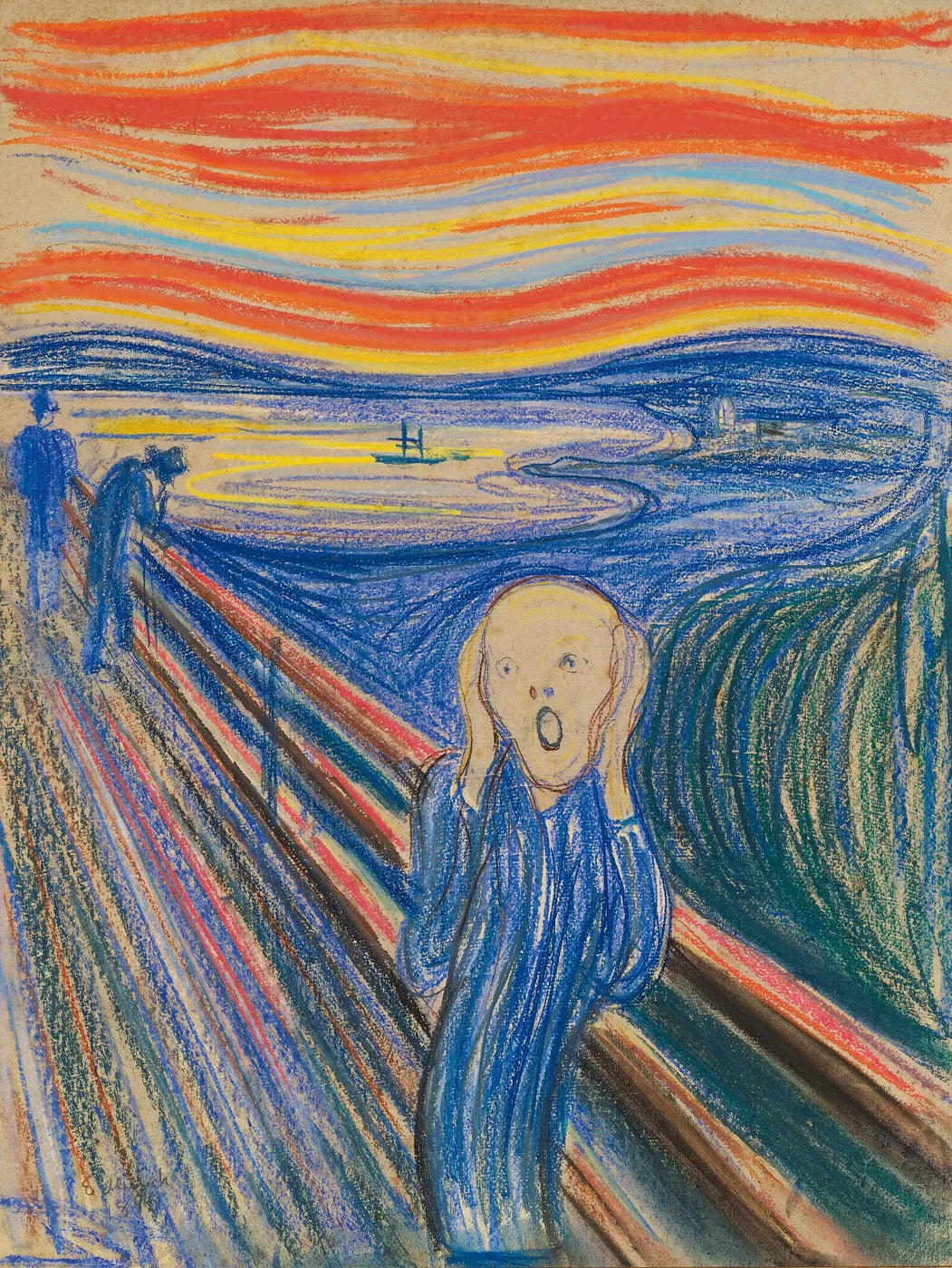

A tiny scribble in the sky
The 1893 version at the National Museum in Oslo holds one more intriguing secret. In the red sky at the upper left, a line of Norwegian is penciled in small letters, meaning “Could only have been painted by a madman!”
For a long time, this inscription was thought to be the prank of some viewer. But in 2021, after the museum examined the handwriting using infrared photography and other methods, it was confirmed to be Munch’s own. When the painting was exhibited in Norway in 1895, critics had questioned the artist’s state of mind, and it is thought that Munch wrote the line himself in response.
A figure frozen in place by the scream of nature, and a painter who wrote “madman” about himself. The Scream may have been a picture of the very anxiety Munch carried within him.