How smart are crows?
Smart enough to make tools and remember human faces for years. Their brains are packed with neurons.
1.2 billionneurons
Japanese has an expression, toriatama (鳥頭), literally “bird head,” used to tease someone with a poor memory: a person who forgets everything after three steps. English has its own version in “birdbrain.” Behind both may lie the same assumption: birds have small brains, so they can’t be doing much thinking.
Over the past few decades, though, one group of birds has seriously shaken that idea. They are the crows and their relatives, the very birds you see picking through the garbage almost every morning.
Bending wire into a hook
In 2002, a research team at the University of Oxford published a paper in the journal Science. Its star was a female New Caledonian crow named Betty.
In the experiment, a small bucket of food with a handle sat at the bottom of a narrow tube. A straight piece of wire could not lift the bucket out. So Betty wedged one end of the wire into a gap to hold it in place, pulled the other end with her beak to bend it, and then used the hook she had made to fish the bucket out. In later trials she bent the wire herself and got the food 9 times out of 10.
These crows, which live on the island of New Caledonia in the South Pacific, are known for making tools in the wild as well. They trim the tips of twigs into hooks and cut strips from barbed leaves to make long, narrow probes, which they use to pull insects out of holes in trees.
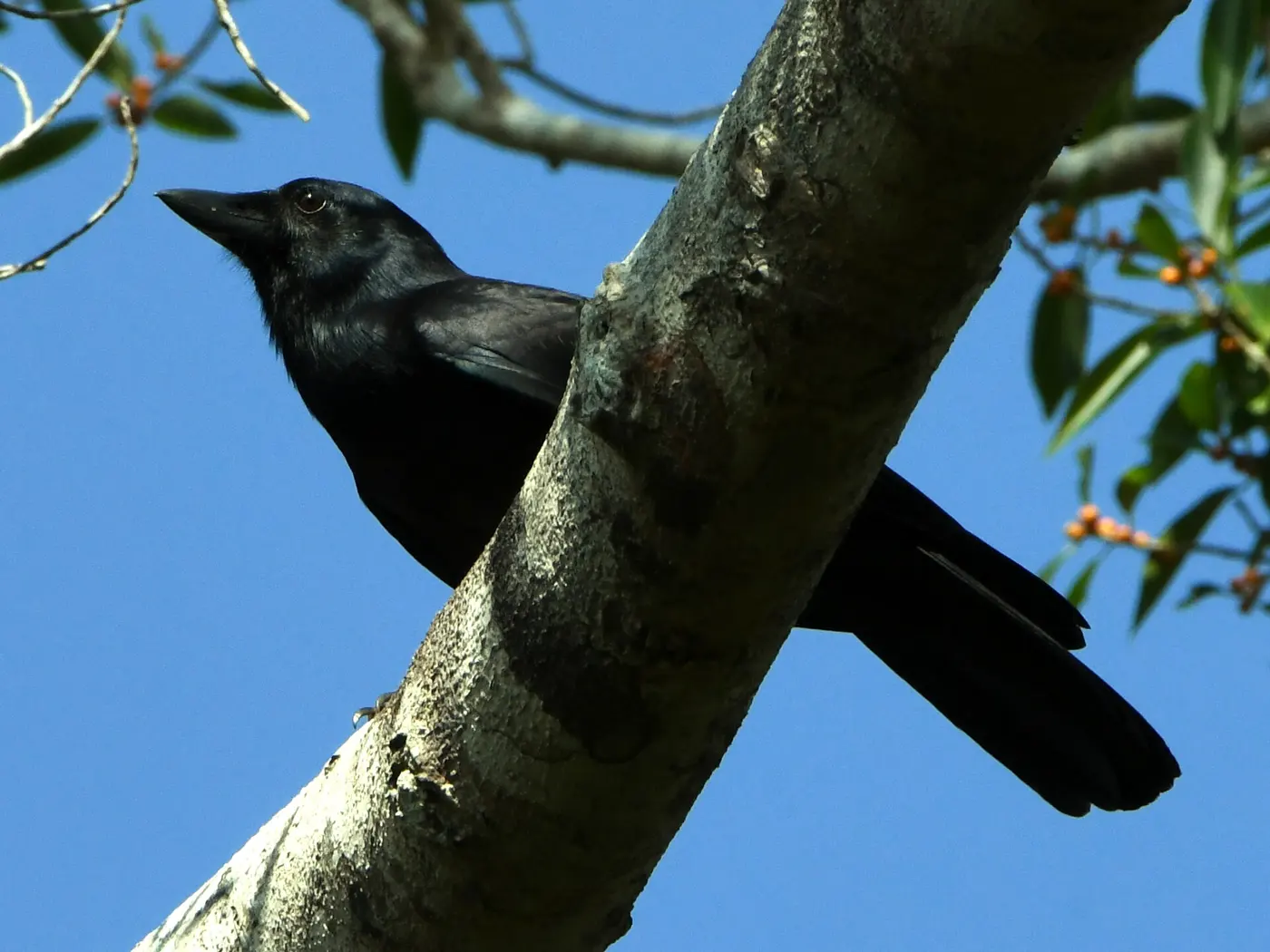

Other experiments have shown off the cleverness of the crow family too. In 2009, researchers reported that rooks would drop stones into a tube of water to raise the water level and eat a worm floating on top. It is exactly what happens in Aesop’s fable “The Crow and the Pitcher.”
They never forget a face that wronged them
Crows are also good at remembering human faces. In 2006, Professor John Marzluff of the University of Washington and his colleagues put on rubber masks shaped like a caveman, caught seven American crows on campus, fitted them with leg bands, and let them go.
From then on, whenever someone wore that mask around campus, the crows would scold and mob them with harsh calls. Here is the remarkable part. Crows that had never been caught, and even young crows born after the experiment, began mobbing the same mask. At the peak, in 2013, 47 of the 53 crows encountered reportedly made a racket at the mask. A different, “neutral” mask, by contrast, drew almost no reaction.
The wariness toward the mask was passed down within the flock and lasted nearly 17 years. It was reported to have finally faded only in 2023.
Using cars as nutcrackers
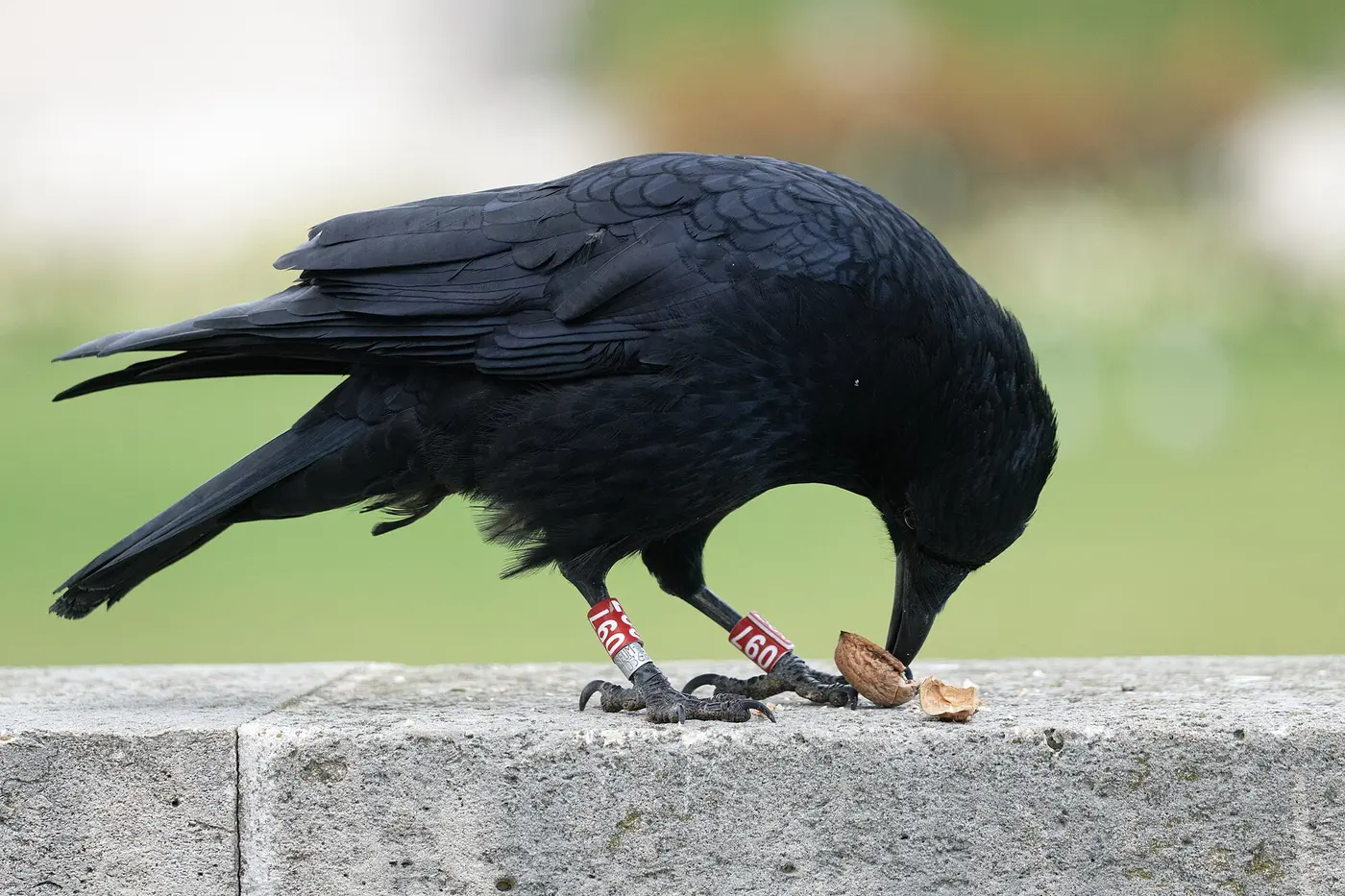
Japan’s crows have a famous story of their own. Starting around 1990, carrion crows were seen getting cars to crack walnuts for them at and around Tohoku University in Sendai, Miyagi Prefecture.
According to observations by psychologist Yoshiaki Nihei and ornithologist Hiroyoshi Higuchi, the crows placed walnuts in front of the tires of cars stopped at traffic lights, then ate the cracked contents after the cars drove off. The birds were also seen repositioning the nuts and waiting for just the right moment, so the behavior is thought to be deliberate rather than accidental. Still, dropping walnuts from the air is the more common way to crack them, and using cars seems to be limited to certain areas and individual birds.

Small brains, densely packed
How can such small brains manage all this?
One clue came from a study published in 2016. When researchers counted the neurons in bird brains, they found that the brains of crows and parrots held about twice as many neurons as primate brains of the same weight. The part of a raven’s brain corresponding to our cerebrum, for example, contains an estimated 1.2 billion neurons. That is more than in the cerebral cortex of the capuchin, a monkey known for its intelligence. Bird brains may be small, but what is inside them is packed far more densely.
More recently, a study reported that carrion crows could handle complex rules, like nested parentheses, with an accuracy approaching that of young children. Whatever “birdbrain” may mean, it clearly doesn’t apply to crows.