What is the giant panda’s “sixth finger”?
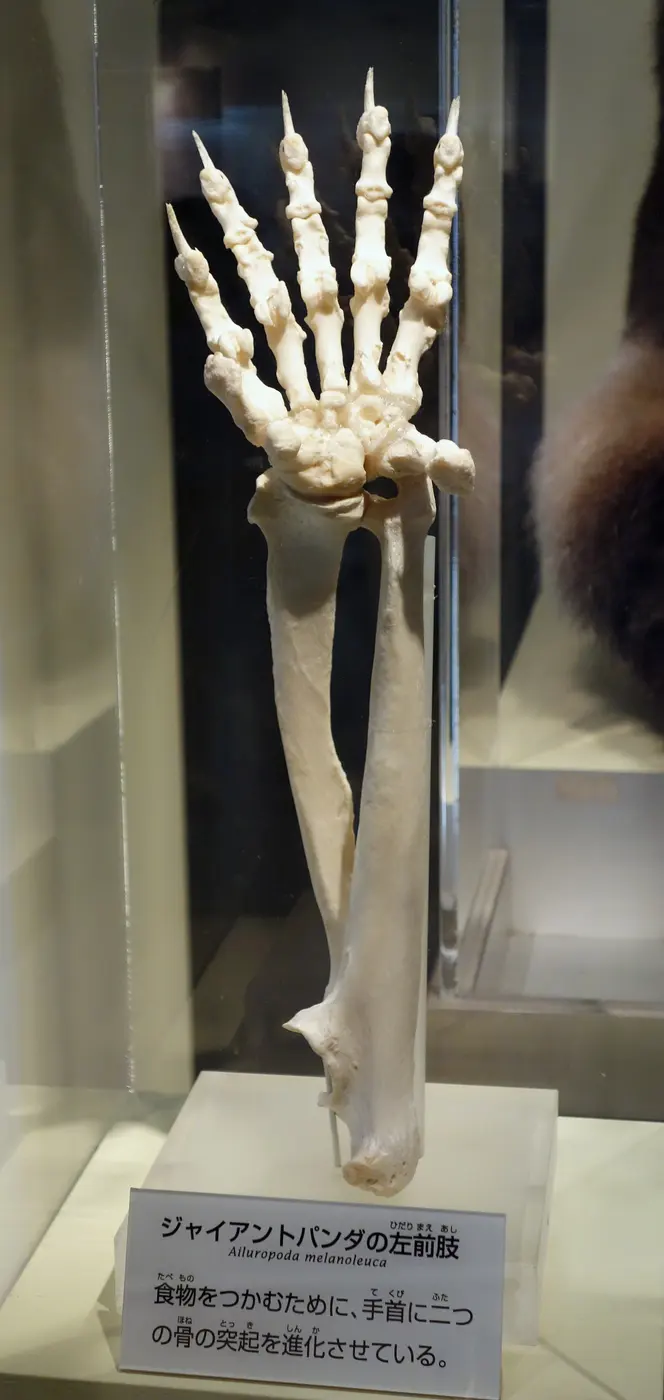
An enlarged wrist bone, the radial sesamoid. It has no joints and no claw, so it isn’t a true finger.
Watch a giant panda eating bamboo at the zoo, and you’ll notice that it holds each stalk firmly in its front paw, much the way a person grips a stick. It strips off leaves and brings thick stems up to its mouth with real dexterity.
Yet the five fingers on a panda’s front paw all point the same way. None of them can swing around to face the others, as our thumb does. So how does a panda grasp anything at all? The secret is a curious bump known as its “sixth finger.”
Not a finger, but a wrist bone
On the thumb side of a panda’s palm there is a plump, finger-like bulge. What lies inside is not a finger bone. It is a wrist bone called the radial sesamoid, grown unusually large.
A sesamoid is a small bone that forms inside a tendon; the human kneecap is one. In most animals the radial sesamoid is small and unremarkable, but in the panda it has grown long and slender. Padded with flesh, it juts from the palm like an extra finger.
Unlike a real finger, though, it has no row of joints and no claw. The panda holds bamboo by pinching it between its five fingers and this bump. That is why it is also known as the “false thumb.”

There was a “seventh,” too
The panda’s hand had one more surprise in store. In 1999, a research team led by the Japanese anatomist Hideki Endo examined panda paws with CT and MRI scans, building three-dimensional images to analyze how the bones move.
They found that besides the radial sesamoid on the thumb side, another wrist bone on the little-finger side, the accessory carpal, also sticks out. Together the two work like a “double pincer,” clamping bamboo from both sides. The study was published in the journal Nature, and the accessory carpal is sometimes called the panda’s “seventh finger.”
A tool made from spare parts
The man who made the panda’s false thumb famous was the American paleontologist Stephen Jay Gould. In his 1980 essay collection The Panda’s Thumb, he held it up as a perfect illustration of how evolution works.
An engineer designing from scratch would surely have given the panda a true, opposable thumb. But pandas descend from meat-eating bears, and their thumbs had already become part of a paw lined up with the other digits for walking. Evolution can’t go back to the drawing board; it can only reshape, little by little, the bones it already has. The false thumb, a stretched-out wrist bone pressed into service, tells the story of that history precisely because it is so makeshift.
A “thumb” six million years old
How long have pandas had this false thumb? In 2022, Xiaoming Wang of the Natural History Museum of Los Angeles County and his colleagues described a false-thumb bone from Ailurarctos, an ancestral panda that lived about 6 to 7 million years ago, from fossils found in Yunnan Province, China. It is the oldest one known.
Surprisingly, the fossil false thumb was longer and straighter than a modern panda’s, which is short with a hooked tip. The researchers think this is because the bone does more than grip bamboo: it also helps bear the animal’s weight when it walks. A longer bone would get in the way of walking, so today’s shape may be a compromise between grasping bamboo and getting around.
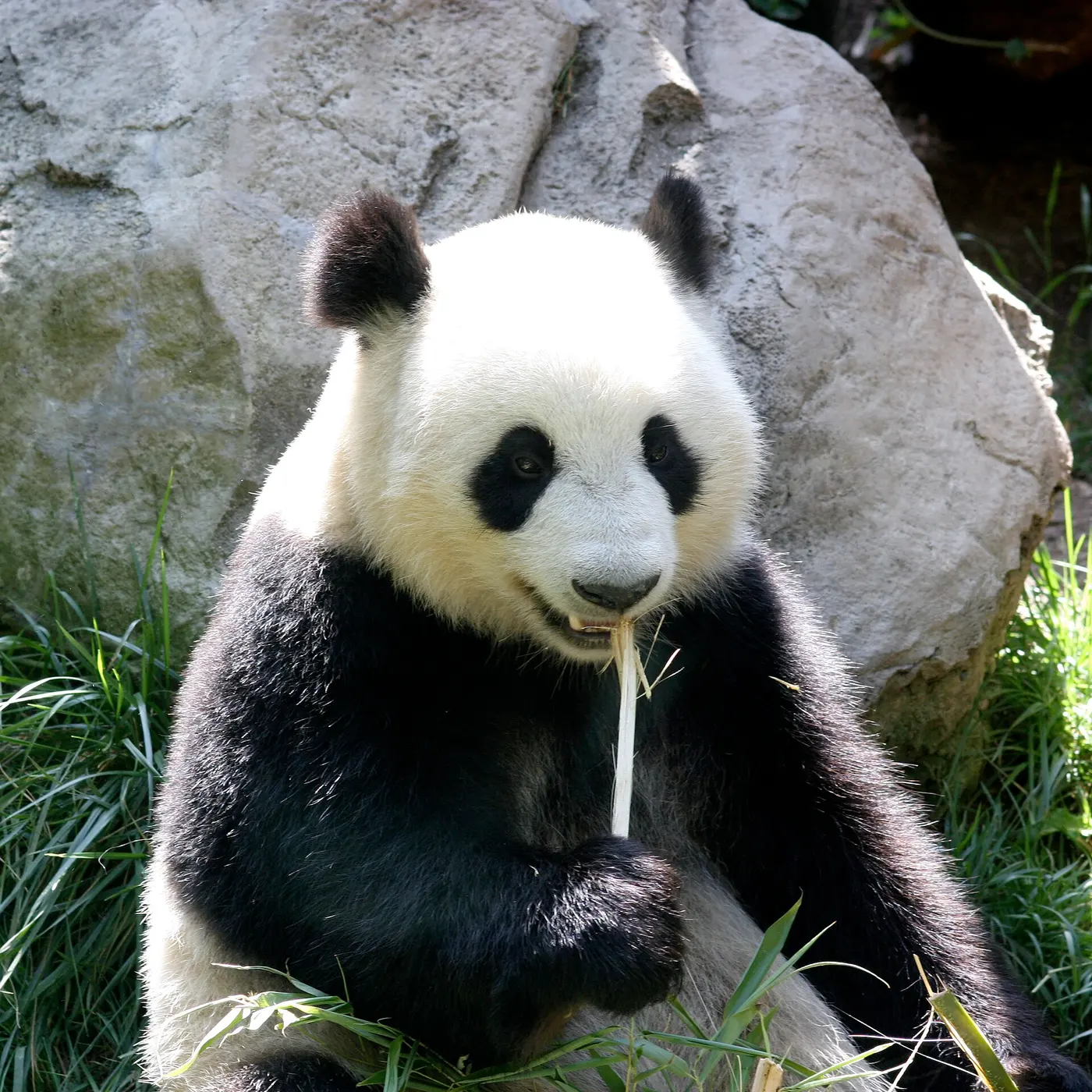

The red panda, another bamboo eater, is known to have a similar bump formed from an enlarged wrist bone. The two species are only distantly related, so each is thought to have arrived at much the same tool by its own route.