Are tomatoes and potatoes related?
Yes. Both are in the genus Solanum, and research suggests the potato arose from a cross with tomato ancestors.
9 millionyears ago
Tomatoes are a salad staple; potatoes turn up as fries and in comforting stews such as Japan’s nikujaga, simmered meat and potatoes. One is a red fruit that hangs from a branch, the other a tuber that grows in the soil, and in the kitchen they are used in completely different ways.
As plants, though, the two are close kin. Both come originally from the Andes region of South America, and botanists place them in the same group. What’s more, recent research has shown that the tomato’s ancestors were deeply involved in the very birth of the potato as a plant.
Same family, same genus
Tomatoes and potatoes both belong to the nightshade family, Solanaceae. The family has about 2,700 species and also includes bell peppers and chili peppers, tobacco and petunias.
Within that family, the tomato and the potato share the genus Solanum with the eggplant. The tomato’s scientific name is Solanum lycopersicum and the potato’s is Solanum tuberosum; both begin with Solanum. The genus alone holds more than 1,200 species, and among them these two are especially closely related.
Their flowers make the kinship plain. Potato flowers are white or pale purple and tomato flowers are yellow, but apart from the color they look remarkably alike: star-shaped petals with yellow anthers clustered into a tube at the center.


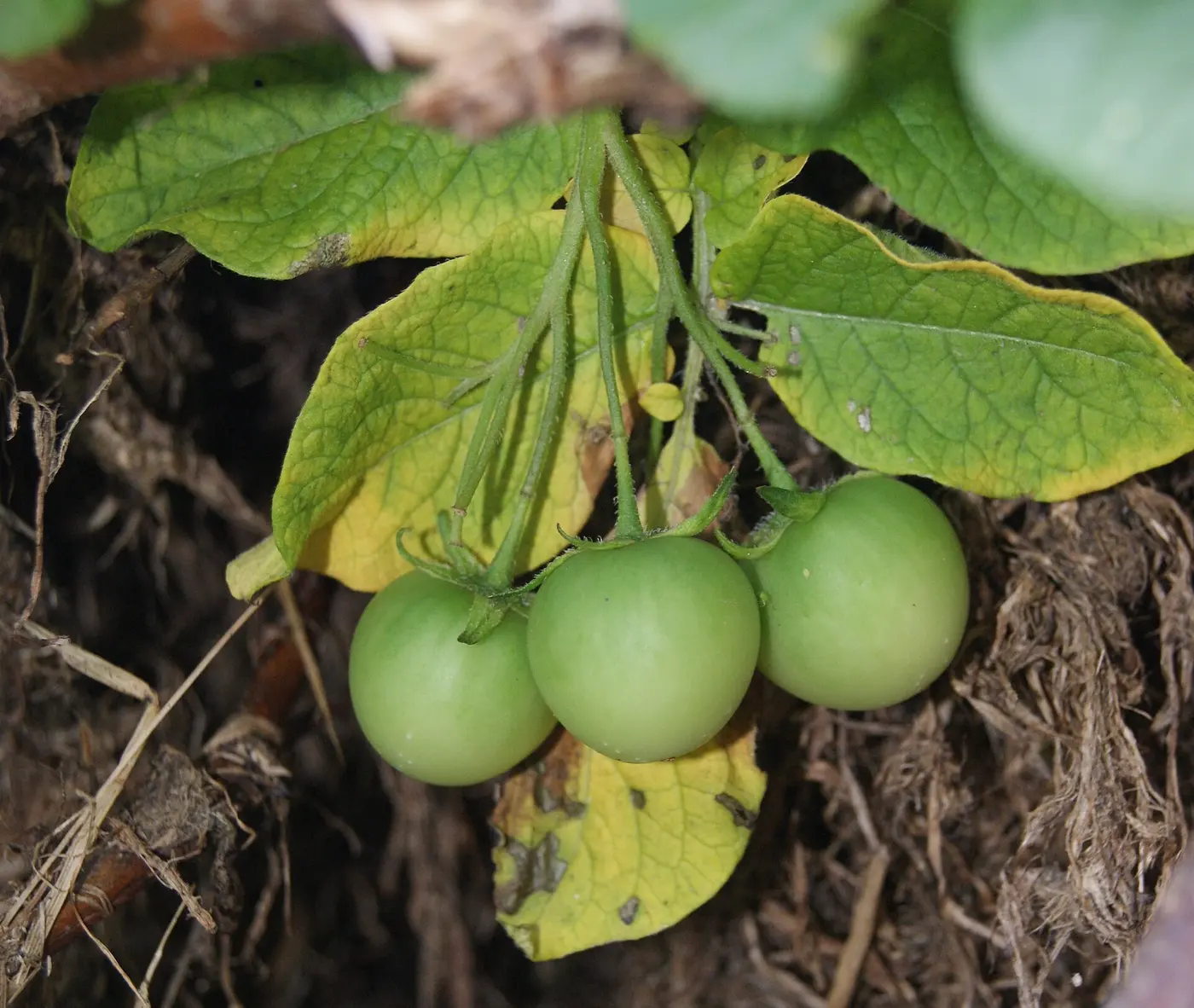
Potato plants sometimes even produce small green fruits that look like unripe tomatoes. These fruits, however, are rich in solanine and other toxic compounds, just like potato sprouts and skins that have turned green, and they cannot be eaten.
Tomatoes and potatoes on one plant
Because they are such close relatives, tomatoes and potatoes can be grafted together. Join a tomato stem onto a potato plant, and you get a greedy plant that ripens tomatoes above ground while growing potatoes below.
The combination has been tried since at least the early 19th century. In 2013 a British horticultural company began selling plants grown this way under the name TomTato, and they drew plenty of attention. Then there was the “pomato” made by German researchers in 1978 by fusing cells from the two plants, but it could not produce seeds and never became practical.
A cross nine million years ago
In July 2025, an international team including Sanwen Huang of the Chinese Academy of Agricultural Sciences and Sandra Knapp of the Natural History Museum in London published a startling paper in the journal Cell. Potatoes, they reported, arose from a cross between the tomato’s ancestors and a group of South American plants called Etuberosum.
The team analyzed the genomes, the complete genetic information, of 450 samples of cultivated potatoes and 56 samples of wild potato relatives. Every member of the potato group, they found, carries a stable blend of genes from the tomato lineage and the Etuberosum lineage. The two lineages are estimated to have split about 14 million years ago and then, about 9 million years ago, crossed naturally to give rise to the potato’s ancestor.
The intriguing part is that neither parent could make tubers. Etuberosum looks a lot like a potato plant, but it grows no tubers underground. Through the cross, though, a gene that acts as the “switch” to start tuber formation came from the tomato side, and a gene that drives the growth of the underground stems that become tubers came from the Etuberosum side. Brought together, they are thought to have produced a brand-new organ: the tuber.

At about that time, the Andes were rising rapidly. Tubers, which store nutrients underground, helped the plants survive the cold, harsh conditions, and the team thinks the potato group spread through the mountains and branched into many species. You might say the tomato’s ancestor was one of the potato’s “parents.”