What is the biggest flower in the world?
For a single bloom, Rafflesia arnoldii: nearly 1 meter across and weighing around 10 kilograms.
1m
When you think of a big flower, what comes to mind—a sunflower, perhaps, or a large peony? Even those are a few dozen centimeters across at most. But in the rainforests of Southeast Asia lives a plant whose flowers are several times that size.
Its name is Rafflesia arnoldii. It is said to be the largest single flower in the world, reaching nearly 1 meter (over 3 feet) across and weighing around 10 kilograms (22 pounds). Yet what is truly remarkable about this plant may be less its size than the way it lives.
A plant with no leaves, stem or roots
Rafflesia has no leaves, no stem and no roots. It cannot even make chlorophyll, the pigment essential for photosynthesis, so it has no way of producing its own food. How does it survive, then? The answer is parasitism.
Rafflesia lives inside a vine called Tetrastigma, a member of the grape family, spreading thin, threadlike tissue through its host. It takes all its water and nutrients from the host and is normally completely invisible from the outside. The only time we ever see it is when a bud pushes out through the surface of the host’s roots or stems.
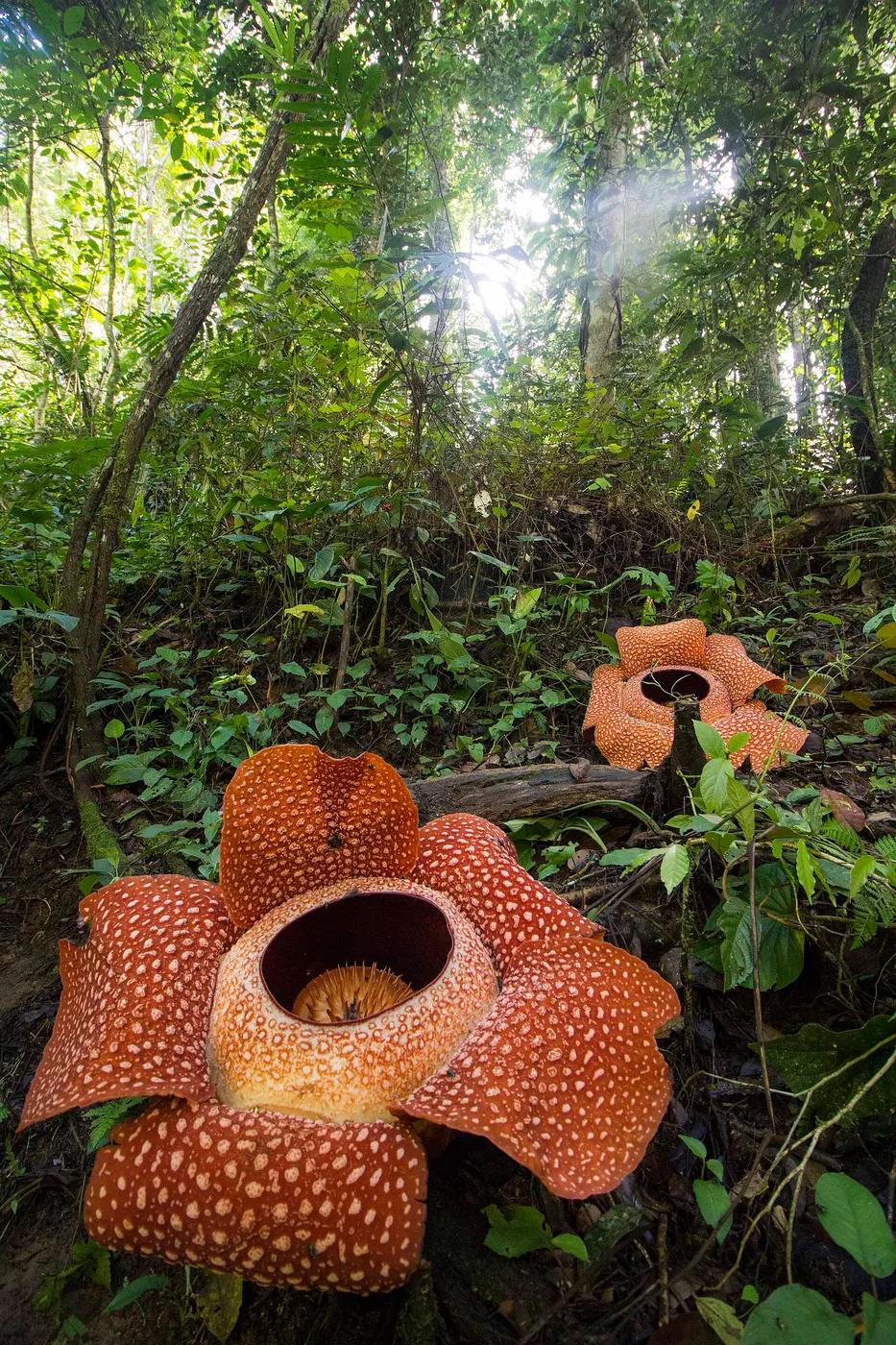
Over many months, the bud swells to about the size of a cabbage. Then one day, it opens five thick petals.

A flower made to lure flies
The open flower is reddish-brown, scattered with white spots, with a large, pot-like hollow at its center. And it gives off a powerful smell often likened to rotting meat.
That smell is aimed at flies of the kind that gather on animal carcasses. The flies arrive expecting a feast, but there is no meat. Instead, they pick up pollen and carry it off to another flower.
Pollination, however, rarely succeeds. In many species, male and female flowers are separate, so no fruit forms unless both are blooming nearby at the same time. On top of that, after the long months it takes a bud to grow, the flower lasts only about a week from opening to withering. The giant bloom is staking everything on a very risky bet.
The truth about “even bigger flowers”
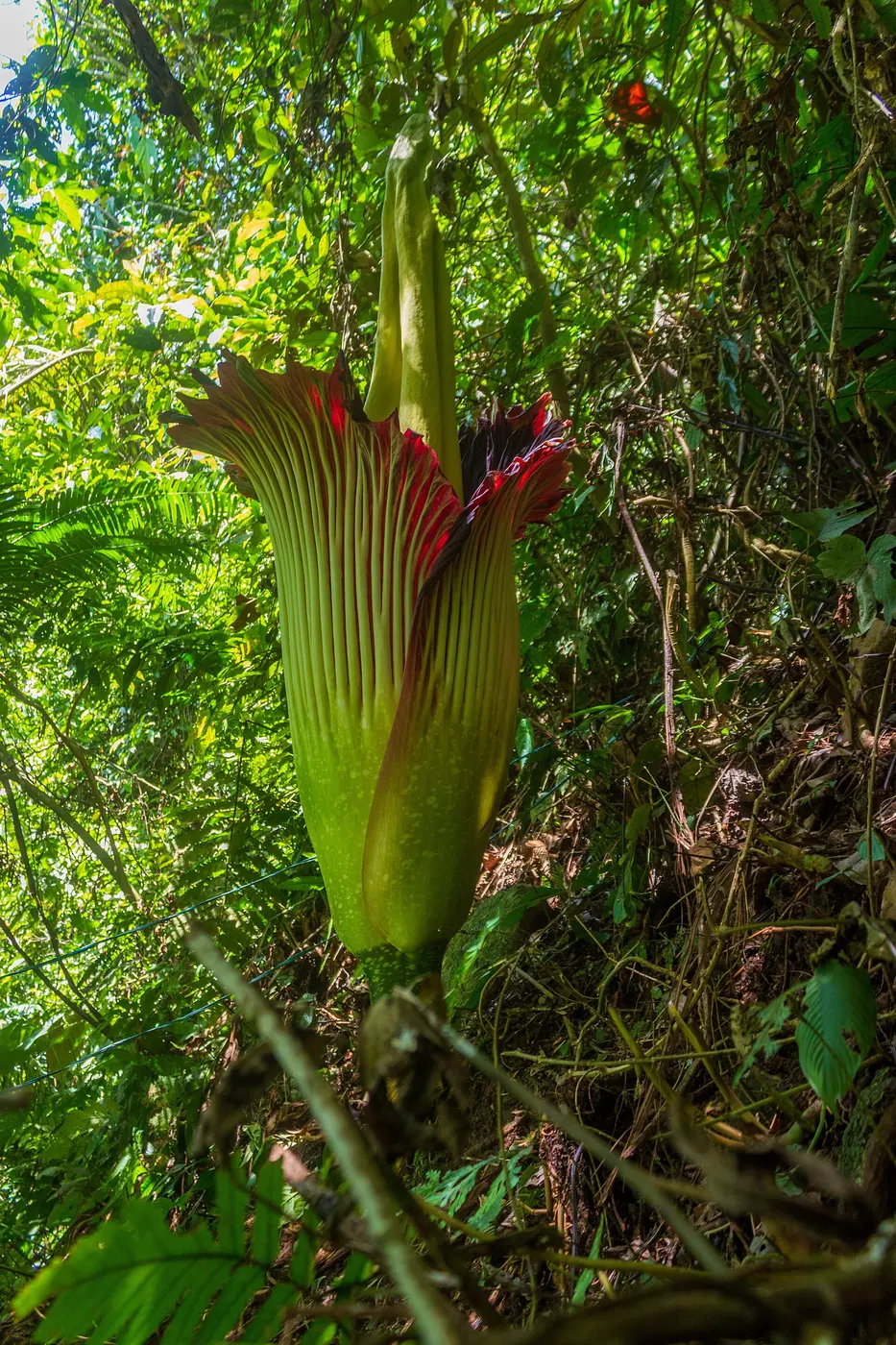
Some people may say they have seen a flower bigger than rafflesia. The plant that usually comes up is the titan arum, which also grows wild on Sumatra. It is a giant that can reach 3 meters (10 feet) tall, and it too attracts insects with a smell like rotting meat.
The titan arum, though, is not a single flower. The part that looks like a petal is a kind of leaf called a spathe, and the real flowers, many small ones, are clustered at the base of the thick central spike. A cluster of flowers like this is called an inflorescence, and the titan arum is said to have the largest unbranched inflorescence in the world.

Incidentally, judged by diameter alone, a different but closely related rafflesia species in western Sumatra was reported in 2020 to have reached 111 centimeters. Taking weight into account as well, though, the title of “largest flower” is said to belong to arnoldii.
A giant born from a family of tiny flowers
With no leaves or roots, rafflesia offers few clues for comparison with other plants, and where it belonged on the plant family tree was long a mystery. In 2007, a research team that analyzed its genes announced that the rafflesia group branched off from the spurge family. That makes it a relative of the poinsettia, cassava and the rubber tree.
Most plants in the spurge family have very small flowers. The study estimated that flower diameter increased roughly 79-fold along the rafflesia lineage. In other words, the largest flower in the plant kingdom arose from a family of tiny ones.
Today, that giant is in trouble. A 2023 report found that all 42 known species of rafflesia are under threat, 25 of them critically endangered. If the forests they live in disappear, they will vanish along with their host vines.