What is the tallest waterfall in the world?
On land, it is Angel Falls in Venezuela, which drops about 979 meters.
979m
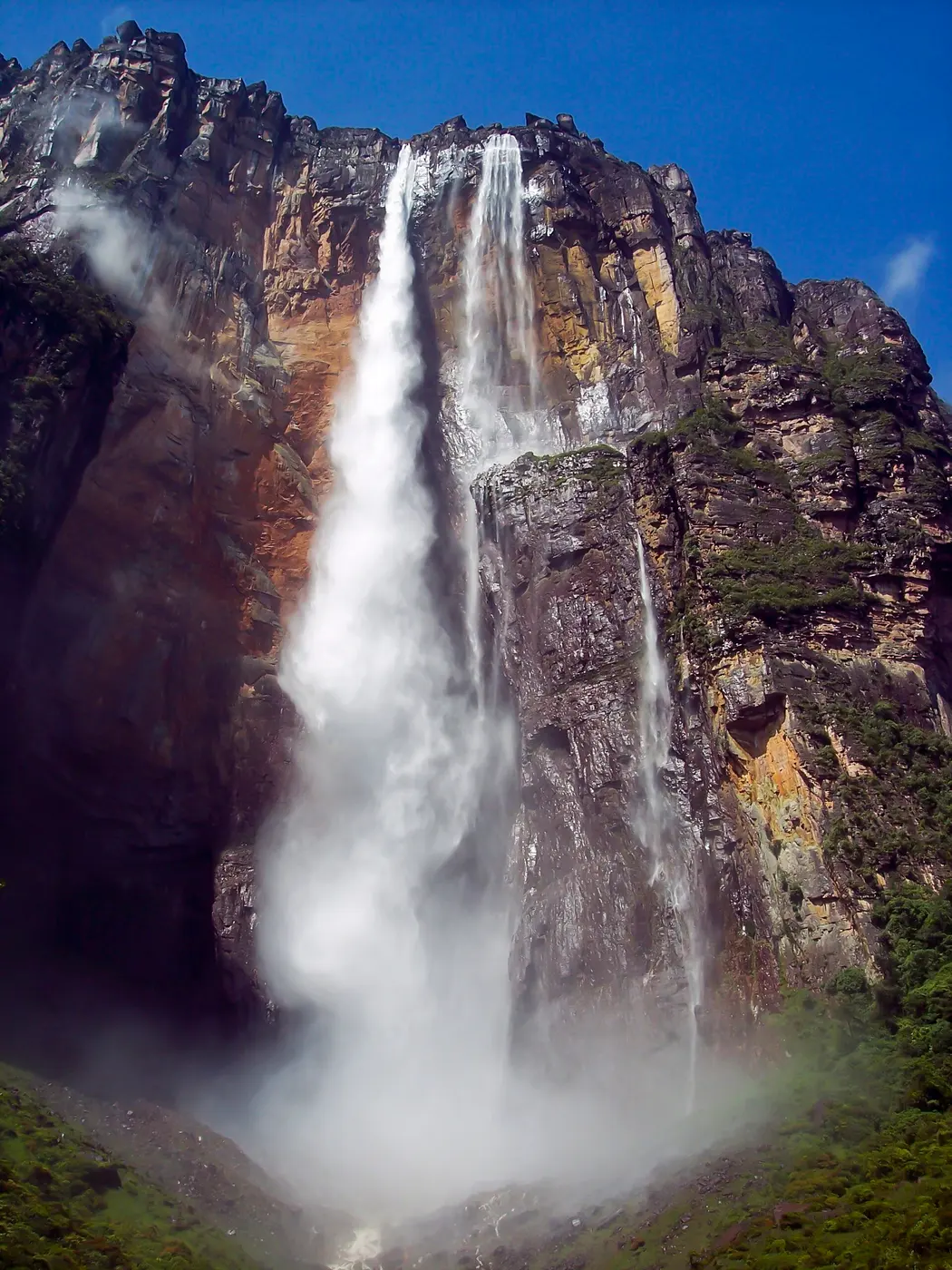
Deep in the interior of Venezuela, in South America, flat-topped mountains ringed by sheer cliffs rise out of the tropical jungle. From the summit of one of them, a thread of white water falls toward the forest far below. This is Angel Falls, the tallest waterfall known today.
Its drop is about 979 meters (3,212 feet). Stack one and a half Tokyo Skytrees, the 634-meter broadcasting tower that is Japan’s tallest structure, and you still would not reach the top.
Water falling from a table mountain
Angel Falls lies in Canaima National Park in southeastern Venezuela. The region is dotted with flat-topped, table-like mountains surrounded by vertical cliffs. Locally they are called tepuis.
The falls pour from near the top of one of them, Auyán-tepui. Of the total 979-meter drop, the section where the water falls in one clean plunge, without touching anything on the way down, is about 807 meters on its own. The falls are so high that in the dry season the water is said to sometimes scatter into mist before it reaches the ground.

A waterfall named after a pilot
The “Angel” in its name refers not to a heavenly being but to a person: Jimmie Angel, an American aviator who flew over the falls in 1933. In 1937 he tried to land his plane on the tepui above the falls, but the aircraft got stuck in a marsh and could not move.
The height of the falls was first officially measured in 1949. An expedition organized by the American journalist Ruth Robertson made it all the way to the base of the falls and carried out a survey.
Of course, the falls were known to the local Indigenous Pemón people long before the outside world “discovered” them. In the Pemón language they are called Kerepakupai Merú, which is said to mean “waterfall of the deepest place.” In 2009, Venezuela’s then-president Hugo Chávez even proposed that the Indigenous name be used instead.
An even bigger “waterfall” under the sea
Stretch the meaning of “waterfall” a little, though, and a contender appears that dwarfs Angel Falls: a “waterfall” flowing along the seafloor of the Denmark Strait, between Greenland and Iceland.
Seawater chilled in the northern seas becomes heavy and tends to sink. This cold, dense water spills over a rise in the seabed in the strait and flows down the undersea slope, slipping beneath the warmer water to the south. Its drop is said to be about 3,500 meters, more than three times that of Angel Falls. The volume of water it carries is estimated at more than 3 million cubic meters per second, over ten times the amount the Amazon River pours into the ocean.
Mind you, this “waterfall” does not tumble off a cliff; it is a current that slowly descends a slope over a long distance. Being underwater, it cannot be seen either. Even so, it is thought to play an important part in sustaining the great ocean circulation that stirs seawater around the globe.
Japan’s tallest: Shōmyō Falls in Tateyama
Japan’s tallest waterfall is Shōmyō Falls (称名滝) in the town of Tateyama, Toyama Prefecture. It drops 350 meters in four tiers. The name is said to come from Hōnen, founder of the Pure Land (Jōdo) school of Buddhism, who heard the roar of the falls as the voices of people chanting shōmyō nenbutsu, the recitation of “Namu Amida Butsu.”
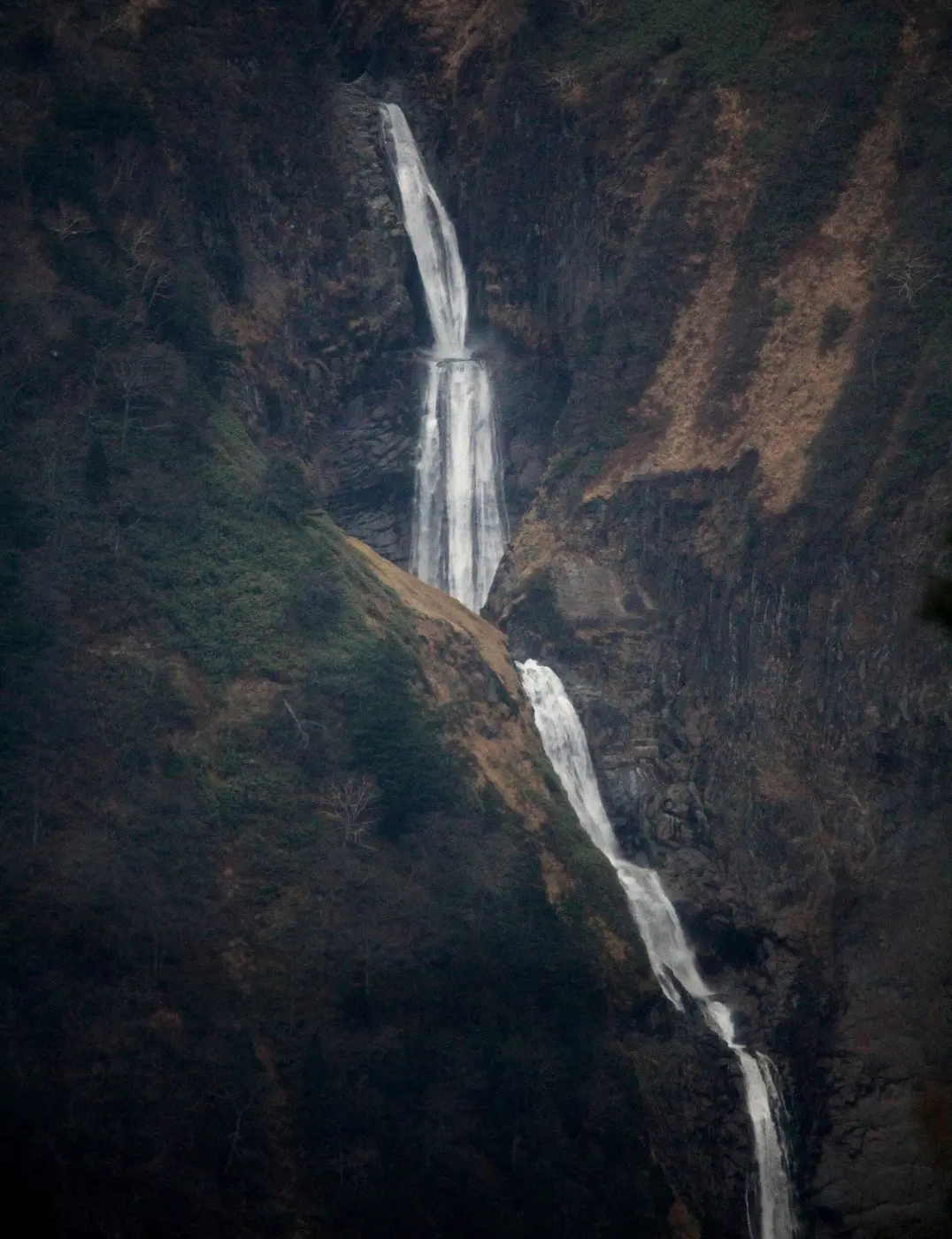

In fact, an even taller waterfall sometimes appears right beside Shōmyō Falls. Called Hannoki Falls, it drops about 500 meters. But water flows over it mainly during the snowmelt season, from spring to early summer. Because it does not flow year-round, it yields the title of Japan’s tallest to Shōmyō Falls.