Why do you float in the Dead Sea?
Its water is about 34 percent salt, which makes it much heavier (denser) than the human body.
-440m
Plenty of people find it hard to float on their backs in a pool or the sea. Relax for a moment and your legs start to sink, and you end up paddling frantically to stay up.
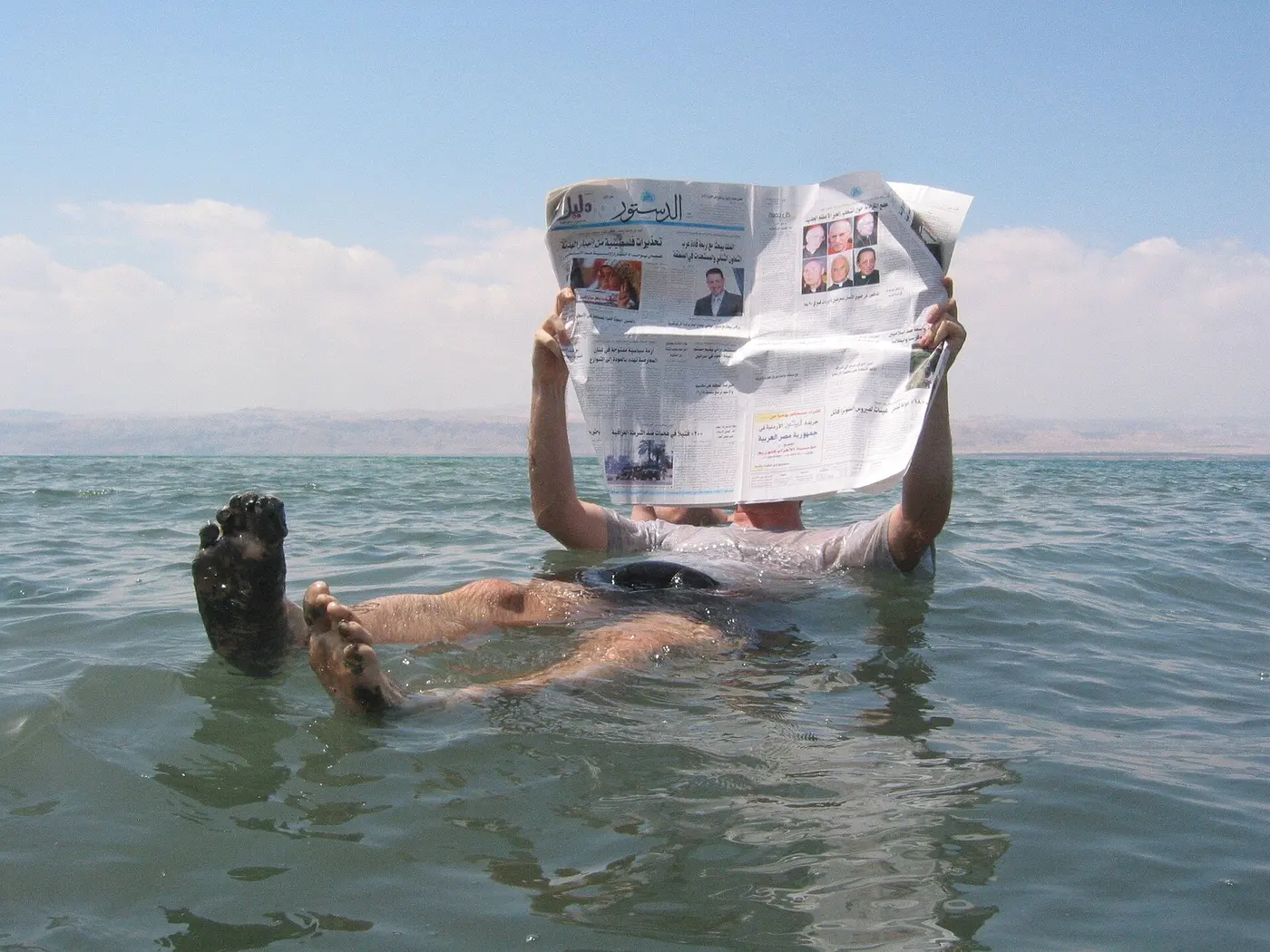
In the Dead Sea, a lake in the Middle East bordered by Jordan, Israel and the West Bank, anyone floats without even trying. You may have seen photos of tourists lying on the surface, calmly reading a newspaper or a book.
Ten times saltier than the ocean
The reason you float in the Dead Sea is how concentrated its water is. About 34 percent of the Dead Sea’s water, by weight, is dissolved salt. Ordinary seawater is about 3.5 percent salt, so the Dead Sea is roughly ten times as salty.
What is dissolved in it is different from seawater, too. Sea salt is almost all sodium chloride—table salt—but in the Dead Sea the most abundant salt is magnesium chloride, followed by sodium chloride, calcium chloride and potassium chloride.
Whether something floats depends on its density compared with the water’s—that is, how much a given volume of it weighs. Fresh water has a density of about 1 gram per cubic centimeter. The human body is about the same, and with your lungs full of air you are only slightly lighter. That is why, in a pool, you hover right on the edge between floating and sinking.
The Dead Sea’s water, by contrast, has a density of about 1.24 grams per cubic centimeter. Because it is so much heavier than your body, it pushes you firmly upward. By the numbers, close to a fifth of your body ends up riding above the surface.

A lake with no way out
So why is the Dead Sea’s water so concentrated?
The Jordan River and other streams flow into the Dead Sea from the north, but not a single river flows out of it. And because the land around it is hot and dry, the water that comes in keeps evaporating from the surface. When water evaporates, the salt dissolved in it stays behind. Repeated over a staggeringly long time, this has made the water saltier and saltier.
The water is so salty that fish cannot live in it. That is where the name “Dead Sea” comes from: a lake where nothing can live. In Hebrew it is called the “Sea of Salt.” It isn’t entirely lifeless, though; salt-tolerant microbes are known to live there. In 1980, after a rainy winter diluted the water, algae and microbes multiplied until the lake turned red.
The buoyancy of this salty water has amazed people since ancient times. The Greek philosopher Aristotle wrote of a lake where even a person or an animal thrown in bound will float back up.
The lowest place on land, and a shrinking lake
The Dead Sea is known for another world record as well. As of 2025, its surface lies about 440 meters (1,440 feet) below sea level, making it the lowest place on land.
And that record keeps getting “broken.” In 1970, the Dead Sea’s surface stood at about 395 meters below sea level, but it has kept falling ever since, and recently it has been dropping by about a meter a year. Its area has shrunk too, from about 1,050 square kilometers in 1930 to about 605 square kilometers in 2016.
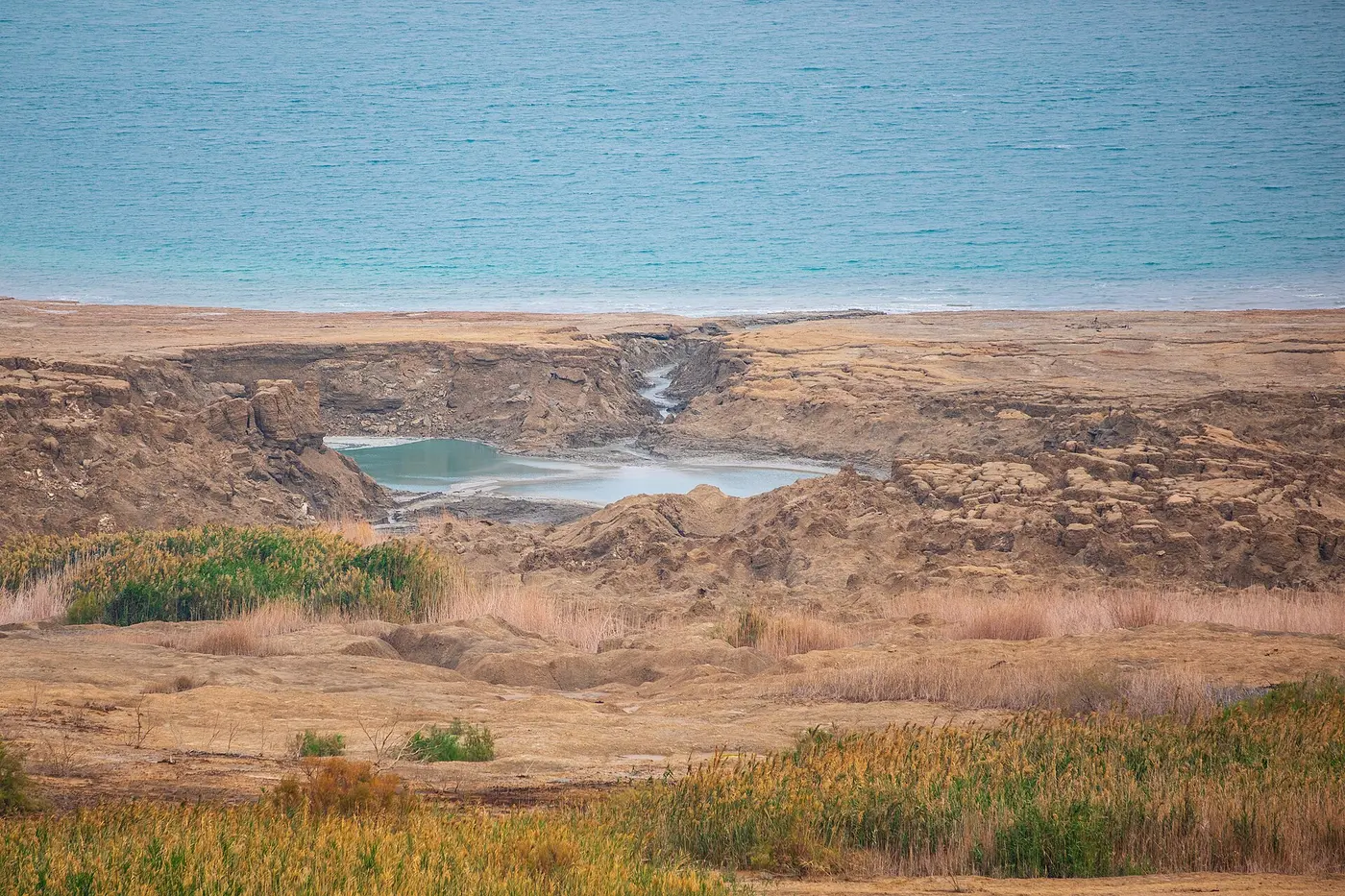
The main cause is that, since the 1960s, the countries around it have drawn off large amounts of water from the Jordan River, which feeds the Dead Sea, for farming and other uses. On the shores left behind by the retreating water, sinkholes, where the ground suddenly collapses, have appeared in great numbers. Plans to pipe in water from the Red Sea to restore the Dead Sea have been discussed, but none has come to fruition.