How long does sunlight take to reach Earth?
About 8 minutes 19 seconds on average. It varies by a dozen seconds or so as Earth’s distance from the Sun changes.
8.3min
Look up on a clear day and there is the Sun, shining. But what you are seeing is not the Sun as it is now. Light leaving the Sun takes, on average, about 8 minutes and 19 seconds to reach Earth. In other words, we are always looking at the Sun as it was some eight minutes ago.
Light travels about 300,000 kilometers (186,000 miles) every second, fast enough to circle Earth seven and a half times. Even at that speed, the fastest in the universe, the trip takes over eight minutes. That is how great a distance lies between the Sun and Earth.
Divide 150 million kilometers by the speed of light
The calculation itself is surprisingly simple. The average distance between Earth and the Sun is about 149.6 million kilometers. Astronomers call this distance one “astronomical unit” and use it as a basic yardstick for space. Divide it by the speed of light, about 299,792 kilometers per second, and you get about 499 seconds, or 8 minutes and 19 seconds.
Earth’s orbit, however, is not a perfect circle but a slightly squashed ellipse. Around early January, when Earth is closest to the Sun, the distance shrinks to about 147.1 million kilometers and light arrives in about 8 minutes and 11 seconds. Around early July, when Earth is farthest away, the distance grows to about 152.1 million kilometers, and the trip takes about 8 minutes and 27 seconds. It may come as a surprise that sunlight arrives a little later during the Northern Hemisphere’s summer. What makes the seasons hot or cold is not our distance from the Sun but the tilt of Earth’s axis.
The man who saw that light has a speed
Light doesn’t arrive instantaneously; it travels at a finite speed. The first person to show this is generally credited as Ole Rømer, a Danish astronomer of the 17th century.
Astronomers of his day were busy observing the timing of eclipses of Io, one of Jupiter’s moons, as it disappeared into Jupiter’s shadow. Io circles Jupiter with clockwork regularity, so the eclipses should have been precisely predictable. Rømer noticed, though, that when Earth was moving away from Jupiter, the eclipses came later than predicted, and when Earth was approaching, they came earlier.
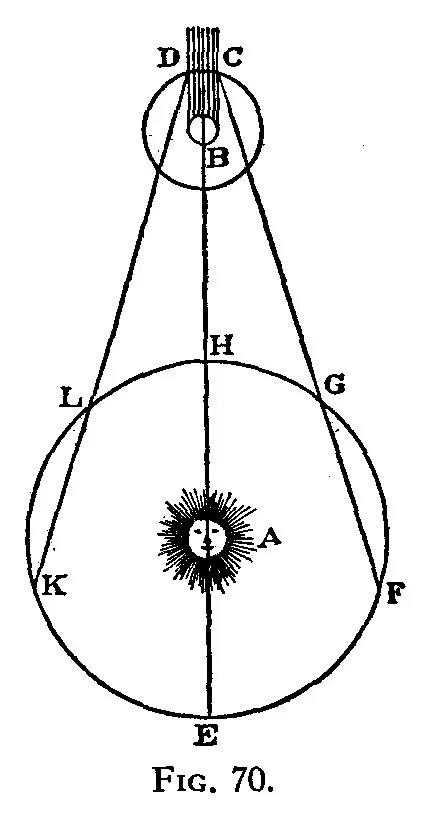

Rømer reasoned that the difference was the time light took to travel to Earth. The farther Earth was from Jupiter, the longer the path the light had to cover, and the later it arrived. By his estimate, light took about 22 minutes to cross the diameter of Earth’s orbit. The true figure is about 17 minutes, so his number was off, but the insight—reading the speed of light from the motions of the heavens—was brilliant.
Stuck inside the Sun for tens of thousands of years
The 8 minutes and 19 seconds, mind you, is only the journey after light leaves the Sun’s surface. The energy that becomes sunlight is born in the Sun’s core. There, at a temperature of about 15 million degrees and under immense pressure, hydrogen nuclei fuse into helium, releasing enormous amounts of energy.
But light born at the center can’t simply stream straight out. The Sun’s interior is packed with gas, and light travels only a tiny distance before it is absorbed or knocked in a new direction. Like someone pushing through a dense crowd, it zigzags back and forth, over and over. Closer to the surface, the energy is carried outward on churning currents of gas, like a boiling pot.
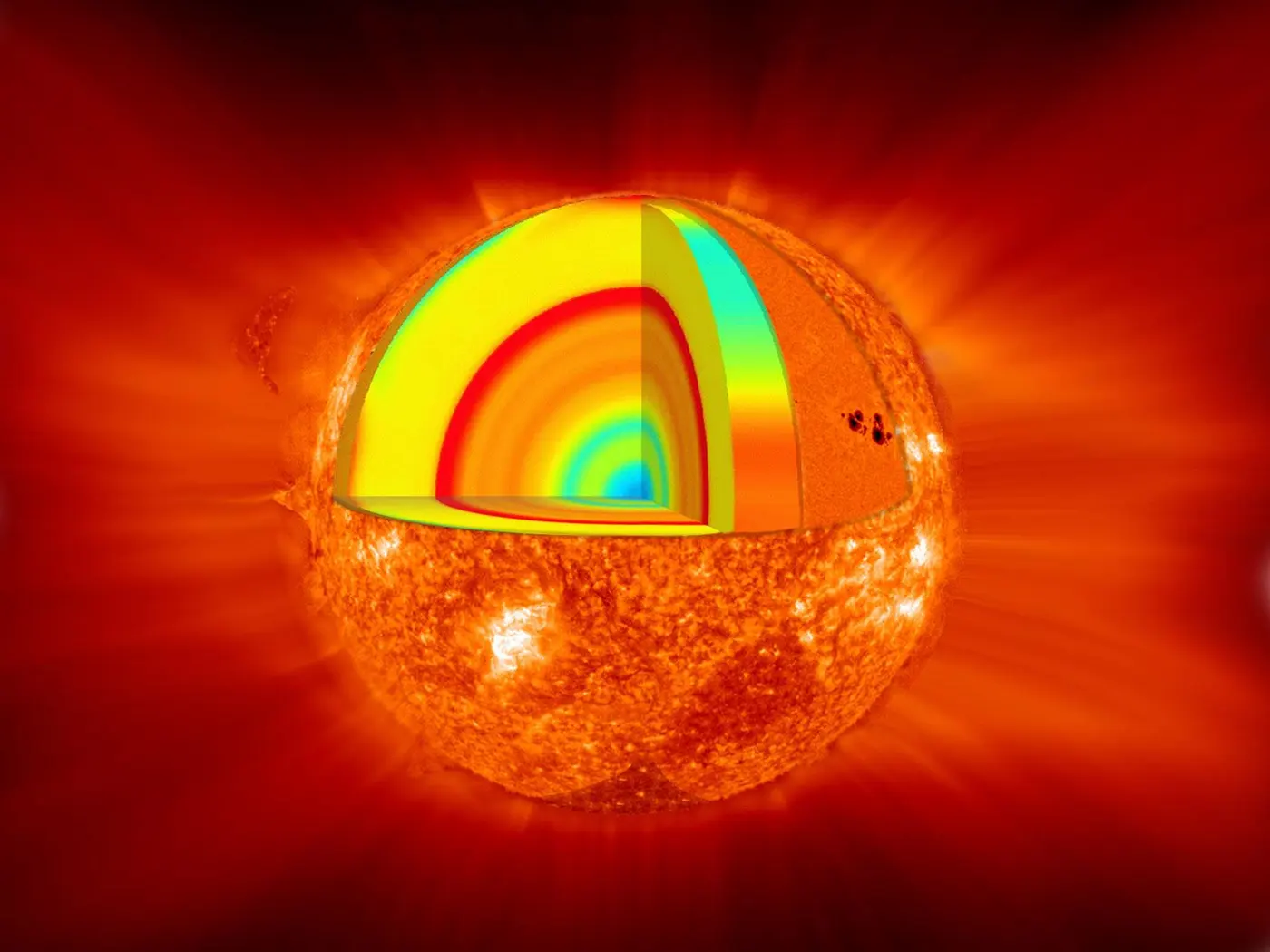

All told, it is estimated to take anywhere from tens of thousands to well over a hundred thousand years for energy to make its way from the center to the surface. The numbers vary widely depending on the model used, and there is no definitive value. Still, it seems clear that the energy behind today’s sunshine was born at the heart of the Sun back when our ancestors were living with stone tools in hand. The final eight-odd minutes are just the finishing stretch of a very long journey.
What if the Sun suddenly vanished?
Because light takes eight minutes to arrive, if the Sun suddenly disappeared right now, we would go on basking in sunshine for more than eight minutes, none the wiser.
What about the gravity that holds Earth in its orbit? Would Earth fly off course the instant the Sun vanished? According to Einstein’s general theory of relativity, changes in gravity also travel at the speed of light. In 2017, gravitational waves and gamma rays from the merger of two neutron stars about 130 million light-years away reached Earth only about two seconds apart. This confirmed, to extraordinarily high precision, that gravity travels at almost exactly the speed of light.
News that the Sun had vanished would reach us as light and as gravity at the same moment, a little over eight minutes late.
In reality, of course, the Sun is expected to keep shining for billions of years to come. So relax, and enjoy your eight-minute-old sunshine.