How many times a day does the International Space Station circle Earth?
It goes around once every 90 minutes or so—about 16 times a day, with about 16 sunrises to match.
16orbits
Look up just before dawn or shortly after dusk and you may catch a bright point of light, as bright as a star, gliding silently across the sky. It doesn’t blink like an airplane, and within a few minutes it slips away over the horizon. That light may well be the International Space Station (ISS).
The ISS is a huge, habitable research facility run jointly by the space agencies of the United States, Russia, Europe, Japan and Canada. Someone has been living aboard without a break since November 2000. And this “house in space” is racing around the planet at a staggering speed.
Around the world in 90 minutes
The ISS flies about 400 kilometers (250 miles) above the ground. Picture the distance from Tokyo to Osaka turned straight up, and it may seem surprisingly close. Shrink Earth to a ball one meter across, and the station would be skimming along just 3 centimeters above its surface.
It travels at about 7.7 kilometers per second, or roughly 28,000 kilometers per hour (17,000 mph)—fast enough to cover the distance from Tokyo to Osaka in under a minute. At that speed, one lap of the planet takes about 90 minutes. In 24 hours, that comes to about 16 orbits.
Strictly speaking, each orbit takes around 92 to 93 minutes, so the station actually completes about 15.5 orbits a day. NASA rounds this to a tidy “16 orbits a day.” According to NASA, the distance the ISS covers in a day is about the same as flying to the Moon and back.
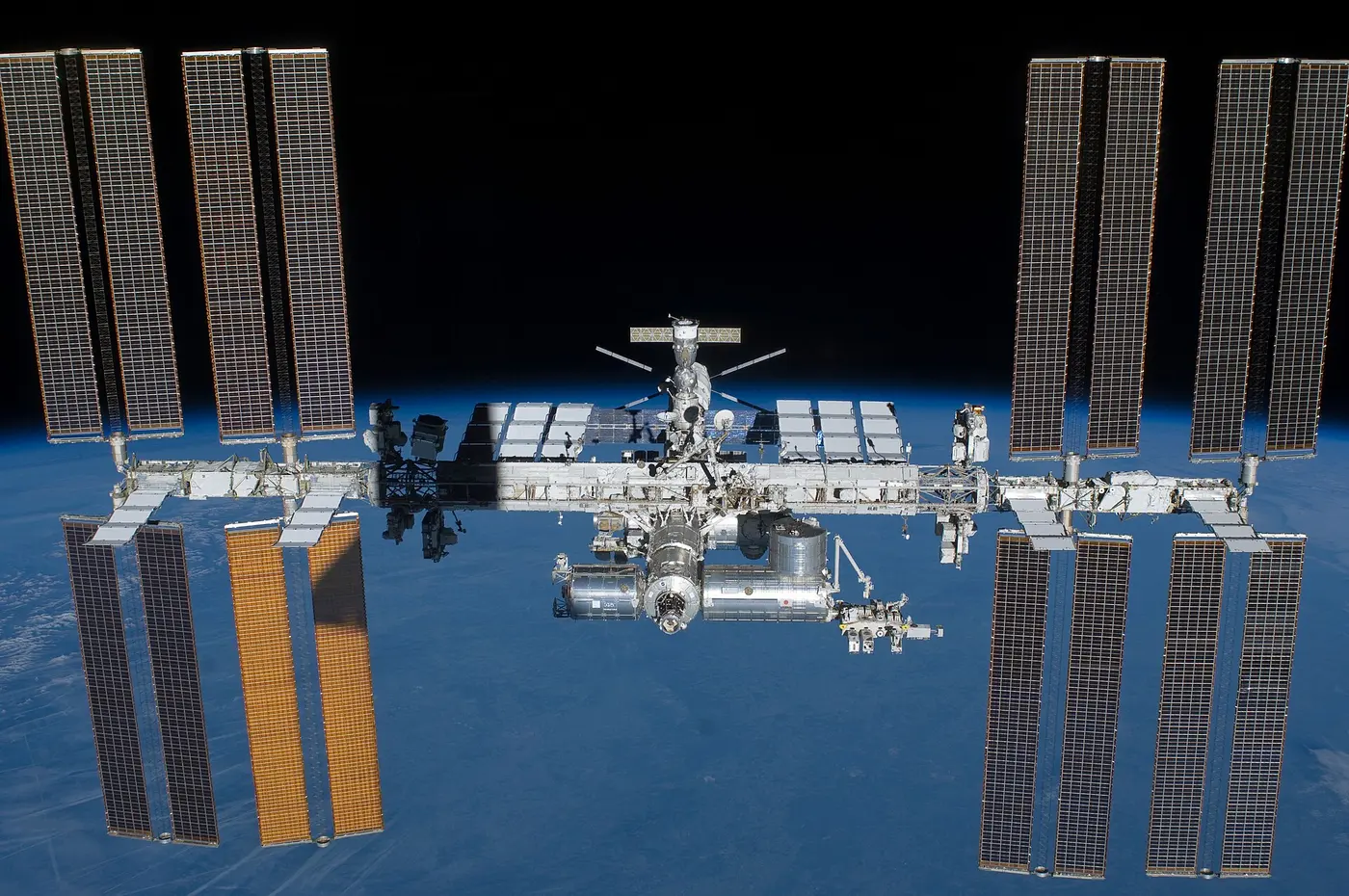

It stays up by always falling
There’s a reason it has to go so fast. Even at an altitude of 400 kilometers, Earth’s gravity is still about 90 percent as strong as it is on the ground. The ISS is, in fact, constantly falling toward Earth.
But because it is also moving sideways at tremendous speed, the curved surface of the planet keeps falling away beneath it as it drops. It falls and falls and never reaches the ground. That is what being “in orbit” means. The astronauts inside seem to float not because there is no gravity, but because they and the station are falling together.
Even so, a trace of air still lingers at 400 kilometers. That faint drag slowly robs the ISS of speed, and its altitude creeps downward—by about 2 kilometers a month, by one estimate. Every so often, a docked spacecraft fires its engines to boost the station back up.
Sixteen sunrises a day
On every orbit, the ISS passes once through Earth’s day side and once through its night side. So the astronauts see a sunrise or a sunset roughly every 45 minutes—about 16 of each per day.
Outside the window, a thin band of light appears along the dark edge of the Earth, shifts from blue to orange, and then, almost at once, the dazzling Sun bursts into view. A sunrise that comes once a day on the ground arrives here several times between one meal and the next.
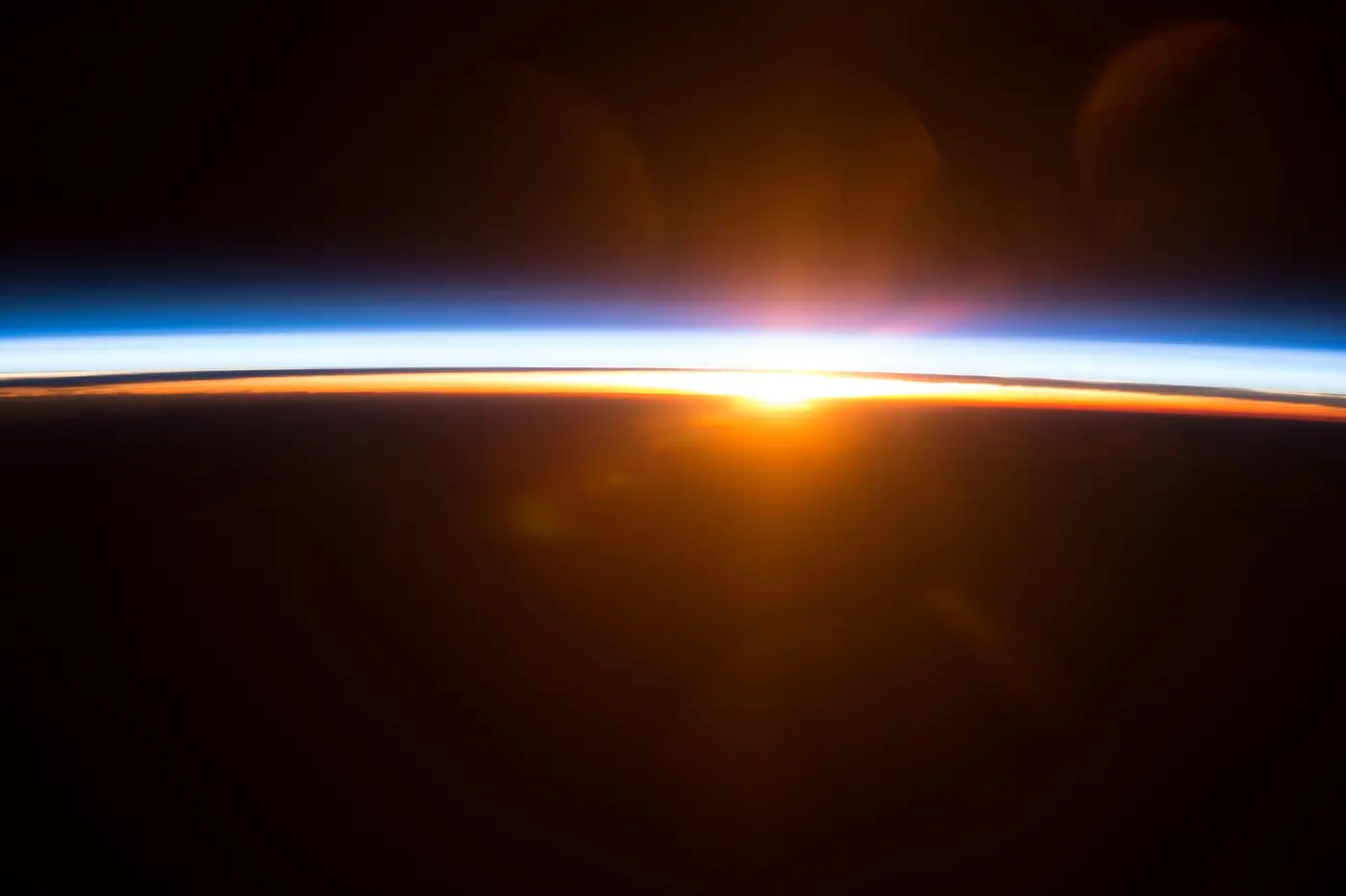

So how do you keep any kind of daily rhythm when day and night swap places so often? On the ISS, people live by the clock, not the Sun. The station runs on Greenwich Mean Time (Coordinated Universal Time), with set hours for waking, meals, work and sleep. At bedtime, crew members zip into sleeping bags in their own small cabins, shut away from the whirl of day and night outside.
Spot it from the ground
You can see the ISS from the ground with the naked eye. It measures about 109 meters from end to end—roughly the size of an American football field—and its outspread solar panels reflect sunlight well.
It is visible for an hour or two before sunrise or after sunset, when the ground is already dark but the high-flying station is still lit by the Sun. At its brightest it shines far more brightly than a first-magnitude star, and it crosses the sky over a few minutes, much more slowly than a shooting star. You can look up when and in which direction it will appear on the websites of JAXA and NASA.
Inside that small point of light, a handful of astronauts are working, eating and sleeping right now. Keep that in mind as you look up, and the night sky may feel a little closer.