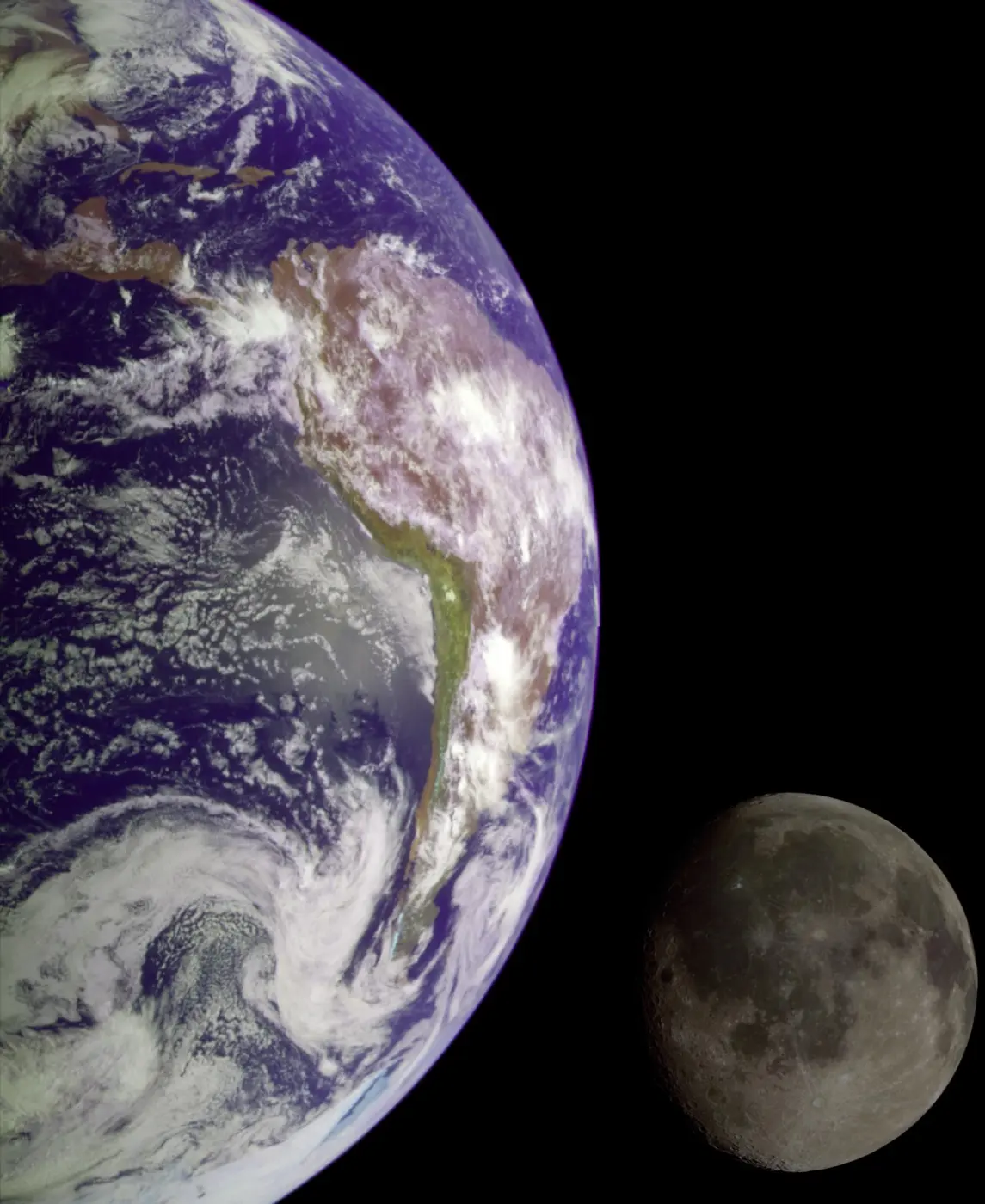
Is the Moon really drifting away from Earth?
Yes. The Moon is moving away from Earth by about 3.8 centimeters a year.
3.8cm/year
The Moon in the night sky looks as if it has hung in the same place, unchanged, for thousands of years. In reality, it moves a tiny bit farther from Earth every year. The rate is about 3.8 centimeters (1.5 inches) a year, often compared to the speed at which human fingernails grow.
A movement of just a few centimeters, by a body 380,000 kilometers away. How on earth did anyone measure that?
The mirrors we left on the Moon
The answer lies in small mirrors that humans left on the lunar surface.
In 1969, the Apollo 11 astronauts set up a reflector array on the Moon. Apollo 14 and 15 later carried similar reflectors there, as did the Soviet Union’s uncrewed Lunokhod rovers. These devices have a special design that sends light straight back in the direction it came from, so a laser beam fired from Earth returns precisely to its sender.
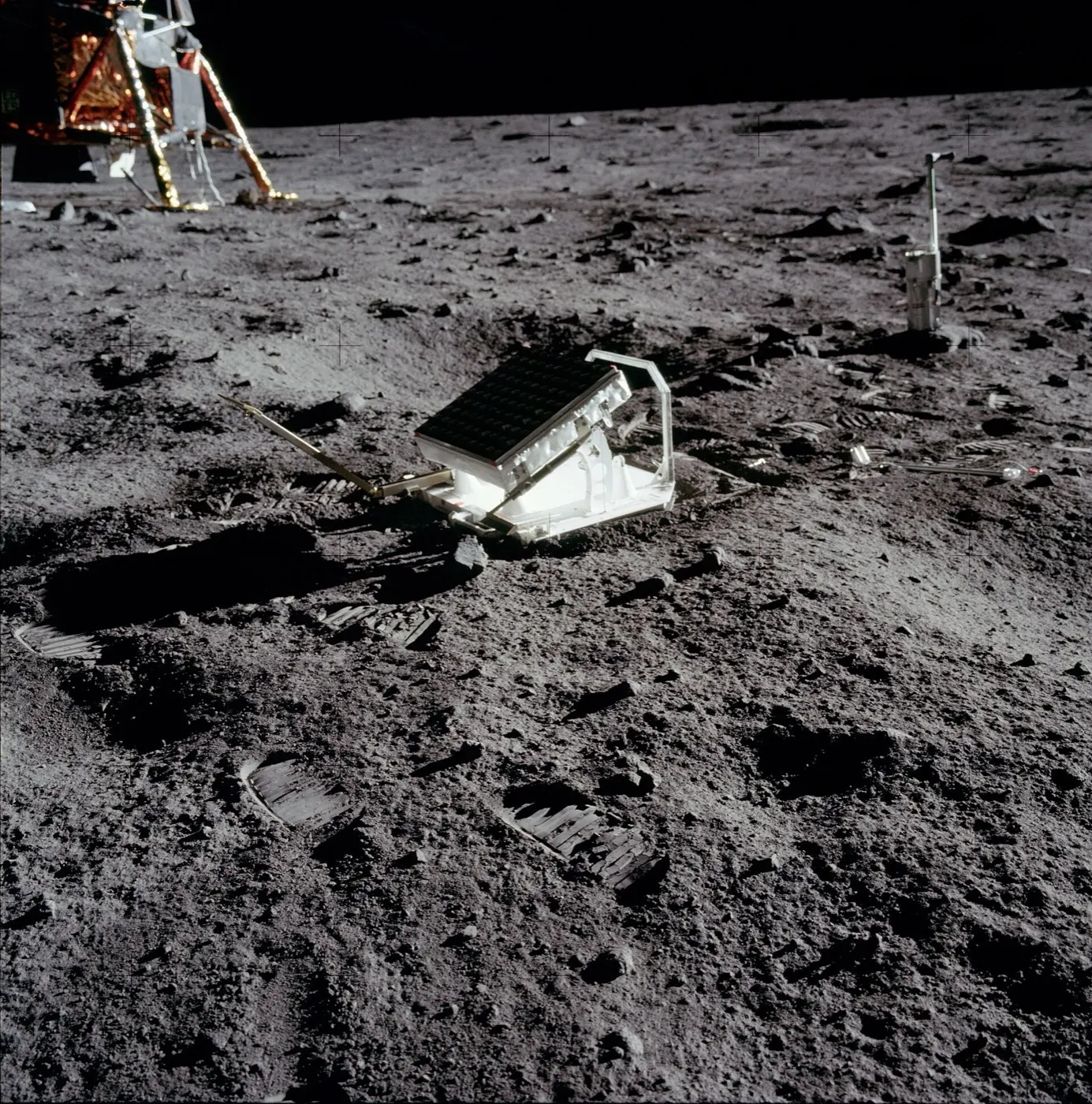

An observatory on the ground fires a laser at the Moon and times how long the light takes to come back. The round trip takes about 2.5 seconds, but by timing it with extreme precision, astronomers can pin down the distance to the Moon to the centimeter, and even the millimeter. This lunar laser ranging has continued for more than half a century, and it is what produced the figure of about 3.8 centimeters a year. A souvenir of the Apollo program is still on the job.
The culprit: the daily tides
The reason the Moon is drifting away is something we all know well: the rise and fall of the tides.
The Moon’s gravity stretches Earth’s oceans slightly, both toward the Moon and toward the opposite side, creating bulges. These are the high tides. But Earth spins once a day, far faster than the Moon circles Earth (about once a month). So the bulge of water gets dragged along by Earth’s rotation and ends up slightly ahead of the point directly beneath the Moon.
That leading bulge tugs the Moon forward ever so slightly with its gravity. Pulled forward, the Moon gradually gains momentum and moves out into a larger orbit. Earth, meanwhile, which is dragging the bulge along, is being braked. With help from friction between the seafloor and the water, Earth’s rotational energy is slowly being handed over to the Moon’s orbit.
The day is slowly getting longer
If Earth’s spin is being braked, the day must be getting longer.
The day is estimated to lengthen by roughly 2 milliseconds per century (the figure varies depending on how it is worked out). Earthquakes, melting glaciers, movements deep inside the planet, and other factors make Earth’s rotation wobble even over short periods, so there are stretches of a few years when it actually speeds up. Over the long run, though, the tides are steadily slowing it down.
It’s not a difference anyone could notice in a lifetime. Over geological time, however, it adds up. Fossil corals from about 400 million years ago preserve daily growth lines, like tree rings, and counting them suggests that a year back then had about 400 days. Since the length of the year has barely changed, a day must have lasted only about 22 hours.
The rate at which the Moon recedes and the rate at which the day grows longer are two sides of the same phenomenon.
Will the Moon eventually escape?
You might worry that if the Moon keeps drifting away, it will one day leave Earth altogether. But that is not expected to happen.
The farther away the Moon gets, the weaker the tidal forces become, and the slower it recedes. In theory, the exchange will reach a balance once the length of Earth’s day matches the Moon’s orbital period. Getting there, however, would take an almost unimaginable length of time, and long before then the Sun itself will have aged and changed dramatically. The Moon will remain in our sky for a very long time to come.