What is the nearest star to the Sun?
Proxima Centauri, in the constellation Centaurus, about 4.24 light-years away.
4.24light-years
Ask what the nearest star to Earth is, and the correct answer is the Sun. Like the stars that sparkle at night, the Sun is a star that shines by its own nuclear fire. So which star is closest to us once you leave the Sun out?
You might think of Sirius, which blazes in the night sky, or Vega, the star at the heart of Japan’s Tanabata star festival. But the answer is not among the bright stars at all. The Sun’s next-door neighbor is a small, dim star that you cannot see without a telescope.
A neighbor invisible to the naked eye
The closest star to the Sun is Proxima Centauri, in the southern constellation Centaurus. “Proxima” is Latin for “nearest.” It lies about 4.24 light-years away, so even light needs a little over four years to make the trip. If you saw its light tonight, that light would have left the star about four years ago.
The star was discovered in 1915 by Robert Innes, a Scottish-born astronomer working in South Africa. It went unnoticed until the 20th century for one simple reason: it is very faint. At around magnitude 11, it is far dimmer than magnitude 6, the limit of what the naked eye can see, and it is not easy to find even with binoculars.
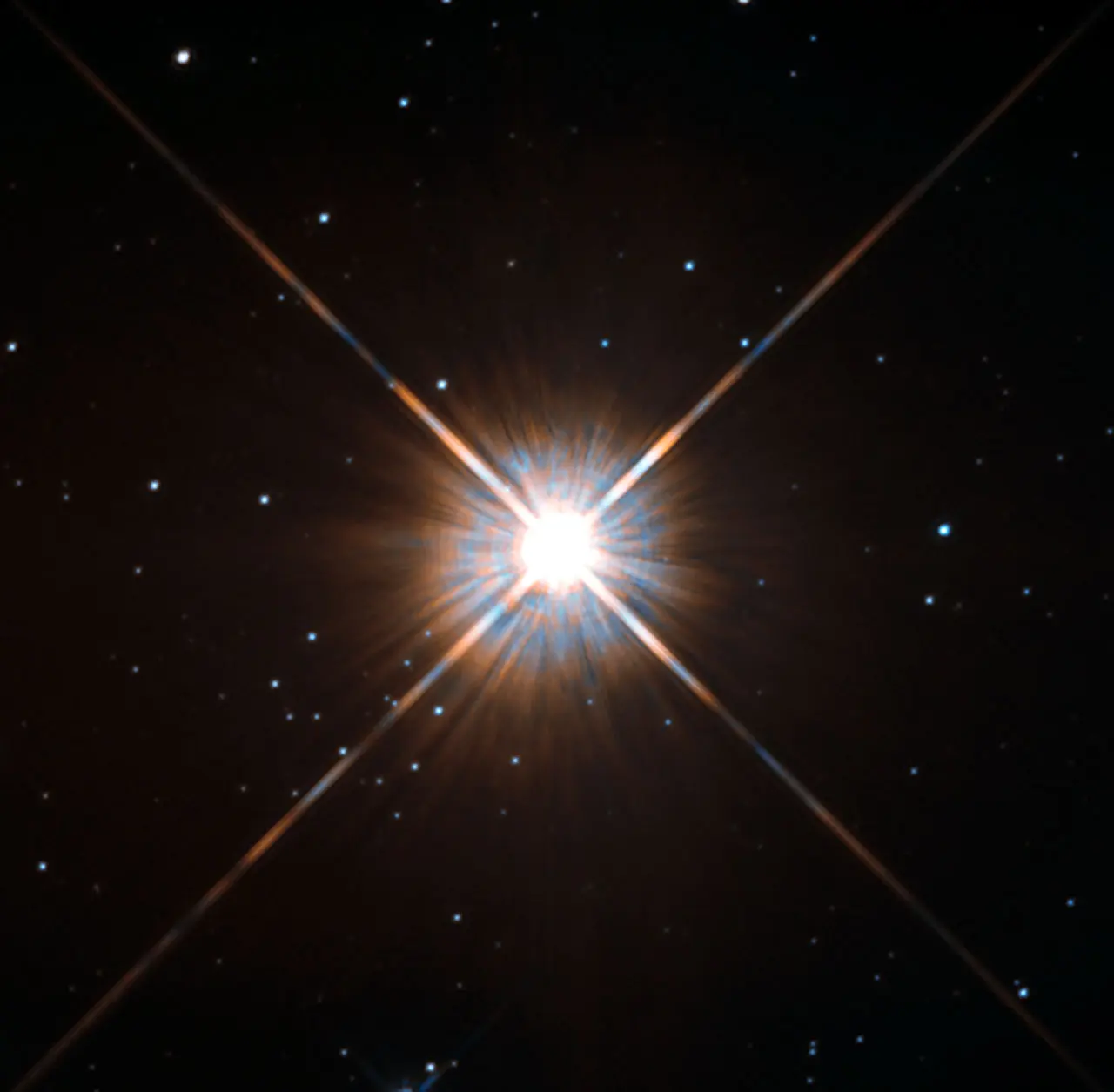

Proxima Centauri is a type of star called a red dwarf. Its diameter is about one-seventh of the Sun’s, and its mass is only about 12 percent of the Sun’s. Its surface temperature is only about half the Sun’s, so it glows a dull red. It is invisible despite being so close because the star itself is small and feeble.
Part of a family of three
Proxima Centauri is not alone. Some distance away from it are two bright stars, Alpha Centauri A and B. This pair of stars, both fairly similar to the Sun, orbit each other once every 80 years or so.
Alpha Centauri A and B are about 4.3 light-years away, only slightly farther than Proxima. Seen together as a single point of light, Alpha Centauri is known as the third-brightest star in the night sky, after Sirius and Canopus.
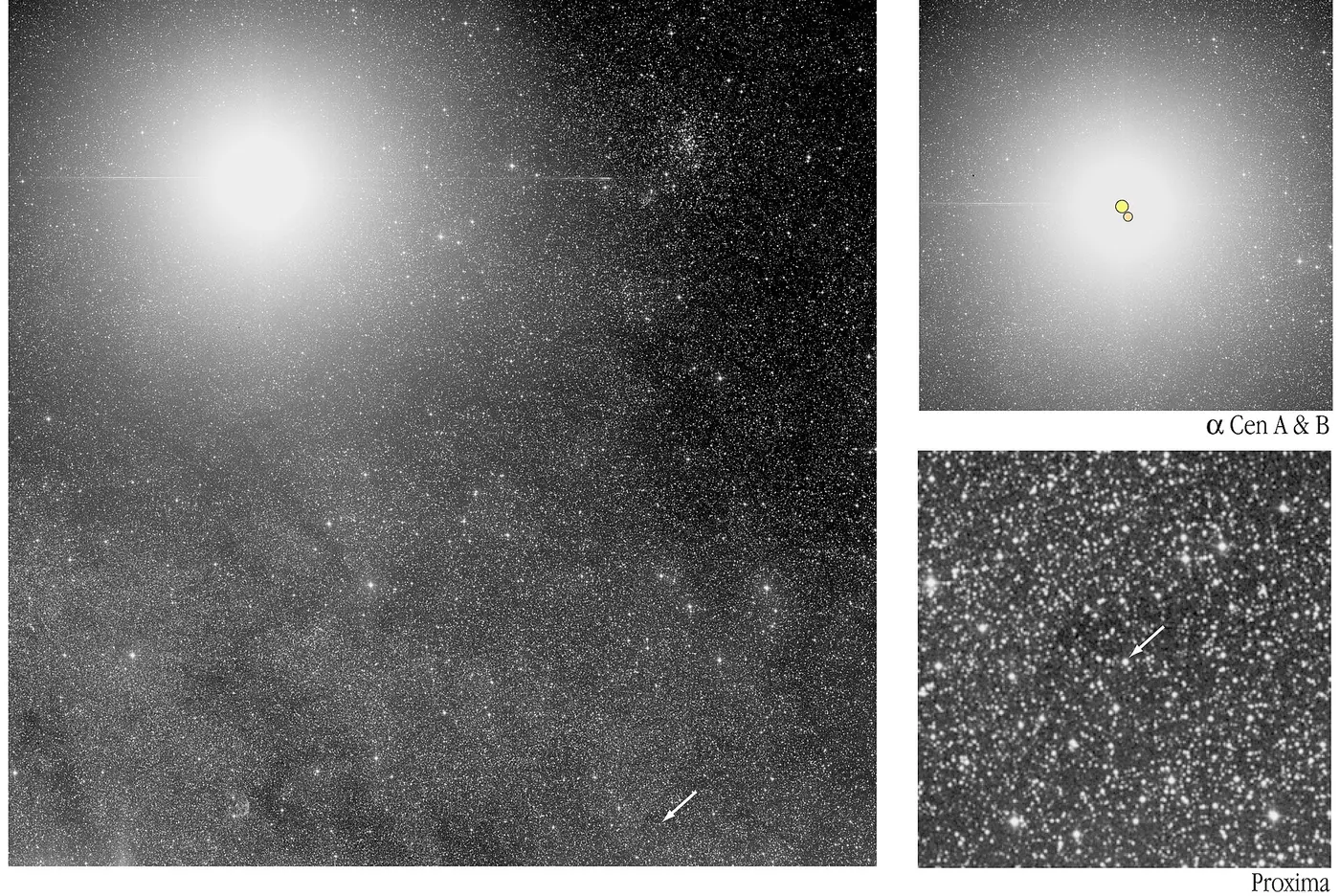

Proxima Centauri is thought to orbit this pair at a distance of about 13,000 astronomical units (13,000 times the distance from the Earth to the Sun), taking a mind-boggling 550,000 years or so to go around once. The three stars are bound together by gravity into one family.
Unfortunately, Alpha Centauri sits low in the southern sky and never rises above the horizon north of about 29 degrees north latitude. In Japan, it is a star you might just glimpse skimming the horizon from the southernmost regions, such as Okinawa.
How long would Voyager take?
Just how far is 4.24 light-years? One light-year is about 9.46 trillion kilometers, so 4.24 light-years comes to about 40 trillion kilometers (25 trillion miles).
Let’s measure that against Voyager 1, one of the most far-traveled objects humans have ever made. Launched in 1977, Voyager 1 is now moving at about 17 kilometers per second relative to the Sun. That is about 60,000 kilometers per hour (37,000 mph), an unimaginable speed by earthly standards.
Even so, at that speed a trip to Proxima Centauri would take roughly 75,000 years. That is more than ten times as long as humans have been writing. Voyager 1 is not actually headed toward Proxima Centauri, so it will never pay the star a visit. On a bullet train traveling at 320 kilometers per hour (200 mph), the journey would take about 14 million years. Even the nearest star is that far away.