Why is the night sky dark?
Because the universe has an age, and light from distant stars hasn’t reached us yet. Cosmic expansion helps too.
13.8 billionyears
When night falls, the sky goes dark. Few people stop to wonder about something so obvious. Once the Sun slips below the horizon, of course it gets dark.
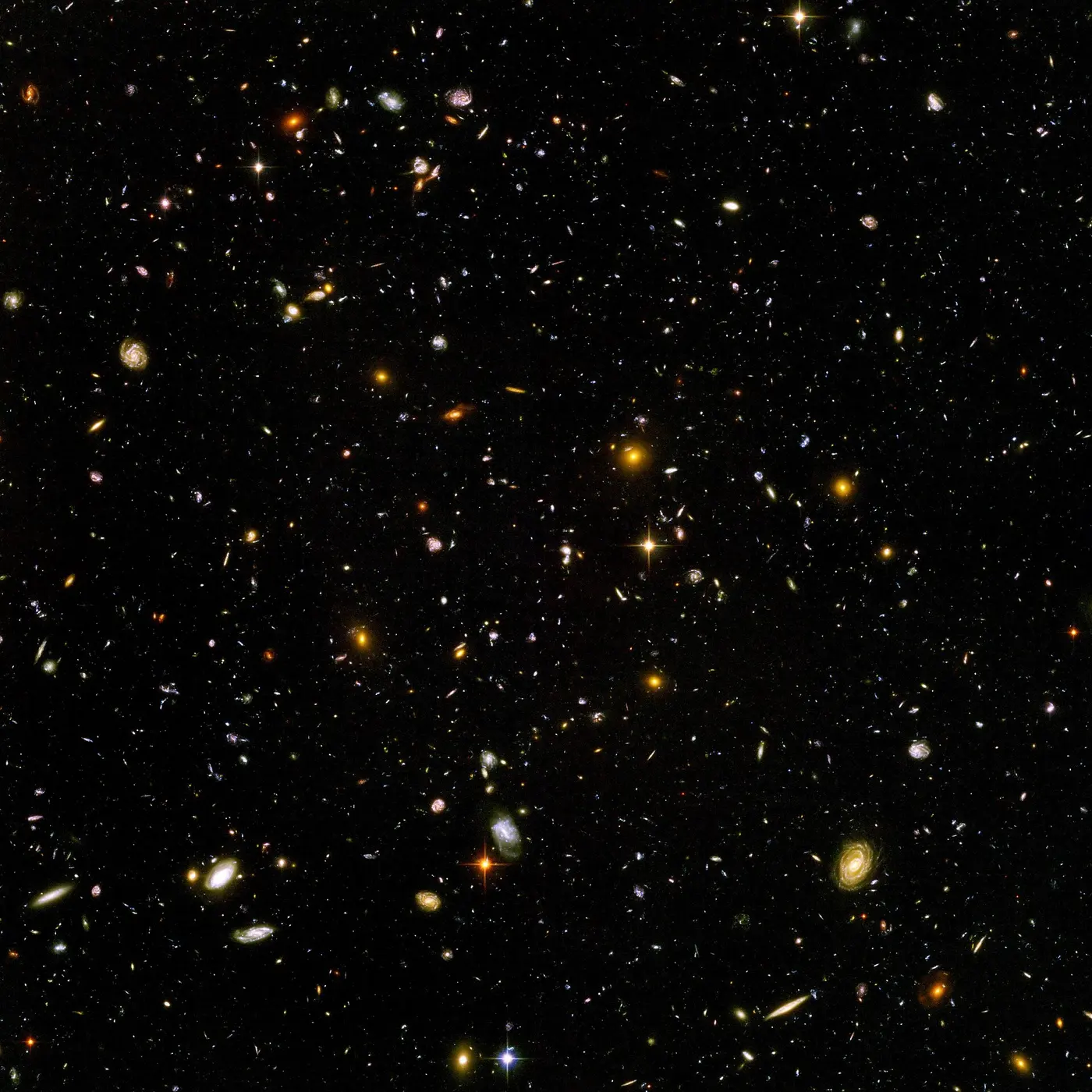
But think about it a little further and this “obvious” fact starts to look strange. If the universe stretched on forever, with stars scattered endlessly through it, the night sky ought to blaze as brightly as day—no, as brightly as the surface of the Sun.
A star in every direction
This puzzle is known as Olbers’ paradox, after the 19th-century German astronomer Heinrich Olbers.
The reasoning goes like this. Suppose the universe is infinitely large and stars are spread evenly throughout it. The farther away a star is, the dimmer it looks. But the farther out you go, the more stars there are. Do the math, and the dimming and the growing numbers cancel each other out exactly.
That means that whichever way you look, your line of sight must eventually land on the surface of some star. It is like standing deep in a forest: whichever way you turn, all you see in the end is tree trunks. The whole night sky should be wall-to-wall starlight, dazzlingly bright.

Olbers wasn’t the first
Olbers was not, in fact, the first to raise the question. He wrote his paper in 1823, but more than 200 years earlier, in 1610, Johannes Kepler had already taken the darkness of the night sky as evidence that the universe is not infinite. In the 18th century, England’s Edmond Halley and the Swiss astronomer Jean-Philippe Loys de Chéseaux also tackled the problem.
One proposed solution was that dust and gas drifting through space block the light of distant stars. But that doesn’t work. Over time, dust that absorbs light heats up and eventually starts to glow itself.
The answer: the age of the universe
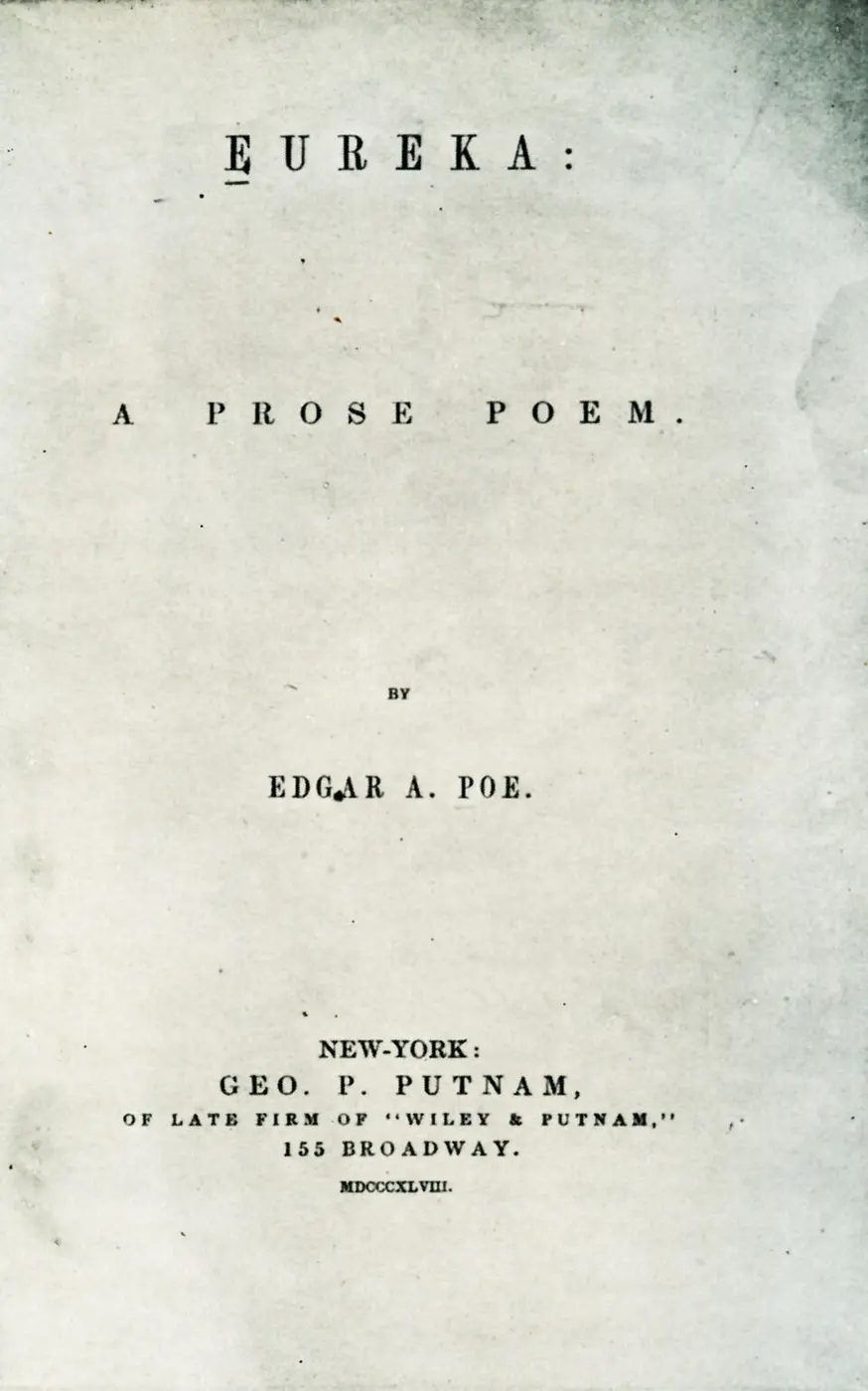
A hint at the answer came from an unexpected quarter: Edgar Allan Poe, the American writer known for “The Black Cat” and “The Murders in the Rue Morgue.”
In Eureka, the prose poem he published in 1848, Poe wrote that if the stars went on without end, the background of the sky would appear uniformly bright, like the Milky Way. He then suggested that the reason we see dark gaps in the sky is that the invisible background is so immensely far away that not a single ray of its light has yet reached us.

Modern astronomy’s answer is, at heart, much the same. The universe is thought to have begun about 13.8 billion years ago. Because light travels at a finite speed, we can only see as far as light has been able to travel since the universe began. The number of stars and galaxies within that range is limited—nowhere near enough to fill the night sky. The darkness we look up at is also a view of a universe whose light hasn’t reached us yet.
The expanding universe adds a push
The fact that the universe is expanding also helps keep the night sky dark. The more distant a galaxy, the faster it is receding, so the light it sends us is stretched toward longer, redder wavelengths (redshift) and loses energy along the way.
The most extreme example is the cosmic microwave background. Light released about 380,000 years after the universe began has been stretched so much by cosmic expansion that it now arrives as invisible microwaves, the kind given off by an object at about −270°C (−454°F). The night sky is, in fact, faintly “glowing” in every direction—just at wavelengths our eyes can’t see.
Even so, the common view is that the finite age of the universe matters more than expansion in explaining why the night sky is dark.