What exactly is a shooting star?
A sand-grain-sized speck of space dust that glows as it plunges into the atmosphere at tremendous speed.
72km/s
A shooting star slips silently across the night sky. There is an old saying that if you can repeat your wish three times before it fades, it will come true, and just spotting one feels like a little stroke of luck. Despite the name, though, a shooting star is not a star falling from the sky.
The stars that shine at night are huge bodies like our Sun, many light-years away. There is no way one of them could burn up in an instant. The real culprit is far closer to home, and surprisingly tiny.
Space dust the size of a grain of sand
The space within our solar system is filled with countless fine particles of dust shed by comets and asteroids. These particles are called meteoroids, and most of the shooting stars we see are thought to come from grains just one to a few millimeters across—about the size of a grain of sand.
So how can such a tiny particle look so bright? The secret is speed. Earth orbits the Sun at about 30 kilometers per second, so it meets these bits of space dust at a ferocious clip. When the particles plunge into the atmosphere, they are traveling at somewhere between 11 and 72 kilometers per second. The fastest of them could cover the distance from Tokyo to Osaka in just a few seconds.
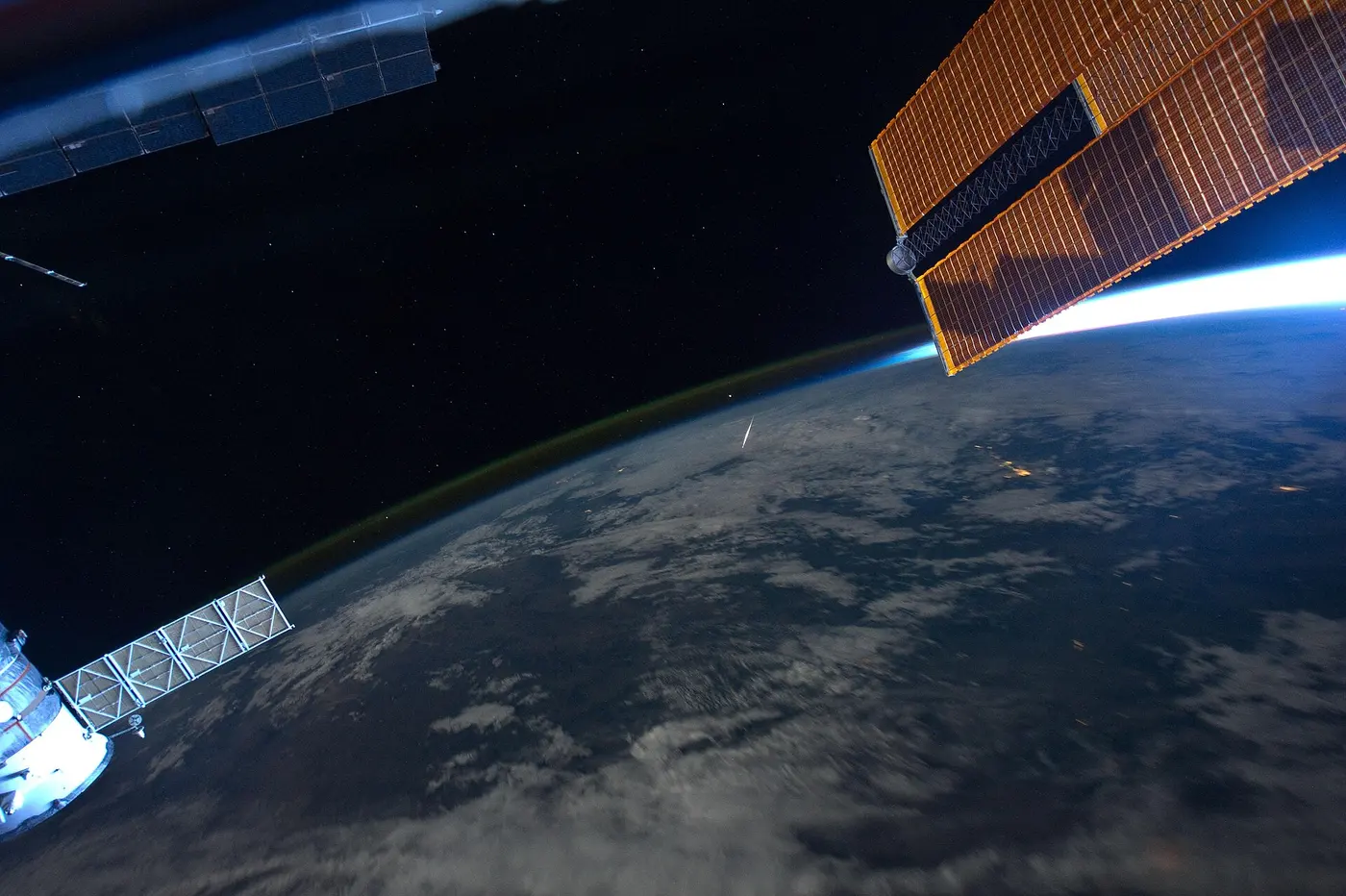

What glows is the particle’s path
Shooting stars are often said to burn up because of friction with the air. In reality, though, friction is not the main player.
In front of a particle hurtling in at such speed, the air has no time to get out of the way. It is squeezed together and heats up in an instant. That heat vaporizes the particle’s surface, and the atoms that fly off collide violently with the molecules of the surrounding air. Energized by these collisions, the atoms and molecules give off light. What we see, then, is not so much a burning particle as a streak of glowing gas along the path it has taken.
The glow begins at an altitude of roughly 80 to 120 kilometers (about 50 to 75 miles). That is about ten times higher than passenger jets fly, but still below the orbit of the International Space Station, at about 400 kilometers. Almost all of the particles vaporize completely long before they get anywhere near the ground.
Meteor showers: debris left by comets
Under a dark sky, you can see a few shooting stars an hour on an ordinary night. But at certain times every year, the number can shoot up dramatically. These are meteor showers.
As a comet nears the Sun, its ice vaporizes and it scatters dust as it travels. That dust is left behind in a band along the comet’s orbit. When Earth crosses this band at the same time each year, the dust plunges into the atmosphere en masse, and shooting stars appear one after another. The Perseids, which light up the summer sky, come from the dust of Comet Swift–Tuttle, which orbits the Sun about once every 133 years. The Geminids in December, on the other hand, are thought to come not from a comet but from an asteroid, Phaethon.
Each meteor shower is named after the constellation containing its radiant, the point from which the shooting stars seem to burst. The dust actually streams in along parallel paths, but thanks to the same trick of perspective that makes straight railroad tracks appear to meet at a distant point, the meteors seem to spread out from a single spot.
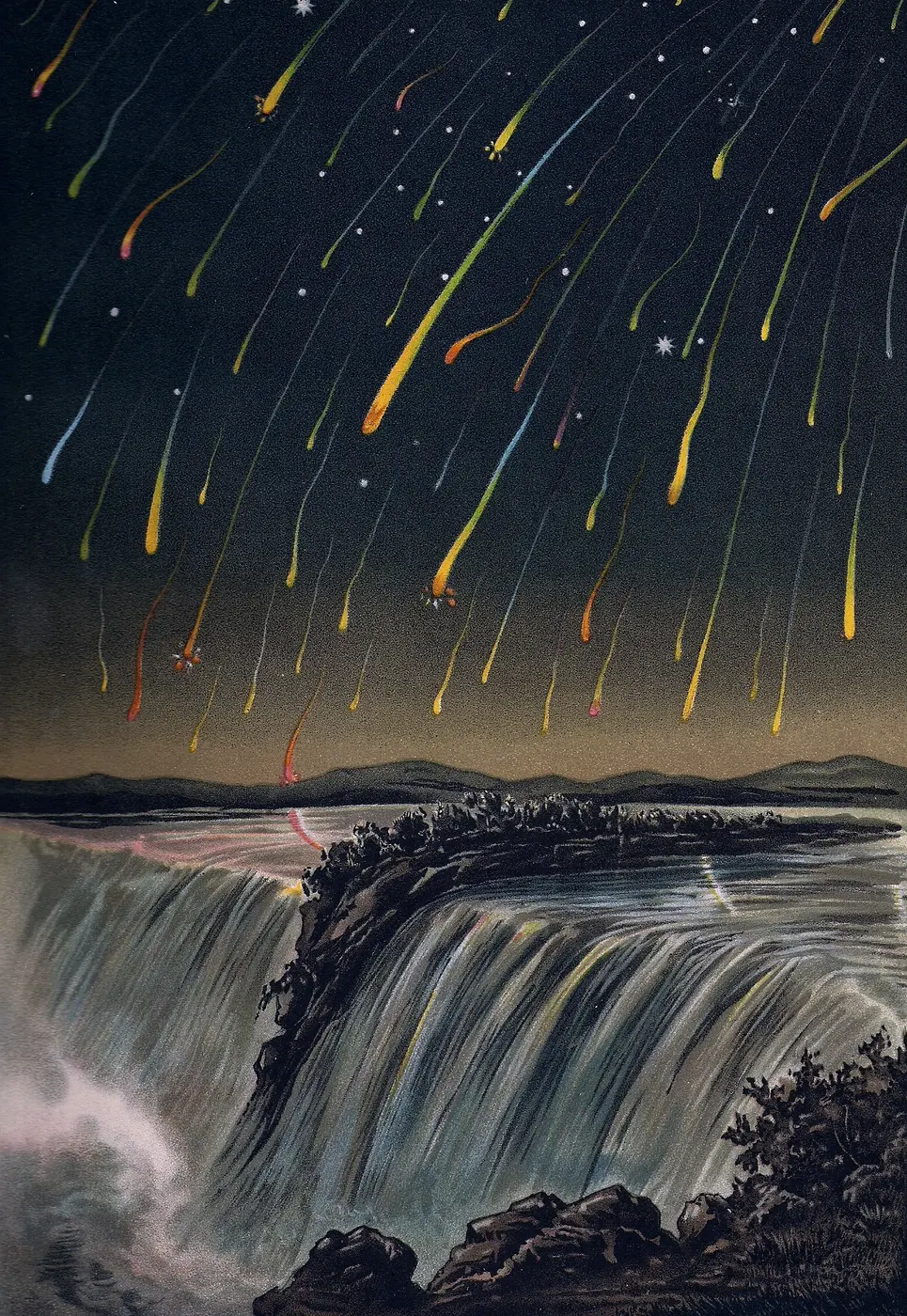
Sometimes Earth plows through an especially dense part of the dust, producing an outburst so intense it is called a meteor storm. During the Leonid shower of November 1833, shooting stars rained down over North America at a rate some put at tens of thousands per hour. Observations from that night drew attention to the way meteors radiate from a single point, and they are said to have greatly advanced the study of meteor showers.

What falls from space every day
The dust that becomes shooting stars adds up to a considerable amount. The space dust falling on Earth is estimated at several dozen tonnes a day. Estimates vary widely from study to study, but NASA cites a figure of about 44 tonnes. Most of it vaporizes in the atmosphere or drifts slowly down to the ground as particles too fine to see.
Very occasionally, a larger chunk plunges in and becomes a fireball, shining brighter than Venus. If it survives all the way to the ground without burning up, it is a meteorite. That brief flash in the night sky is also proof that Earth is still receiving material from space, day after day.