Why doesn’t the stomach digest itself?
A barrier of mucus protects its surface, and its vulnerable lining cells are replaced every few days.
3–5days
Whether you eat a steak or a grilled fish, your stomach breaks it down into a thick, porridge-like mush. The main player is gastric juice, which contains hydrochloric acid, a strong acid, and pepsin, an enzyme that breaks down protein.
That raises a question. The wall of the stomach is itself a mass of muscle and cells made of protein. Why doesn’t gastric juice strong enough to dissolve the meat you eat dissolve the stomach too?
A strongly acidic place
First, let’s get a sense of just how harsh the inside of the stomach is.
On the pH scale, the acidity of gastric juice on an empty stomach is around 1 to 2. A pH of 7 is neutral, and the lower the number, the stronger the acid. Lemon juice is said to be around pH 2, so the inside of your stomach is a world as sour as lemon juice, or even more so.
This strong acid also has the job of killing off many of the bacteria that come in with food. On top of that, the acid acts as a “switch” that lets pepsin go to work.
An invisible barrier of mucus
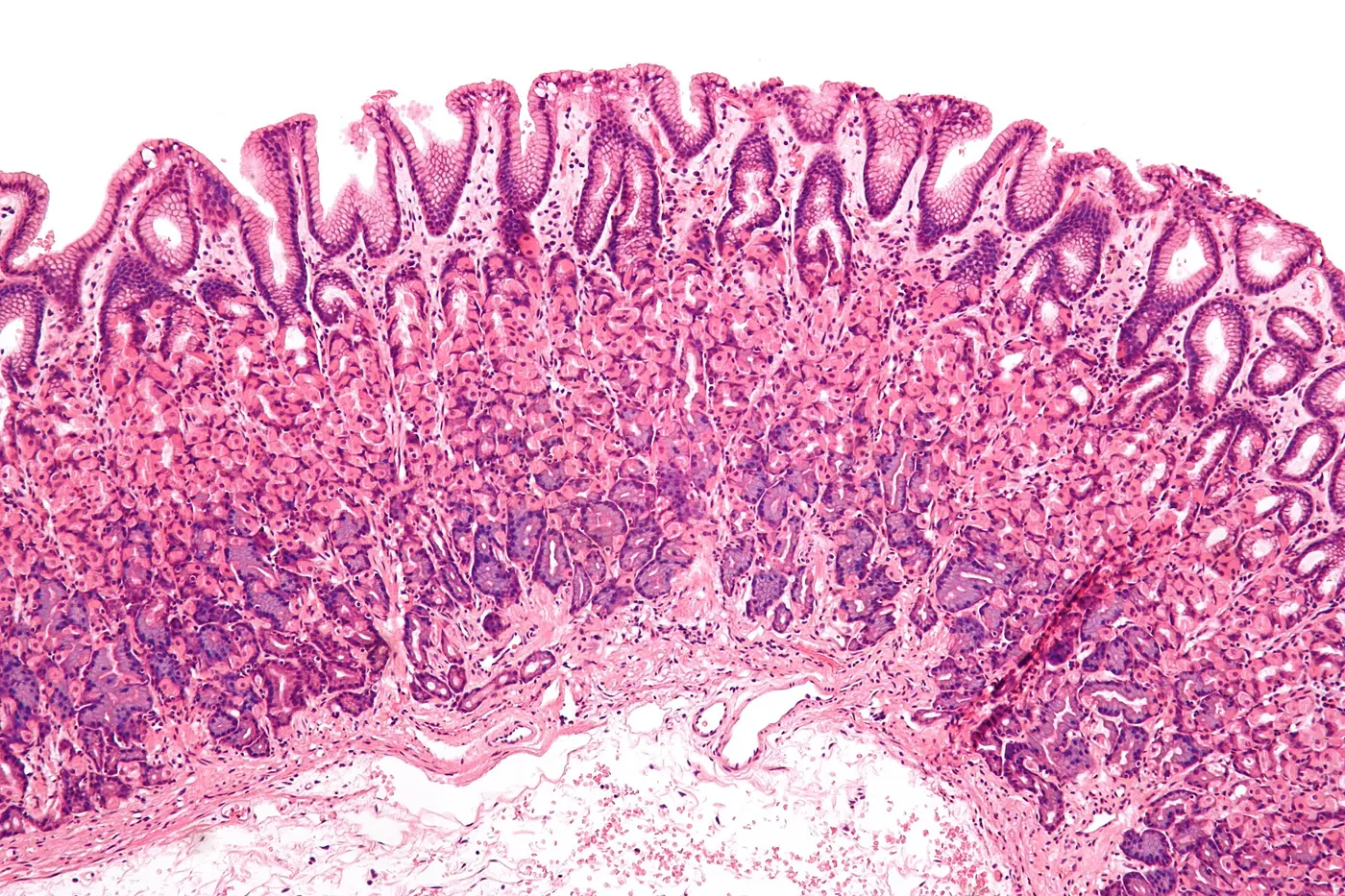
The stomach’s first line of self-defense is a thick layer of mucus coating its surface.
The cells lining the stomach constantly secrete sticky mucus, covering the stomach wall without gaps. This mucus contains bicarbonate ions, which neutralize acid. So even when the middle of the stomach is strongly acidic, the deep part of the mucus layer, right next to the cells, is kept close to neutral.
In other words, the stomach wall never touches the strong acid directly. It faces the acid with a thin but dependable neutral cushion in between.

The dissolving tool is finished just before use
The second defense lies in how the digestive enzyme is made.
Pepsin is not produced in its finished form inside the stomach’s cells. It is first secreted in an inactive form called pepsinogen. Only when it meets acid inside the stomach does it turn into pepsin, the enzyme that breaks down protein.
Think of a pair of scissors shipped from the factory with a cover over the blades, which is only removed once they reach the place they will be used. If cells made finished pepsin inside themselves, they might end up digesting themselves. Keep the dangerous tool asleep until the moment it is needed: that is the safety measure the body has adopted.
Built to wear out, replaced constantly
Even so, the cells on the stomach’s surface are exposed to a harsh environment and gradually get damaged. So, as a third defense, the stomach keeps replacing them with new ones.
The cells covering the stomach’s surface are said to live only about three to five days. Old cells slough off, and new cells born deeper down are pushed up one after another. Even if the surface picks up a little damage, a few days later it has been renewed with a fresh one.
The cells are also joined tightly together with no gaps, which makes it hard for acid to seep deeper into the wall. And the stomach wall is laced with tiny blood vessels that constantly deliver oxygen and the raw materials for making mucus and new cells. Mucus, an enzyme safety catch, rapid cell turnover and a rich blood supply: with layer upon layer of defenses, the stomach manages not to dissolve itself.
When this balance breaks down, though, the stomach wall can be damaged. Stomach ulcers are a typical example. They were once thought to be caused mainly by stress and diet, but we now know that infection with the bacterium Helicobacter pylori and certain painkillers are major causes. Barry Marshall and Robin Warren of Australia, who discovered H. pylori, received the 2005 Nobel Prize in Physiology or Medicine for this work. Marshall is also famous for drinking a liquid containing the bacteria himself, to show that it causes stomach disease, and actually developing gastritis.