Are you taller in the morning than at night?
Yes. During the day the cushions in your spine get squeezed, leaving you 1 to 2 centimeters shorter by night, and sleep restores them.
19mm
Have you ever been measured at a health checkup and come out a little shorter than you expected? It isn’t necessarily a mistake. Your height changes slightly over the course of every day.
You are tallest when you get up in the morning and gradually lose height toward evening. The difference is about 1 to 2 centimeters (0.4 to 0.8 inches). So which part of the body is shrinking?
A clergyman’s discovery 300 years ago
Someone noticed this a long time ago: Mr. Wasse, the rector of Aynho, a village in Northamptonshire, England. In 1724, a letter from him was published in the journal of the Royal Society in London.
Wasse had seen soldiers discharged for falling just short of the required height. Knowing that a person’s height differs between morning and night, he told an officer about it, and, he wrote, several men were kept from being turned out of the service.
Wasse went on to measure all kinds of people, from those who spent their days sitting to day laborers, and reported that the difference between morning and night came to “near an inch,” about 2.5 centimeters. He also tested himself, finding that he lost height after half an hour of pushing a garden roller, or after hours of study at his writing desk. As for the cause, Wasse suggested that the cartilage between the bones of the spine gives way under the weight of the body held upright.
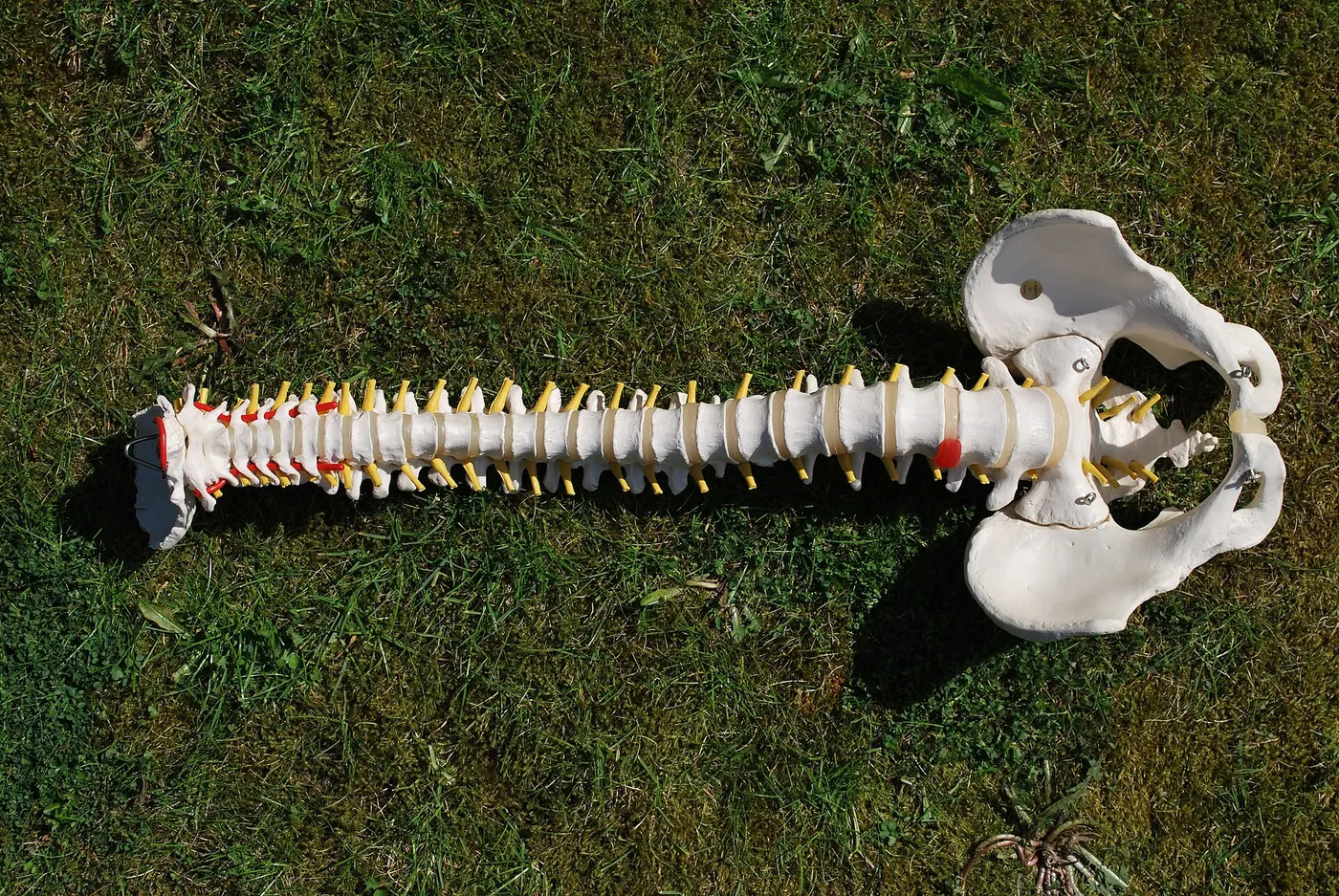

The spine’s cushions shrink
Wasse was essentially right. Our spine is a stack of bones called vertebrae running from the neck to the lower back, and between them sit 23 disc-shaped cushions called intervertebral discs.
The discs hold a lot of water. While we stand or sit, the weight of the upper body presses down on them constantly, slowly squeezing water out and making them thinner. At night, when we lie down and the weight comes off, the discs take water back in and swell again. The change in each disc is tiny, but added up over 23 discs it shows up clearly as a difference in height.
More than half lost in the first hour
So when during the day does the shrinking happen? In 1985, researchers in Britain measured the height of eight young adults to within a millimeter. Their height varied over the day by an average of 19.3 millimeters, about 1.1 percent of their stature.
The interesting part is the timing. Fifty-four percent of the day’s loss happened in the first hour after getting up. Once we rise and our weight bears down, the discs shrink quickly. At night, the reverse happens: about 70 percent of the lost height came back during the first half of the night.


Carrying heavy loads makes the shrinkage even greater. In another study, the ordinary daily variation in height (14.4 millimeters on average) was larger than the amount experienced runners shrank during a 25-kilometer (15-mile) run. Everyday life alone puts that much load on the spine.
Measure at the same time of day
If you want to compare your height fairly over time, it makes sense to measure at about the same time each time. And if you want the biggest number, first thing in the morning is your best bet.
In space, where there is no weight on the spine, the discs swell even more, and astronauts can grow several centimeters taller. It is like a magnified version of the small change we go through on the ground every day.
Morning discs call for a little care, though. Experiments have shown that when the discs are full of water in the morning, the spine is more vulnerable to bending forward, and that the discs become harder to injure as they lose water later in the day. So it may be wise to take some care when lifting something heavy right after you get up.