Is muscle soreness caused by lactic acid?
Lactate clears within about an hour of exercise; soreness is thought to come from tiny muscle damage and inflammation.
The day after a long hike after months off, or perhaps the day after that, you start down the stairs and a dull ache shoots through your thighs. Has anyone ever told you, at a moment like that, “That’s just lactic acid building up in your muscles”?
Exercise produces a substance called lactic acid, which collects in the muscles and makes them hurt. For a long time, that explanation was repeated almost as common knowledge. Today, though, many researchers believe lactic acid is not the main cause of muscle soreness.
By the time it hurts, the lactate is gone
Lactate is produced when the body breaks down sugar to release energy. During hard exercise, the amount of lactate in the muscles and in the blood rises for a while.
But that extra lactate doesn’t stick around. Many studies have found that blood lactate returns to its normal level within about an hour after exercise ends.
The soreness that arrives a day or more after a workout, on the other hand, is known in medicine as delayed onset muscle soreness. It is said to be most intense, in many cases, 24 to 72 hours after exercise. In other words, the pain peaks long after the lactate has been cleared away. That makes lactic acid a hard suspect to convict.
Flat ground versus downhill: which one hurt?
One experiment put this question to the test. In 1983, an American research team had volunteers run on a treadmill for 45 minutes: once on the level, and once tilted to run downhill. They measured lactate in the runners’ blood during the run and tracked their muscle soreness for the next 72 hours.


The results were clear. Running on the level raised lactate significantly, yet no notable soreness followed. Running downhill, by contrast, never raised lactate at all, and yet the runners became thoroughly sore over the following days. The team concluded that lactic acid has nothing to do with delayed onset muscle soreness.
The key is “braking” movement
So why does running downhill make your muscles sore more readily? The answer lies in how the muscles are used.
Muscles don’t only produce force while shortening; they can also produce force while being stretched. When you walk down a slope or a flight of stairs, the muscles at the front of your thighs are lengthening even as they strain to keep your body from sinking. They are, in effect, working while applying the brakes. This kind of “eccentric contraction” is known to make exercise far more likely to cause soreness.
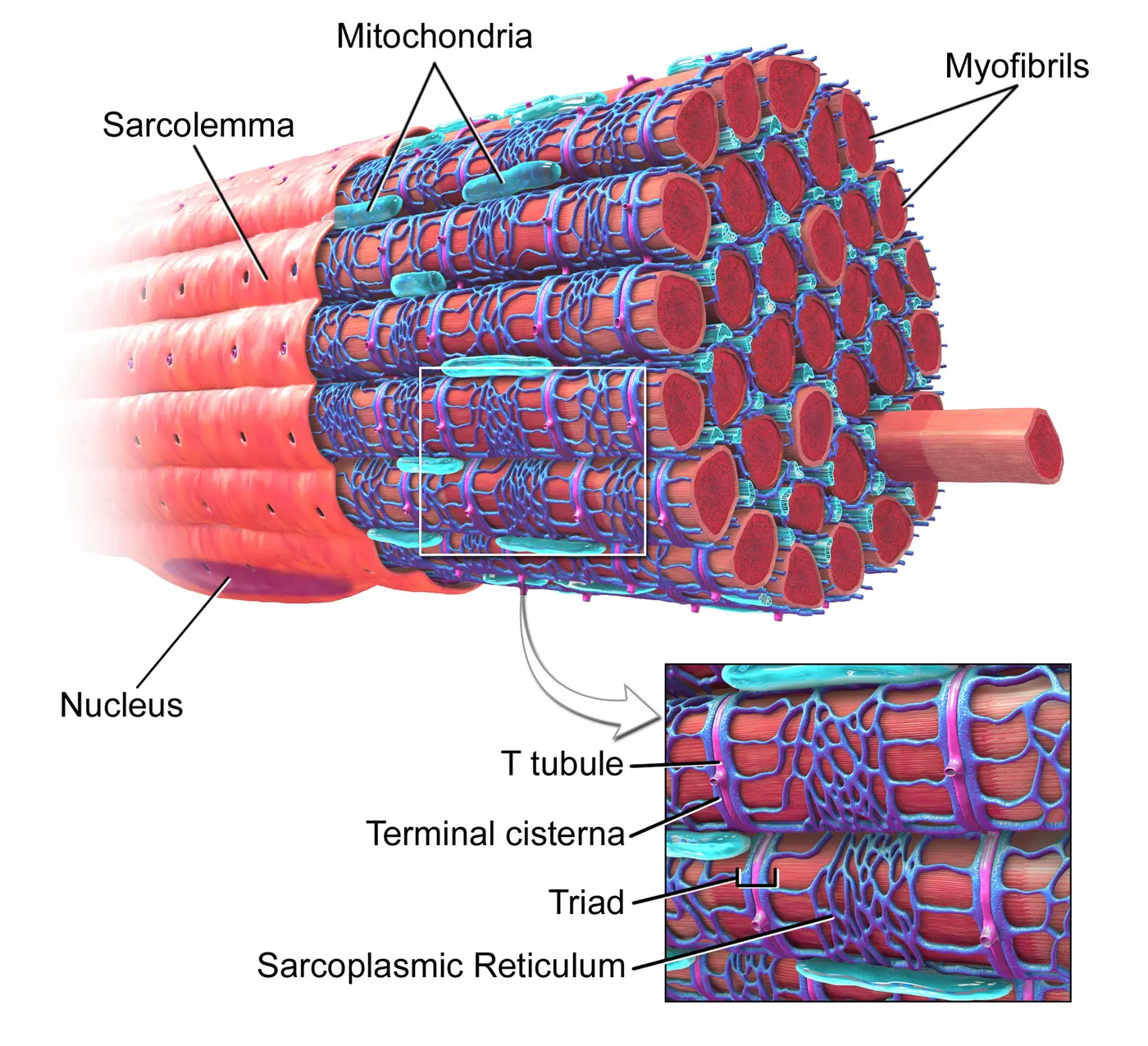

A muscle is made of bundles of thin muscle fibers. Inside each fiber are even thinner myofibrils, lined with rows of tiny units called sarcomeres. When a muscle produces force while being stretched, minute damage has been observed in places such as the boundaries between sarcomeres. The leading explanation is that inflammation follows as the body repairs that damage, making the muscle more sensitive to pain.
Even so, many details of exactly how the pain arises remain unclear. Research has also found that stretching before or after exercise does not prevent soreness.
Lactate is actually a valuable fuel
To clear lactic acid’s name a little further: it can’t simply be dismissed as “the cause of fatigue” or as waste. In 1985, the American physiologist George Brooks proposed the “lactate shuttle” hypothesis, the idea that lactate is carried around the body and reused as an energy source. Lactate made by working muscles during exercise is burned as fuel by the heart and other muscles, or rebuilt into sugar in the liver.
It is also known that once a muscle has been sore, the same exercise causes much milder soreness the next time. This protective effect lasts at least several weeks and is said to fade almost completely after about a year. That may be why the first workout after a long break hurts the most.