How many smells can humans tell apart?
No one knows exactly. A “1 trillion” figure made headlines, but its math has been disputed.
400types
The aroma of coffee drifting through the kitchen in the morning, the smell of asphalt after a summer downpour, the indescribably familiar scent of the house you grew up in when you visit after a long time away. Every day, we live surrounded by more smells than we could ever count.
So how many smells, in total, can the human nose tell apart? It sounds like a simple question, but it has sparked a surprisingly heated debate among scientists.
The long-repeated “10,000”
Humans can distinguish about 10,000 smells. For many years, that was the number you would find in textbooks and magazines.
It is said to trace back to a system for classifying odors devised in 1927 by two American chemists, Crocker and Henderson. They broke smells down into four components, “fragrant,” “acid,” “burnt” and “caprylic” (goaty or fatty), and rated the strength of each on a nine-point scale from 0 to 8. That gives 9 to the fourth power, or 6,561 combinations, a figure that is said to have later been rounded up and popularized as a neat “10,000.”
In other words, 10,000 was never a count of how many smells people could actually distinguish in experiments. It was simply a theoretical number that fell out of a classification scheme.
The “1 trillion” bombshell, and the backlash
In 2014, a paper published in the American journal Science overturned that conventional wisdom. A research team at Rockefeller University prepared mixtures made by combining 128 different odor molecules and asked participants whether they could tell the mixtures apart. Calculating from the results, the team concluded that humans can distinguish at least 1 trillion smells.


The news that the human nose could tell apart a trillion smells was reported around the world. But the following year, in 2015, other researchers published rebuttals one after another. The estimate, they noted, had taken a very limited set of experimental results and stretched them all the way to “1 trillion” through mathematical extrapolation. Change the assumptions behind that calculation or the method of analysis just a little, the critics pointed out, and the answer could come out as anything from a few thousand to an astronomical number.
Today, the view that the trillion figure can’t be taken at face value has become widespread. Even defining what counts as “a different smell” is far from simple, and the honest answer is that nobody yet knows the exact number.
About 400 kinds of sensors in your nose
The number may be unclear, but we do now understand a good deal about how the nose tells smells apart.
High up at the back of the nasal cavity is a patch packed with smell-sensing cells. On the surface of those cells are sensors called receptors, which catch odor molecules. The human genome holds about 800 blueprints for these receptors, but around half of them no longer work, and only about 400 types are thought to be in actual use.
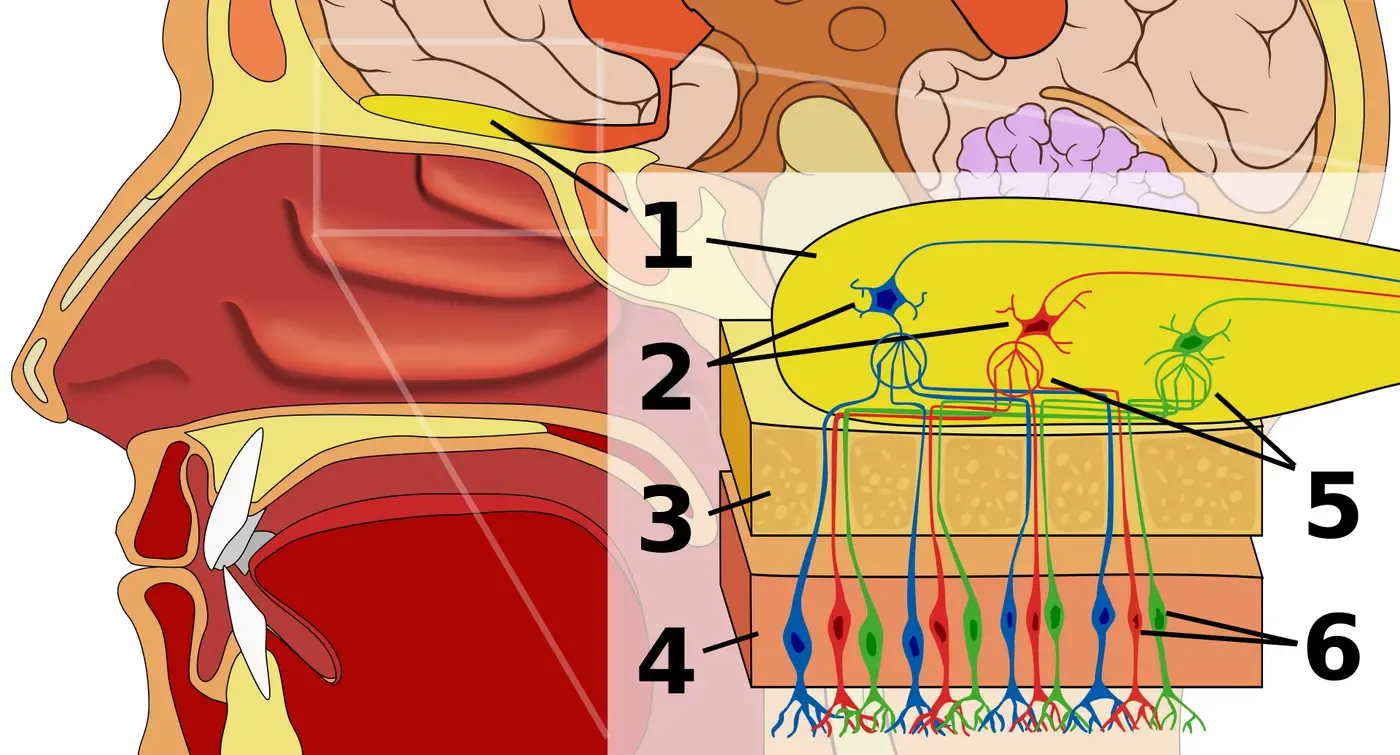

A single odor molecule usually triggers several types of receptors. The brain reads the pattern, which receptors responded and how strongly, as “rose” or “something burning.” Just as a small alphabet can spell out countless words, combinations of about 400 types of sensors can represent an enormous number of smells. Uncovering this mechanism led to the 2004 Nobel Prize in Physiology or Medicine.
The human nose is better than you think
It is often said that humans have a poor sense of smell compared with dogs and other animals. But in 2017, an American researcher argued in a paper in Science that this idea is a “myth” that grew out of the assumptions of a 19th-century anatomist. Because the part of the human brain that handles smell is relatively small, he said, people simply concluded that our sense of smell had degenerated.
In fact, in an experiment published in 2007, blindfolded students with their ears blocked managed to follow a trail of chocolate scent laid across a grassy field, noses close to the ground. About two-thirds of those who tried succeeded. Perhaps we just don’t give much thought to what our noses can really do.