Is it true that starfish have no brain?
Yes. Instead of a brain, they run their bodies with a ring of nerves around the mouth and nerves along each arm.
You can find starfish in rocky tide pools or in an aquarium touch tank. They look like they are sitting still, but flip one over and you will see countless tiny feet wriggling, and they do make their way toward wherever they want to go.
Yet a starfish has no brain. It can see, smell, and move toward its prey, but there is no control center pulling all of that together. So how does a starfish run its body?
Nerves without a command center
Starfish, also called sea stars, are echinoderms, relatives of sea urchins and sea cucumbers, and about 1,900 species are known worldwide. The mouth sits in the middle of the underside, and a ring of nerves runs all the way around it. From that ring, a thick nerve extends down each of the five arms, and a mesh-like net of nerves spreads across the body surface.
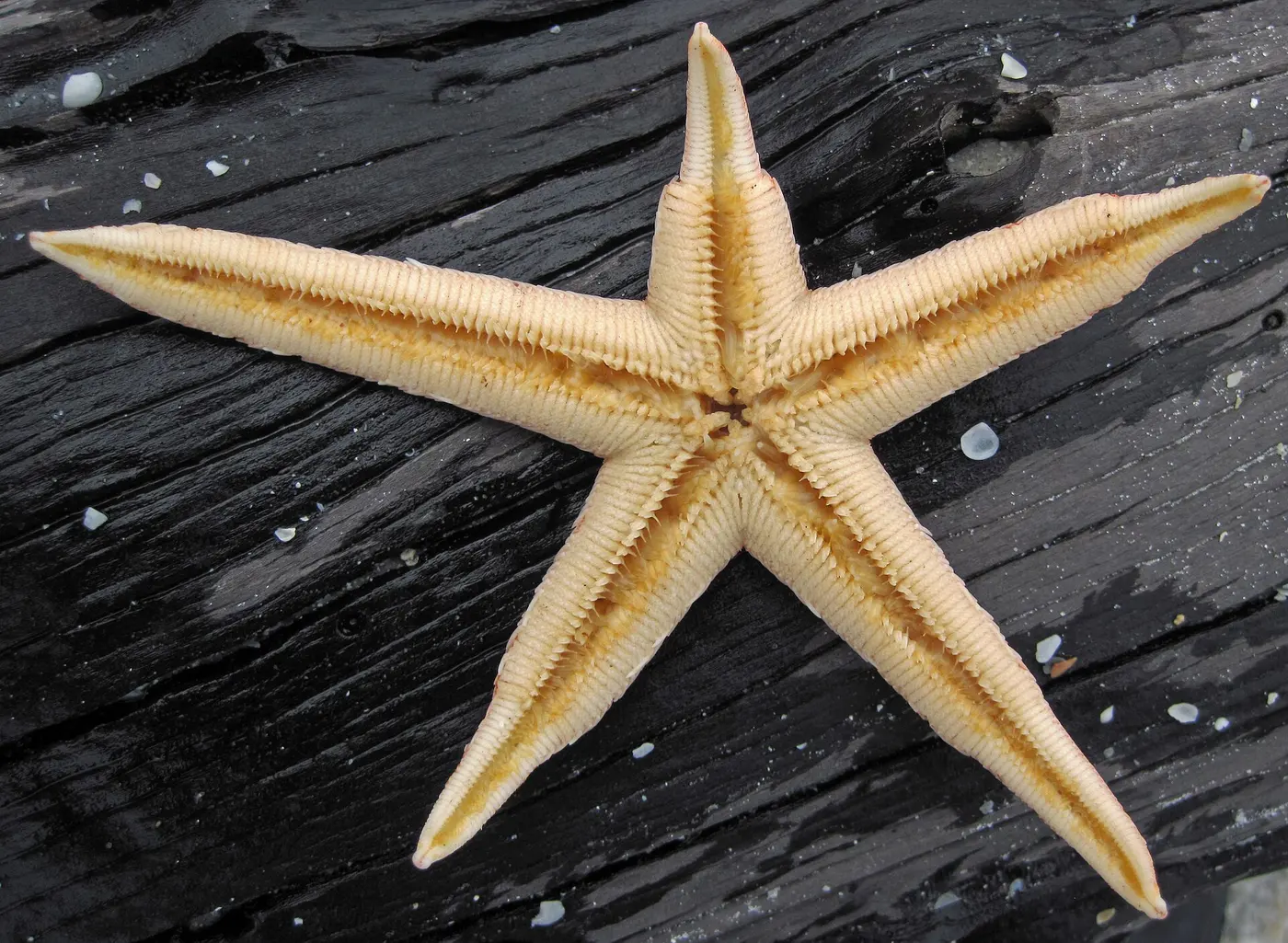

This nerve ring is not a place that handles all the information the way a brain does. The nerves in each arm make decisions on their own to some extent. If one arm detects something attractive, such as the scent of food, that arm temporarily takes the lead and the others follow it in that direction. Instead of a fixed head, the starfish has a leader arm that changes from moment to moment.
Eyes on the arm tips, feet that run on water
No brain doesn’t mean no senses. At the tip of each arm is an eyespot made up of about 80 to 200 tiny simple eyes. It can’t see shapes sharply, but it is thought to distinguish light from dark and pick out rough features of its surroundings.
The way starfish move is unusual, too. The undersides of the arms are lined with rows of little tube feet that extend and retract using water pressure from a network of water-filled canals inside the body, called the water vascular system. The tips of the tube feet look like suction cups, but they are said to actually stick to rocks with an adhesive substance and release with another one.
Even their eating habits are odd. When they feed on clams and other bivalves, many starfish push their own stomach out through the mouth, wrap it around the prey, and digest it right there.
Is the whole body a “head”?
Far from having no brain, one study suggests a starfish may be all head.
Starfish larvae have bilaterally symmetrical bodies, like ours, and change into a star shape as they develop. How did a five-way body arise from a two-sided ancestor? That has long been one of zoology’s great puzzles.
A team led by Laurent Formery at Stanford University in the United States used a species of bat star to map in detail where in the starfish body the genes that build the “head,” “trunk” and “tail” in other animals are active. They published their results in Nature in 2023. The head-forming genes were active in the center of the body and along the midline of each arm, while tail-related genes were active toward the edges of the arms. Trunk-forming genes, meanwhile, were not found anywhere on the body surface.
Formery said that it is as if the starfish is completely missing a trunk and is best described as just “a head crawling along the seafloor.” Of course, this is one interpretation based on gene activity, and much about how starfish evolved remains a mystery.

A whole body from a single arm
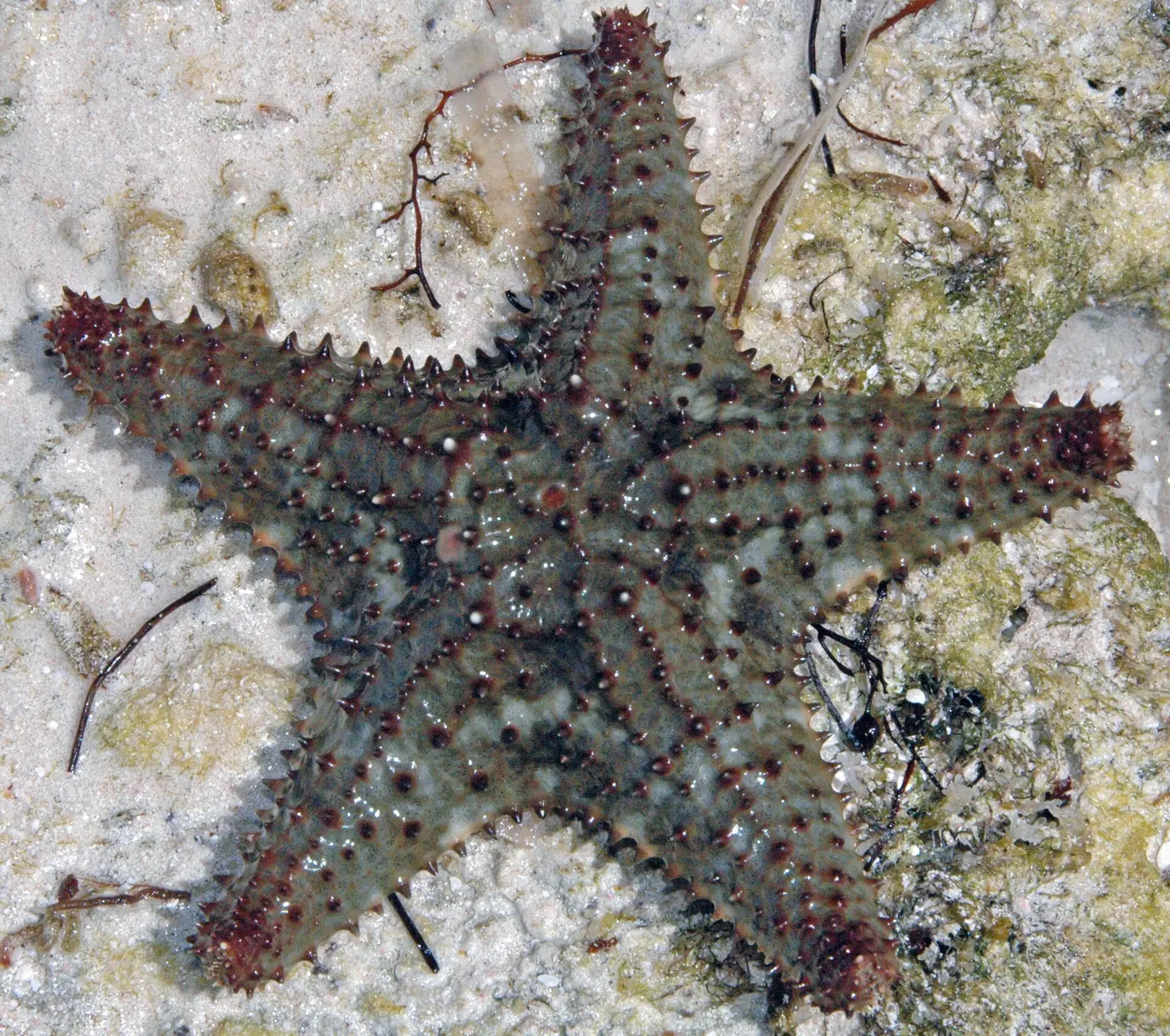
Starfish are also famous for their powers of regeneration. Lose an arm, and given time, they can grow a new one.
Most astonishing of all are the Linckia sea stars of tropical seas. A single severed arm can sometimes regrow the entire rest of the body. Because a long arm sprouting tiny new arms looks like a comet, this stage is called a “comet.” It is said to take several months to return to full form.