Do male seahorses really give birth?
Yes. The female lays her eggs in a pouch on the male’s belly, and he carries the young there until birth.
In an aquarium tank, a seahorse wraps its tail around a strand of seaweed and holds perfectly still. In Japanese it is called tatsu-no-otoshigo, “the dragon’s dropped child,” because it looks like a baby dragon. But it is a fish through and through.
And it has one of the strangest habits in the animal kingdom. The one that gives birth is not the female but the male. That swollen belly belongs to the father.
She hands over the eggs, he takes them in
Seahorses belong to the pipefish family, and nearly 50 species are known worldwide. On the male’s belly is a pouch called a brood pouch, and that is where the parenting happens.
In the breeding season, a male and female swim side by side, brighten their colors, line up their bodies, and repeat their courtship again and again. Once the two are in sync, they face each other and rise slowly through the water, and the female inserts a tube-like organ into the opening of the male’s pouch and passes her eggs inside. In the seahorse species found off Japan, the female is said to lay a few eggs at a time, pause, then lay a few more, depositing 40 to 50 in total over about two hours.
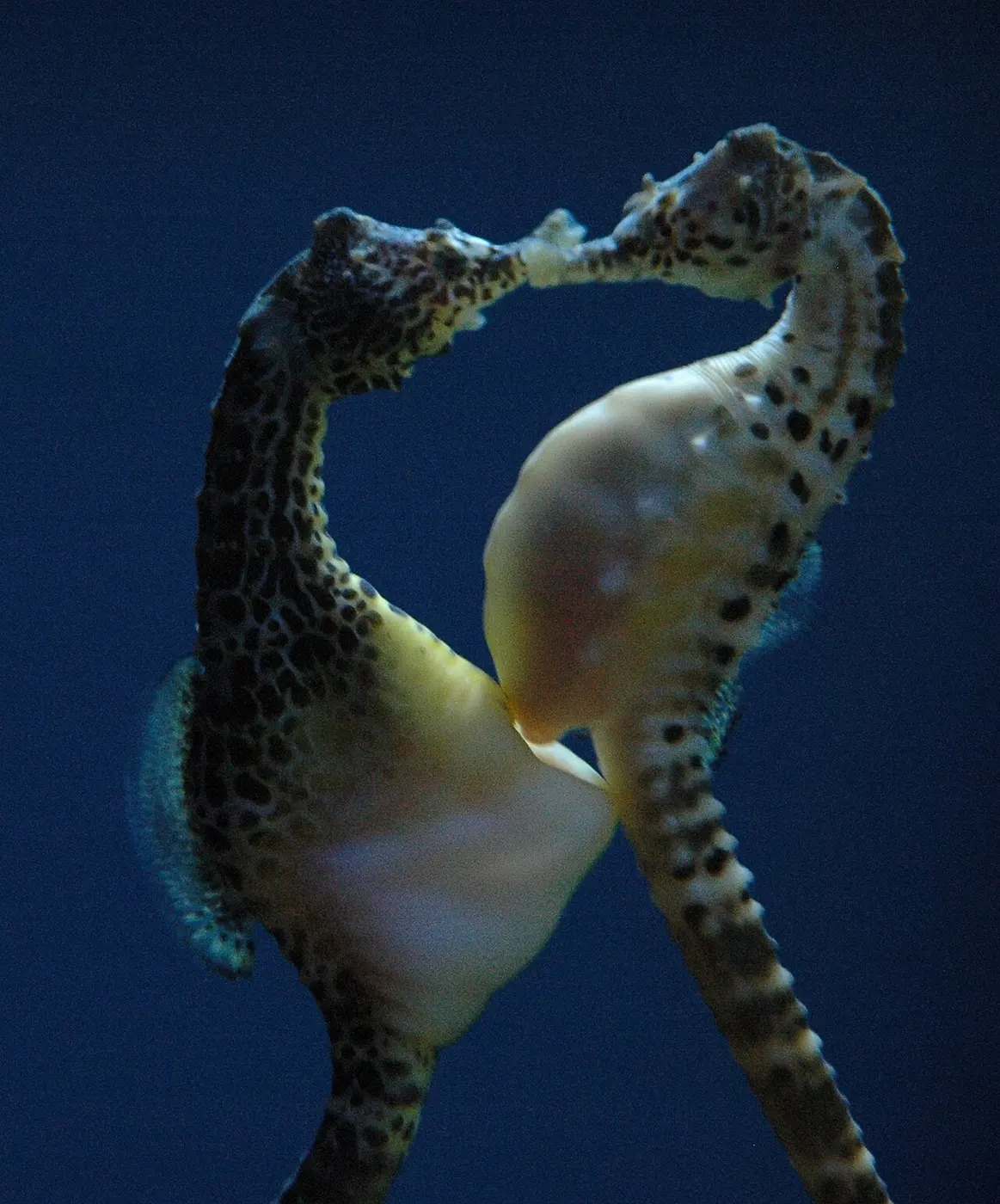

The eggs are then fertilized inside the male’s pouch. You might wonder: if the male gives birth, shouldn’t he be called the female? But biologists define the female as the one that makes eggs and the male as the one that makes sperm. The eggs always come from the female; the male’s job is to look after them.
More than a cradle
The brood pouch is not just a pocket for storing eggs. The eggs are embedded in soft tissue lining the pouch, where the father supplies oxygen, regulates the saltiness of the fluid inside, and protects the young from pathogens. The embryos get most of their nourishment from egg yolk, but there are reports that the father also supplies fats, calcium and other nutrients.
Researchers in Australia examined the brood pouches of pot-bellied seahorses under the microscope at different stages of pregnancy. Their results, published in 2021, showed that fine blood vessels multiply in the pouch lining as pregnancy progresses, especially toward the end. They also found that the distance between the father’s blood and the embryos shrinks steadily. These changes are thought to make the exchange of oxygen and carbon dioxide more efficient.
Many of these changes closely resemble what happens in the uterus during mammalian pregnancy, the researchers say. Another study found that some of the genes active in the pouch during pregnancy are shared with genes involved in pregnancy in mammals and reptiles. Fish and mammals, two very distant groups, may have arrived at “pregnancy” using a similar set of tools.
Dad goes into labor
It is said to take anywhere from 10 days to about a month and a half, usually two to three weeks, for the eggs to develop into young. When the time comes, the father, his belly stretched tight, flexes his body, and tiny miniature seahorses come shooting out of the pouch opening one after another.
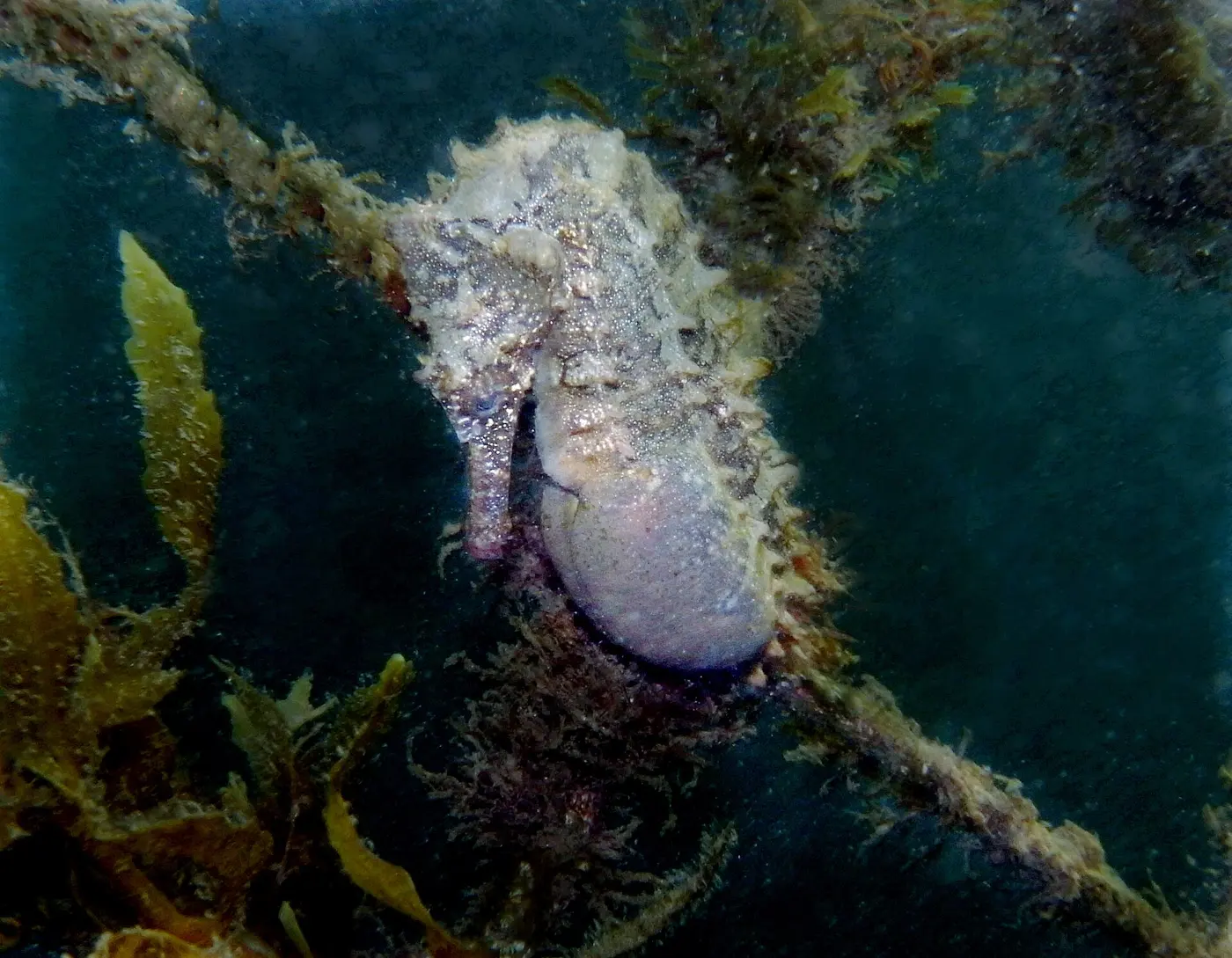

The number born at once varies by species: about 100 to 1,000 in most, but as few as five in small species and as many as 2,500 in others. The newborns get no further care from their parents and start fending for themselves right away. Fewer than 0.5 percent are thought to survive to adulthood, but that is apparently quite high compared with fish that simply scatter their eggs.
Raising young is no small burden for the male, either. One report found that after receiving the eggs, males consume more than 30 percent more oxygen than they did before.
Why the father?
Why did male pregnancy evolve? There is no clear answer yet. One idea is that while the male is brooding one batch of eggs, the female can get the next batch ready, so the pair can breed in faster cycles.
Either way, seahorses and their relatives have taken male egg care about as far as it can go. Many of their close cousins, the pipefishes, also have males that carry eggs on their bellies.