Is there sound in space?
Sound can’t travel through ordinary space. But where gas is dense enough, astronomers have found sound waves.
The 1979 film Alien was promoted with a famous tagline: “In space no one can hear you scream.” Most of us have heard at some point that space is a world without sound. And yet in science fiction movies, spaceships roar as they fly and explode with spectacular booms.
So is there really sound in space? The answer is “in most places, no.” But in certain parts of the universe, we now know, an unimaginably deep sound is ringing out—one that no human could ever hear.
Sound is air that trembles
What is sound, anyway? When we speak, the vibrations of our throat push and pull on the surrounding air, creating a series of denser and thinner regions. This wave of compressions travels through the air and sets our eardrums vibrating, and that is what we perceive as sound. In air at ground level, sound travels at about 340 meters per second.
In other words, sound needs a medium—air, water, metal—to pass the vibration along. Space, however, is nearly a vacuum. Each cubic centimeter of air at ground level is packed with tens of quintillions of molecules, but in the space between stars it is not unusual to find only a few atoms in the same volume. With nothing to pass the trembling along, sound cannot travel.


That is why astronauts on a spacewalk talk by radio even to a crewmate right next to them. Even if they pressed their helmets close and shouted, their voices could not cross the vacuum in between.
Space is not completely empty
That said, space is not perfectly empty everywhere. Thin gas drifts even between the stars, and in some places much more gas has gathered.
Sound can travel through even a very thin medium, as long as its wavelength is long enough. And the universe contains enormous “corridors” for sound, brimming with gas: galaxy clusters, gatherings of hundreds or even thousands of galaxies. The space between the galaxies in a cluster is filled with gas heated to tens of millions of degrees. This gas is so hot that it shines not in visible light but in X-rays.
The B-flat of the Perseus cluster
In 2003, a research team led by the British astronomer Andrew Fabian reported a remarkable discovery in data from NASA’s Chandra X-ray Observatory. In the gas of the Perseus galaxy cluster, about 250 million light-years from Earth, they found patterns etched like ripples spreading across a pond.
These are thought to be sound waves generated by the activity of the supermassive black hole at the cluster’s center. Material blasting out from around the black hole shoves the gas aside to inflate giant bubbles, and the pressure waves from this process had spread through the surrounding gas for hundreds of thousands of light-years.
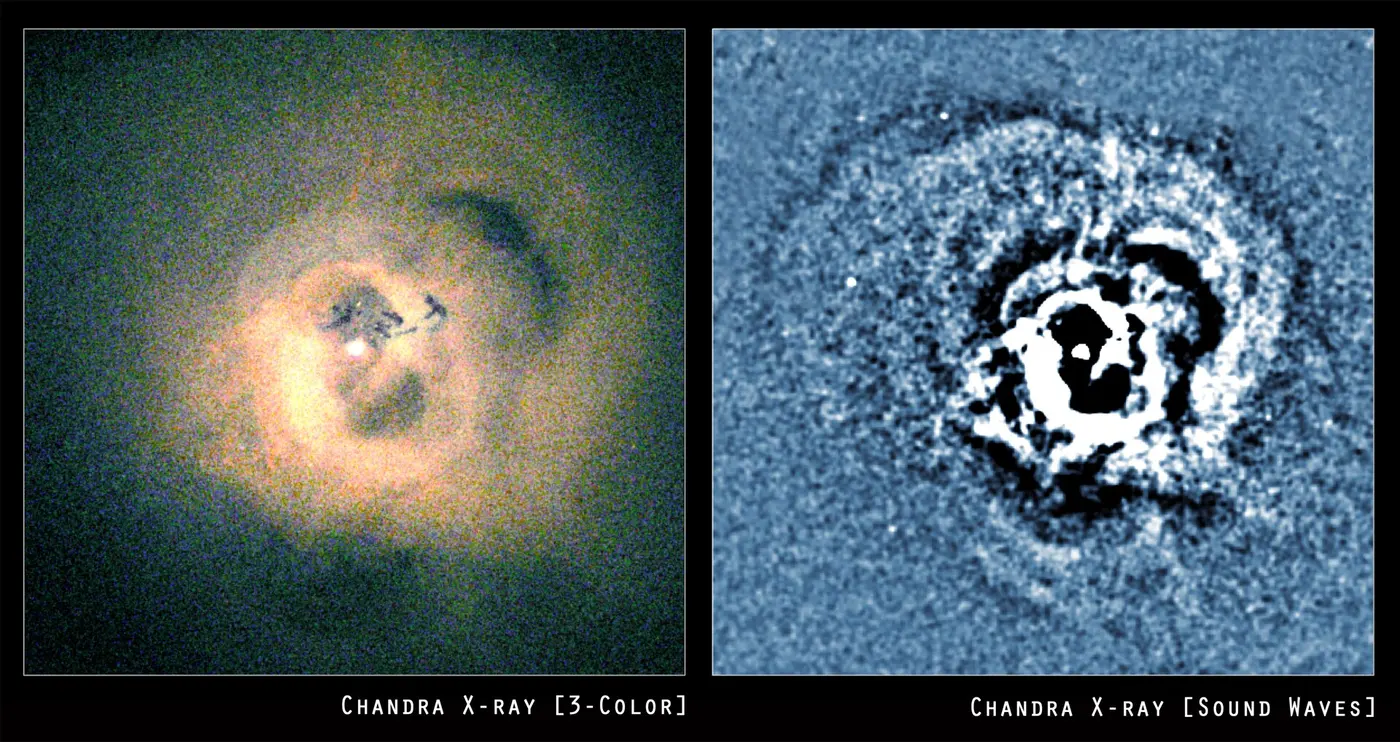
Expressed as a musical note, this wave is a B-flat—but one 57 octaves below middle C. Considering that a standard piano keyboard spans only a little over seven octaves, that depth is beyond imagining. By the numbers, a single vibration takes about 10 million years. The researchers suspect that the energy carried by these sound waves heats the cluster’s gas and keeps it from cooling and forming too many new stars.
Turning it into something we can hear
No human ear could ever hear such a sound. So in 2022, NASA unveiled an attempt to raise the data from these sound waves up to a pitch people can hear. It was a bold transformation: shifting the original sound up by 57 and 58 octaves, which means multiplying its frequency by about 144 quadrillion and 288 quadrillion times.
The result was a low, moaning sound that people widely described as eerie. Turning astronomical data into sound is called sonification, and many other examples have been released. Most of them, however, assign properties such as the brightness of an image to pitch, and are not real sounds. What makes the Perseus cluster recording special is that it is based on sound waves that were actually traveling through gas in space.