Why is the sky blue and the sunset red?
Air molecules scatter blue light far more than red. At sunset, light travels farther, so red is what remains.
Look up, and there is the blue sky, as always. It is so familiar that we rarely stop to wonder why it is blue. Yet air itself is transparent, and space is pitch black. And the very same sky, come evening, blazes with red and orange.
The key to the mystery of the sky’s color lies in the relationship between sunlight and the tiny molecules that make up the air.
Every color hidden in white light
Sunlight looks whitish, but it is really a mixture of light of many colors, from red through to violet. Light behaves like a wave, and differences in color are differences in wavelength. Blue and violet light have short wavelengths; red light has long ones.
When sunlight enters Earth’s atmosphere, it runs into molecules of nitrogen and oxygen in the air and gets bounced off in every direction. This is called scattering. Because the molecules are far smaller than the wavelength of light, something distinctive happens: the shorter the wavelength, the much more strongly the light is scattered.
In the late 19th century, the British physicist Lord Rayleigh showed theoretically that the strength of this scattering is inversely proportional to the fourth power of the wavelength. According to this “Rayleigh scattering,” blue light with a wavelength of about 450 nanometers is scattered more than five times as strongly as red light at about 700 nanometers. Scattered blue light reaches our eyes from every direction in the sky, and that is why the whole sky looks blue.
Why the sky isn’t violet
This raises a question. If shorter wavelengths scatter more strongly, violet light, with an even shorter wavelength than blue, ought to be scattered more strongly still. So why doesn’t the sky look violet?
There are several reasons. First, sunlight contains less violet light than blue to begin with. Some of that violet is also absorbed high in the atmosphere. Even more important is the way our eyes work. Human eyes are not very sensitive to violet light. Our eyes and brain take the mixture of scattered violet, blue and green light and perceive it as “sky blue.”

Red sunsets come from light’s long journey
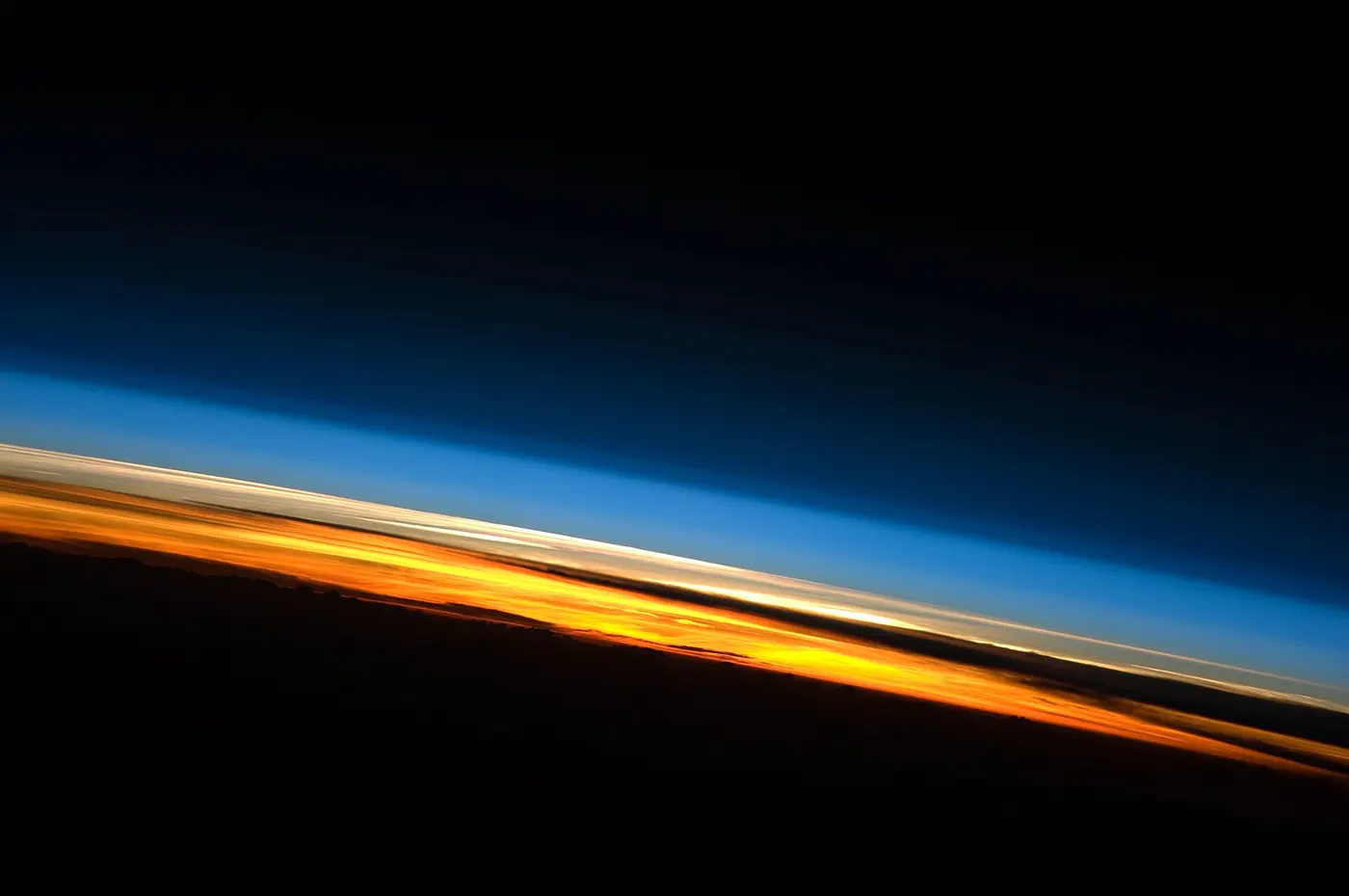
In the middle of the day, when the Sun is high, its light has a relatively short distance to travel through the atmosphere. Around sunrise and sunset, however, sunlight has to skim in close to the horizon, crossing a long, slanting path through the air. That path can be dozens of times longer than when light comes straight down from overhead.
Along that long route, most of the easily scattered blue light gets knocked off to the side. What survives all the way to our eyes is the red and orange light, which scatters less readily. That is why the setting sun and the sky around it turn red. The blue light scattered along the way has not vanished. It is turning the sky blue over places along the light’s path where the Sun is still high.
Scattering also explains why clouds look white. The water droplets that make up clouds are far larger than air molecules, so the strength of scattering hardly varies with color. All colors are scattered about equally, and the result is that clouds look white.
Sunsets on Mars are blue
The color of the sky depends on what the atmosphere contains. Mars offers a vivid demonstration.
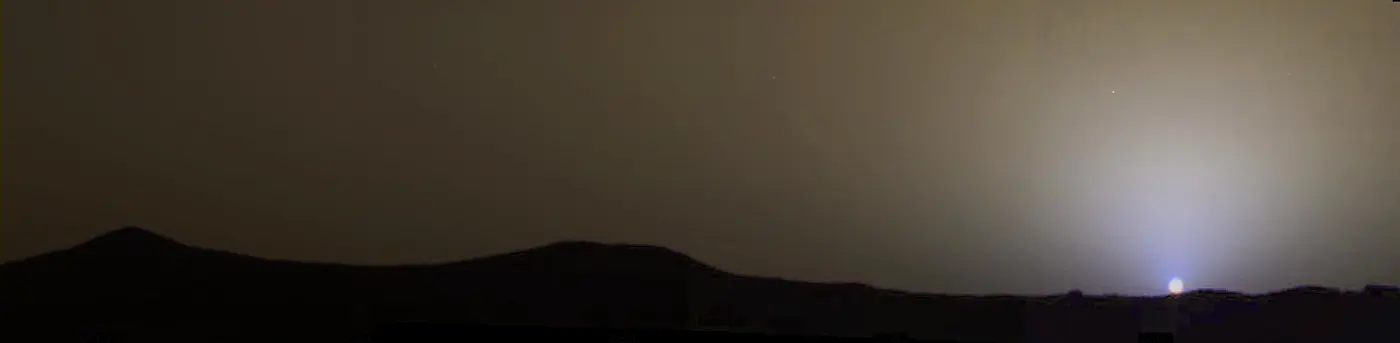
The Martian atmosphere is so thin that the pressure at the surface is less than 1 percent of Earth’s, and fine reddish-brown dust drifts through it. As a result, the daytime sky on Mars is a dull color often likened to ocher. At dusk, though, the area right around the setting Sun glows a hazy bluish white. Martian dust particles tend to scatter blue light forward, in the direction the light is traveling, so when you look toward the Sun, blue light seems to gather there, or so scientists think.

The Moon, on the other hand, has almost no atmosphere, so there is nothing to scatter light. That is why the sky on the lunar surface is pitch black, even in the middle of the day with the Sun blazing down.