How much does a cloud weigh?
The water in a typical cumulus cloud is estimated to weigh about 500 tonnes.
500tonnes
The white clouds drifting across a blue sky look wonderfully light. It seems as if you could reach up and grab a fluffy handful, like cotton candy.
Yet when you calculate how much a cloud weighs, you get a number that will make you look up at the sky again. Even a small, ordinary cloud is far too heavy to be called “fluffy.”
A fluffy cloud weighs 500 tonnes
A cloud is really countless tiny water droplets and ice particles floating in the sky. So to find its weight, you need to work out how much water it holds.
Peggy LeMone, a meteorologist at the U.S. National Center for Atmospheric Research (NCAR), made the following estimate for cumulus clouds, the cottony clouds we often see on fine days. A cumulus cloud contains about 0.5 grams of water per cubic meter. That is about half the weight of a 1-yen coin, which weighs one gram. On its own, that seems like hardly anything.
But clouds are big. Take a cumulus cloud 1 kilometer long, 1 kilometer wide and 1 kilometer tall, and its volume is a billion cubic meters. Multiply that by 0.5 grams and the water weighs about 500 million grams—about 500 tonnes. That is roughly as much as 100 elephants.


Of course, this is a rough estimate based on a typical size and water content. Every cloud differs in size and in how much water it holds, so actual weights vary a great deal from cloud to cloud.
Why clouds don’t fall
So how can 500 tonnes of water stay up in the sky? The secret lies in how tiny the droplets are.
Cloud droplets are only about 0.003 to 0.01 millimeters across, roughly the size of a human red blood cell. At that size, their weight is minuscule compared with the air resistance they meet, so they fall very slowly. A droplet 0.01 millimeters across falls at only about 1 centimeter per second.
Meanwhile, where clouds form, the air is usually rising gently. An updraft of about 1 meter per second is enough to hold cloud droplets aloft instead of letting them fall. Rather than “floating,” a cloud is drifting on the moving air, its droplets falling far too slowly to get anywhere.
How, then, does rain fall? When cloud droplets collide and merge, or ice crystals grow, the particles become big and heavy enough that the updraft can no longer support them, and they fall. If a raindrop is 1 to 2 millimeters across, it is at least 100 times the diameter of a cloud droplet. Its volume is a million times greater or more, so by the numbers it takes over a million cloud droplets to make a single raindrop.
The surrounding air is far heavier
If 500 tonnes surprised you, try one more calculation: the weight of the air the cloud sits in.
Air has weight too—a little over 1 kilogram per cubic meter near the ground. It is somewhat lighter higher up, but if we assume 1 kilogram per cubic meter, a cubic kilometer of air weighs about a million tonnes. The cloud’s 500 tonnes of water is only about one two-thousandth of that.
In other words, a cloud is a huge mass of air with just a sprinkling of water droplets mixed in. Once you realize it is not a heavy lump of water hanging in midair, it makes sense that clouds do not fall.
Thunderclouds are in another league
The cumulonimbus clouds that bring sudden summer downpours are in another league entirely. They can tower more than 10 kilometers high and spread from several to more than ten kilometers across.
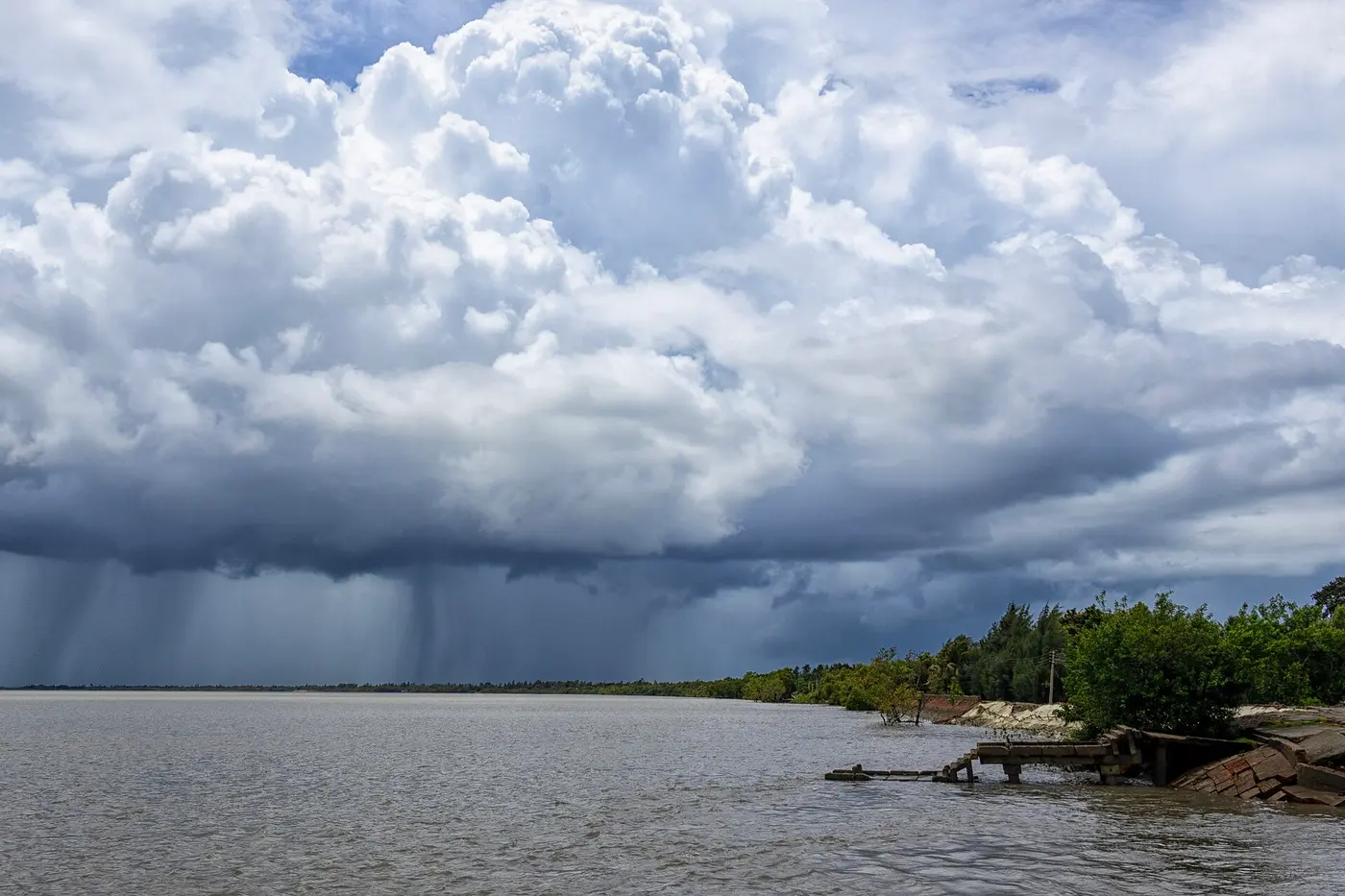

Suppose a cumulonimbus cloud measured 10 kilometers on each side and contained 1 gram of water and ice per cubic meter. It would weigh about a million tonnes, 2,000 times as much as our cumulus. The actual amount varies widely from cloud to cloud, but there is no doubt that the fierce updrafts inside a cumulonimbus lift huge quantities of water high into the sky. When that water comes down all at once, we get cloudbursts and the sudden, intense downpours that Japanese media call “guerrilla rainstorms.”