Would Saturn float in water?
Saturn’s average density is lower than water’s, so on paper it would float. But there’s no way to actually try.
0.69g/cm³
“Saturn would float if you put it in water.” It’s a piece of space trivia you hear often. A giant planet more than nine times as wide as Earth, bobbing gently in water: it’s hard to picture, but by the numbers, the claim is correct.
There is a catch, though. There is no way, even in principle, to actually float Saturn in water. The claim is really a well-crafted thought experiment for thinking about what Saturn is made of.
About 760 times Earth’s volume, but only 95 times its mass
Whether something floats or sinks in water comes down to density. If it weighs less than the same volume of water, it floats; if it weighs more, it sinks. Ice floats on water because its density is slightly lower than water’s.
Saturn’s volume is about 760 times Earth’s. Its mass, however, is only about 95 times Earth’s. For its size, it is remarkably light. Work out its average density from those figures and you get about 0.69 grams per cubic centimeter. Water’s density is about 1 gram, so Saturn is roughly 30 percent lighter than the same volume of water. Of all the planets in the solar system, Saturn is the only one whose average density is lower than water’s.
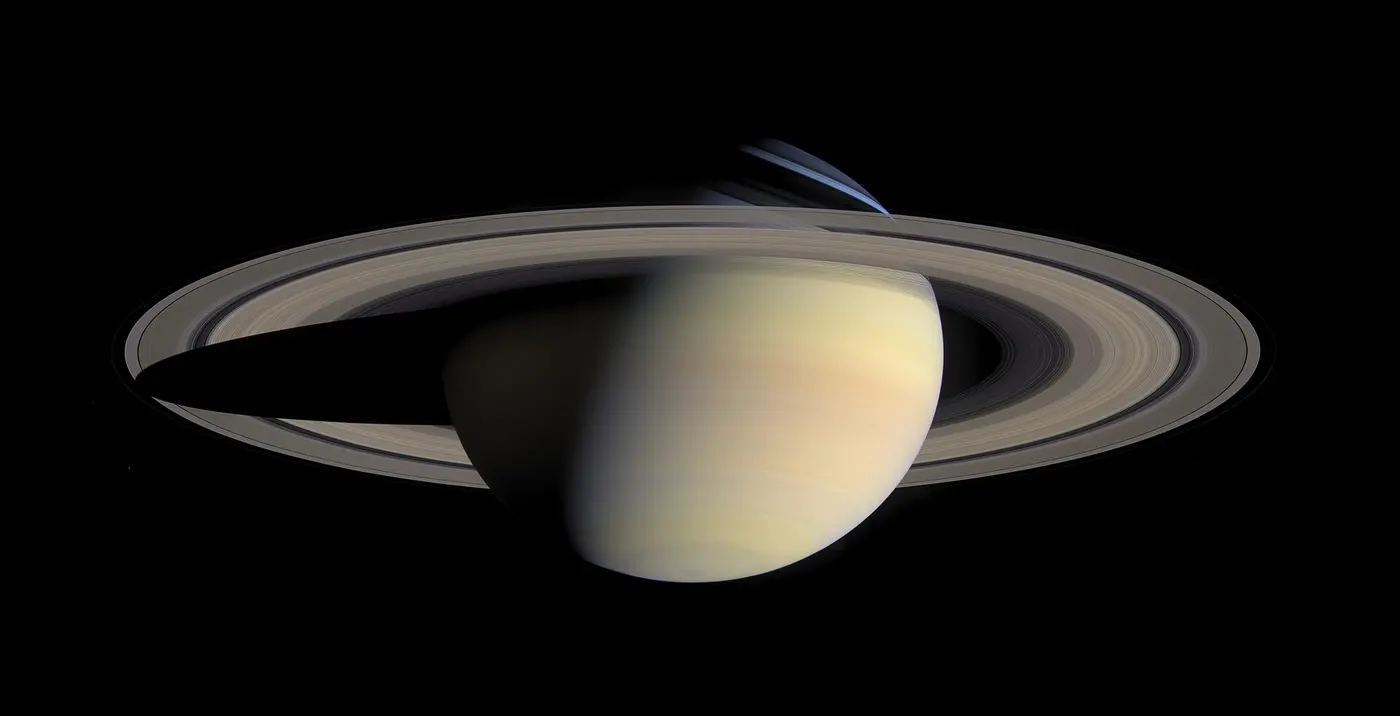

Compare it with other planets and you can see how unusual it is. Earth, made of rock and metal, has an average density of about 5.5 grams per cubic centimeter, roughly eight times Saturn’s. Even Jupiter, a fellow gas giant, comes in at about 1.3 grams.
Mostly hydrogen and helium
Saturn is so light because it is made mostly of hydrogen and helium, the two lightest elements in the universe. The pale yellow bands we see in photographs are patterns of clouds floating in its thick atmosphere.
That doesn’t mean Saturn is fluffy gas all the way through. The deeper you go, the higher the pressure climbs, until hydrogen starts behaving like a liquid; deeper still, it is thought to take on an electrically conducting state known as “metallic hydrogen.”
Rocky and icy material gathers toward the center, but even that picture isn’t simple. A study published in 2021 suggested that Saturn’s center may not be a hard, sharply defined core at all, but a fuzzy-edged one, mixed with hydrogen and other material, that extends to about 60 percent of the planet’s radius. The result came from an ingenious method: decoding the wave patterns that vibrations inside Saturn imprint on its rings.
So the figure of 0.69 is an “average,” smoothing over everything from the dense center to the light outer layers. It doesn’t mean that every part of Saturn is lighter than water.
There’s no bathtub big enough
So could you actually float Saturn in water? Try imagining it as a thought experiment, and you quickly run into a series of obstacles.
First, gathering enough water to hold Saturn is impossible in itself. Floating a body 120,000 kilometers across would require an even bigger tub and an unimaginable amount of water. Collect that much water in one place, and it would outweigh Saturn itself; the water would pull itself into a ball under its own gravity and become a celestial body of its own.
What’s more, Saturn has no distinct “surface.” Its atmosphere simply grows denser and denser until it merges into the interior. The outer gases touching the water wouldn’t hold their shape like a ball; they would mix in and scatter.
It’s probably best to think of “Saturn would float in water” as a vivid way of expressing the fact that its average density is lower than water’s.
Light and fast: a squashed shape
Saturn’s lightness shows in its appearance, too. Look closely at a photograph and you’ll notice that Saturn isn’t a perfect sphere; it’s slightly squashed. Its diameter at the equator is about 120,500 kilometers, while from pole to pole it is about 109,000 kilometers, a difference of roughly 10 percent. That makes it the most flattened planet in the solar system.
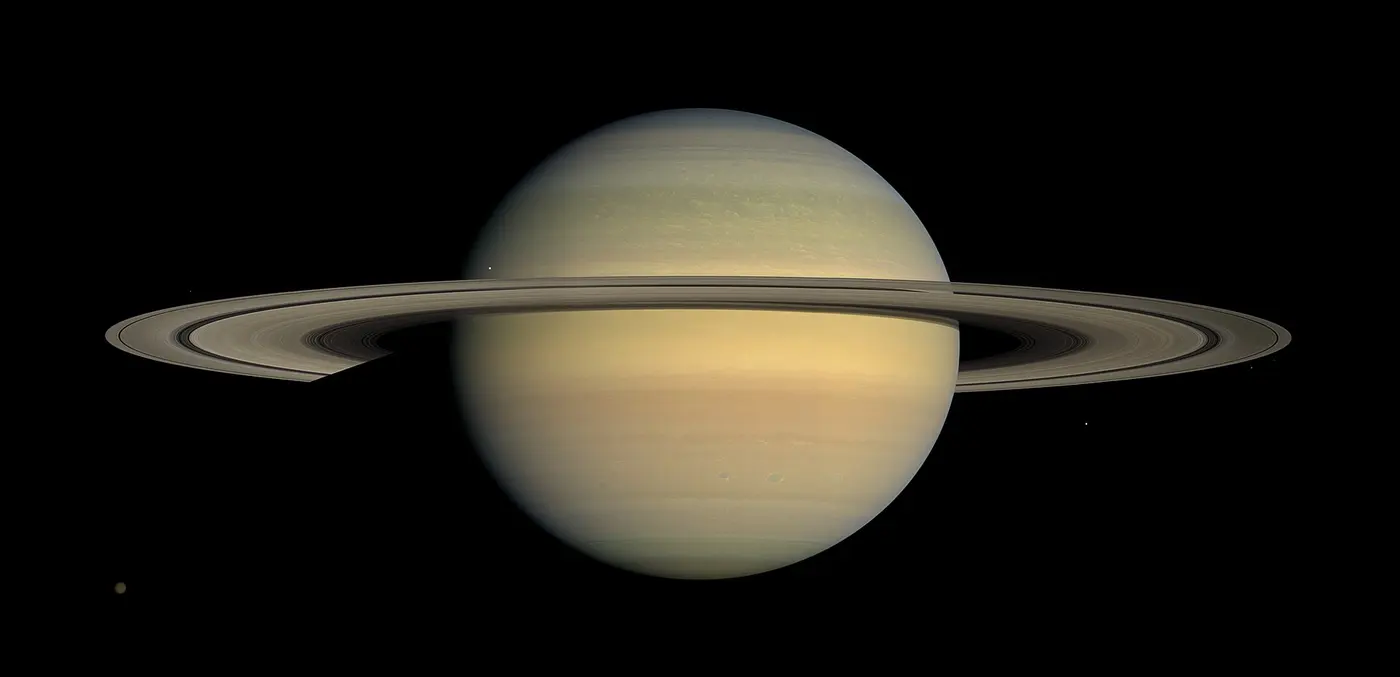

The reason is its fast spin. Huge as it is, Saturn turns once in only about ten and a half hours. Near the equator, centrifugal force is strong, and the planet’s low-density, easily deformed body bulges outward.
Measuring that rotation period precisely was, in fact, a long-standing puzzle. Saturn has no solid ground, and its cloud patterns drift at different speeds in different places, so there is no fixed landmark to track. In 2019, once again using wave patterns in the rings as clues, researchers reported a value of about 10 hours and 33 minutes. When it comes to understanding Saturn’s true nature, its rings have turned out to be an unexpectedly reliable instrument.