Is Jupiter’s Great Red Spot shrinking?
Yes. In the 19th century it was wide enough to fit three Earths; today it is only a little wider than one.
Jupiter is the largest planet in the solar system. Look at it through a telescope and you’ll see a reddish oval sitting alone among its stripes. This is the Great Red Spot.
It is a gigantic vortex in Jupiter’s atmosphere—a storm, in other words. Hurricanes and typhoons on Earth die out within a few weeks at most, but the Great Red Spot has been raging for at least close to 200 years. And this long-lived storm, it turns out, is slowly getting smaller.
A storm bigger than Earth
The Great Red Spot is a high-pressure vortex in Jupiter’s southern hemisphere. Winds around its edge are said to exceed 400 kilometers per hour (250 mph). The clouds at its top tower about 8 kilometers above the surrounding clouds.
Even more astonishing is its depth. Observations by NASA’s Juno spacecraft, which has been orbiting Jupiter since 2016, revealed that the Great Red Spot sends its roots hundreds of kilometers down into the planet’s atmosphere. According to NASA, that is 50 to 100 times deeper than Earth’s oceans.
What gives the storm its red color is still not clear. One idea is that ultraviolet light from the Sun triggers chemical reactions in substances in the atmosphere, producing reddish compounds.
How long has it been blowing?
The story of the Great Red Spot reaches back to the 17th century. In 1665, the Italian-born astronomer Giovanni Cassini spotted a large spot on Jupiter. Known as the “Permanent Spot,” it was observed until 1713.
After that, however, records of the spot all but vanish for more than a century. Then, from 1831 onward, a large red spot was again clearly recorded. This is today’s Great Red Spot. Whether Cassini’s spot and the modern one are the same storm was debated for a long time, but a study published in 2024, after carefully analyzing the old records, concluded that they were most likely different storms. Today’s Great Red Spot may have been born around 1830.
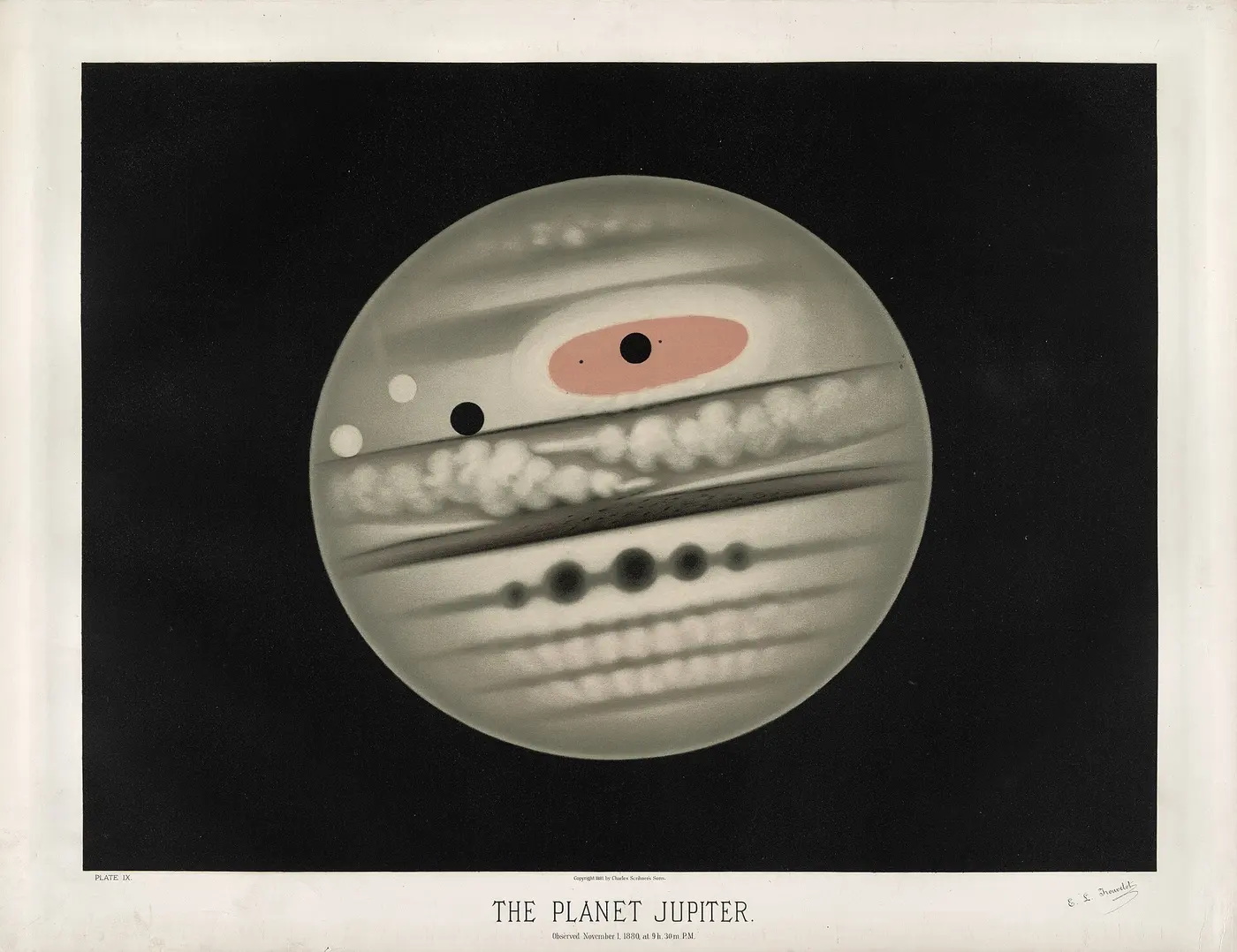

Around 1879, the Great Red Spot suddenly became famous among astronomy enthusiasts. As the drawing above shows, it was much longer and larger back then than it is today.
From three Earths to one
According to NASA, observations in the late 1800s put the spot’s long axis at about 41,000 kilometers. Earth is about 12,700 kilometers across, so three Earths could sit side by side inside it with room to spare.
By 1979, when the Voyager spacecraft flew past Jupiter, it had shrunk to about 23,300 kilometers. Hubble Space Telescope measurements then showed about 21,000 kilometers in 1995, about 18,000 kilometers in 2009 and about 16,500 kilometers in 2014. Starting around 2012, amateur astronomers also reported that the spot was shrinking at a faster pace of more than 900 kilometers a year. As of 2017, it was about 1.3 times as wide as Earth.
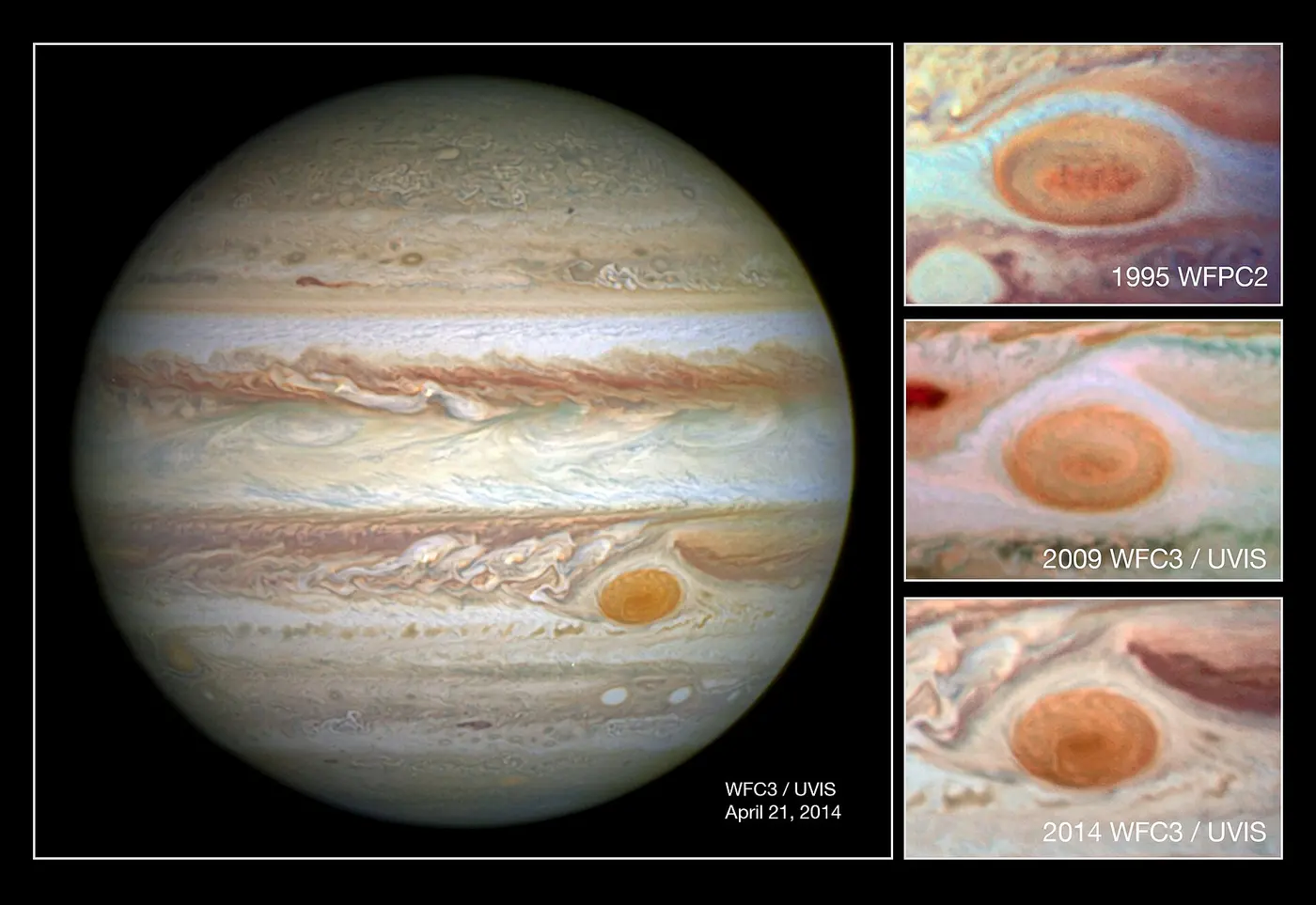

As it has shrunk, its shape has changed too. The once-elongated oval has been growing steadily more circular. Some predict that if the current pace continues, it will be nearly round by about 2040.
So will the Great Red Spot eventually disappear? Nobody knows yet, nor exactly why it is shrinking. It may settle at some stable size, or it may fade away. Either way, we are watching the solar system’s most famous storm change in real time.