What is the tallest mountain in the solar system?
Mars’s Olympus Mons, about 2.5 times Everest’s height, is the front-runner—though a peak on Vesta rivals it.
21–22km
Mount Everest, Earth’s highest mountain, stands a little over 8,848 meters (29,032 feet) above sea level. For humans it is truly the roof of the world, a summit hard to reach without bottled oxygen.
Widen your view to the solar system, though, and the picture changes. On our neighbor Mars stands a colossal mountain that two Everests stacked on top of each other still couldn’t match.
A volcano two and a half Everests tall
Its name is Olympus Mons, after the mountain where the gods of Greek mythology lived.
Mars has no oceans, so there is no “sea level” to measure heights from. Instead, heights are measured from a reference level, or datum, based on the planet’s average elevation. Measured that way, Olympus Mons stands about 21 to 22 kilometers (13 to 14 miles) tall, roughly 2.5 times the height of Everest. What’s more, the plains immediately around it lie below the datum, so from the surrounding plains to the summit the rise is close to 26 kilometers at most.
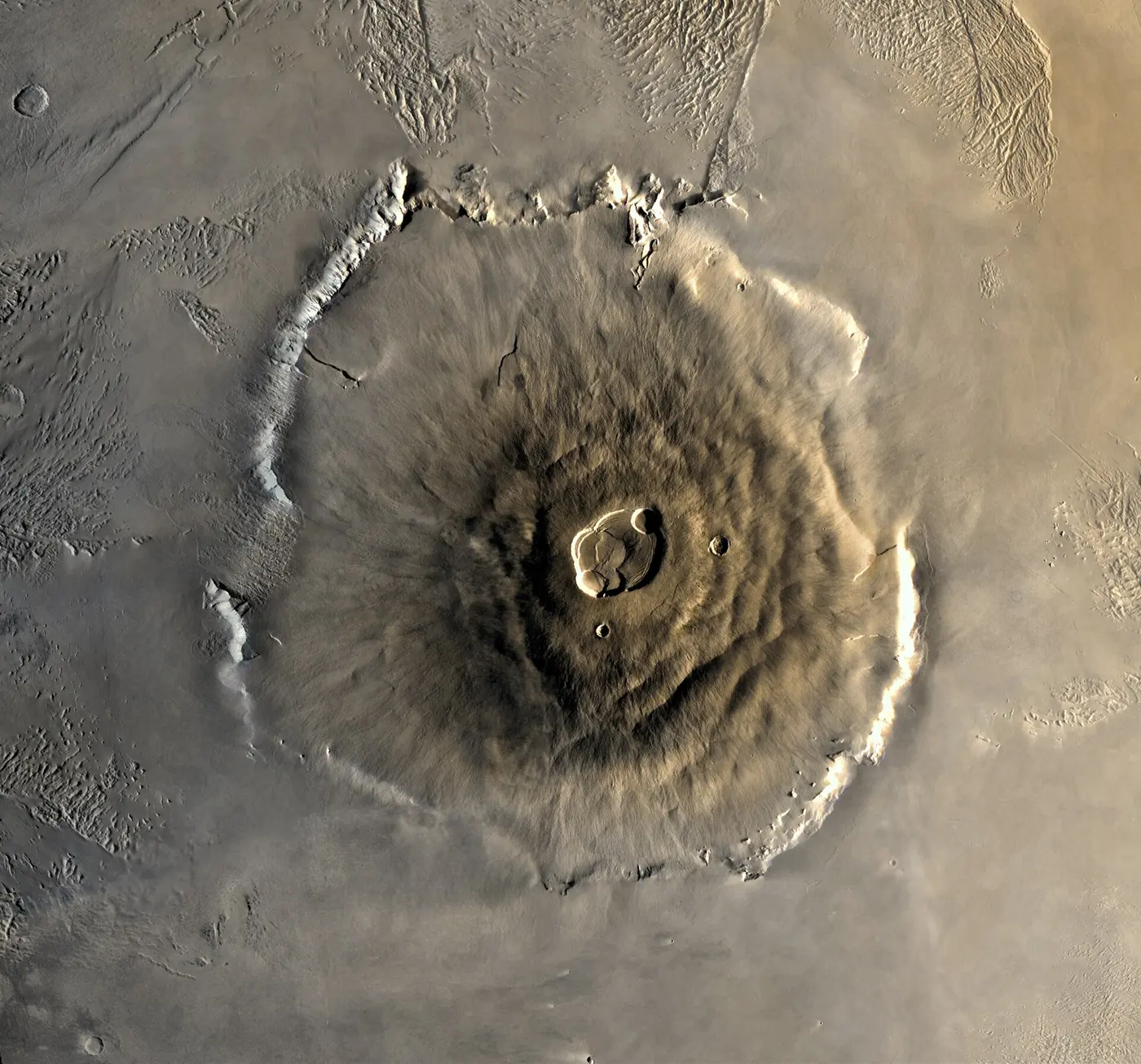

It isn’t only tall. Its base is about 600 kilometers (370 miles) across and covers roughly 300,000 square kilometers—a single mountain spread over an area larger than Honshu, Japan’s main island. At the summit lies an enormous depression formed by several overlapping craters, 80 kilometers long and up to a little over 3 kilometers deep. Around its rim, the mountain is bounded by cliffs that rise as high as 8 kilometers in places.
A mountain that doesn’t look like one
For all its height, its slopes are remarkably gentle. The average incline is only about 5 percent, making it a “shield volcano,” the same type as the volcanoes of Hawaii. Lava poured out again and again and piled up into a shape like a warrior’s shield laid face up.
It is so huge and so gently sloped that, if you stood on it, the curvature of Mars would reportedly keep you from seeing the whole mountain. A climber might see nothing but an endless, gentle incline.
Why are Martian mountains so big?
Earth has shield volcanoes too, but none come close to the size of Olympus Mons. One reason for the difference is the movement of tectonic plates.
Earth’s surface is broken into many slabs of rock called plates, which slowly drift. The Hawaiian Islands lie in a chain because the Pacific Plate keeps moving over a plume of rising magma, so new volcanoes keep forming in new places. Mars, however, has no moving plates like Earth’s. The ground stayed in one place while lava was supplied from directly below for an immensely long time, so a single volcano is thought to have just kept growing.
On top of that, Mars’s gravity is only about 38 percent of Earth’s. With weaker gravity, a mountain can pile up higher without being crushed or sinking under its own weight. And because there is almost no erosion by rain or rivers, its giant form has been preserved.
A rival on an asteroid
Is Olympus Mons, then, the undisputed tallest in the solar system? Not quite. It has a rival: Rheasilvia, a giant crater at the south pole of Vesta, an asteroid that orbits between Mars and Jupiter.
Vesta is only about 570 kilometers across, yet Rheasilvia is about 500 kilometers wide—the scar of a tremendous impact spanning nearly 90 percent of the asteroid’s diameter. In its center stands a mountain that rebounded upward after the collision. Its height is estimated at about 20 to 25 kilometers measured from its base.
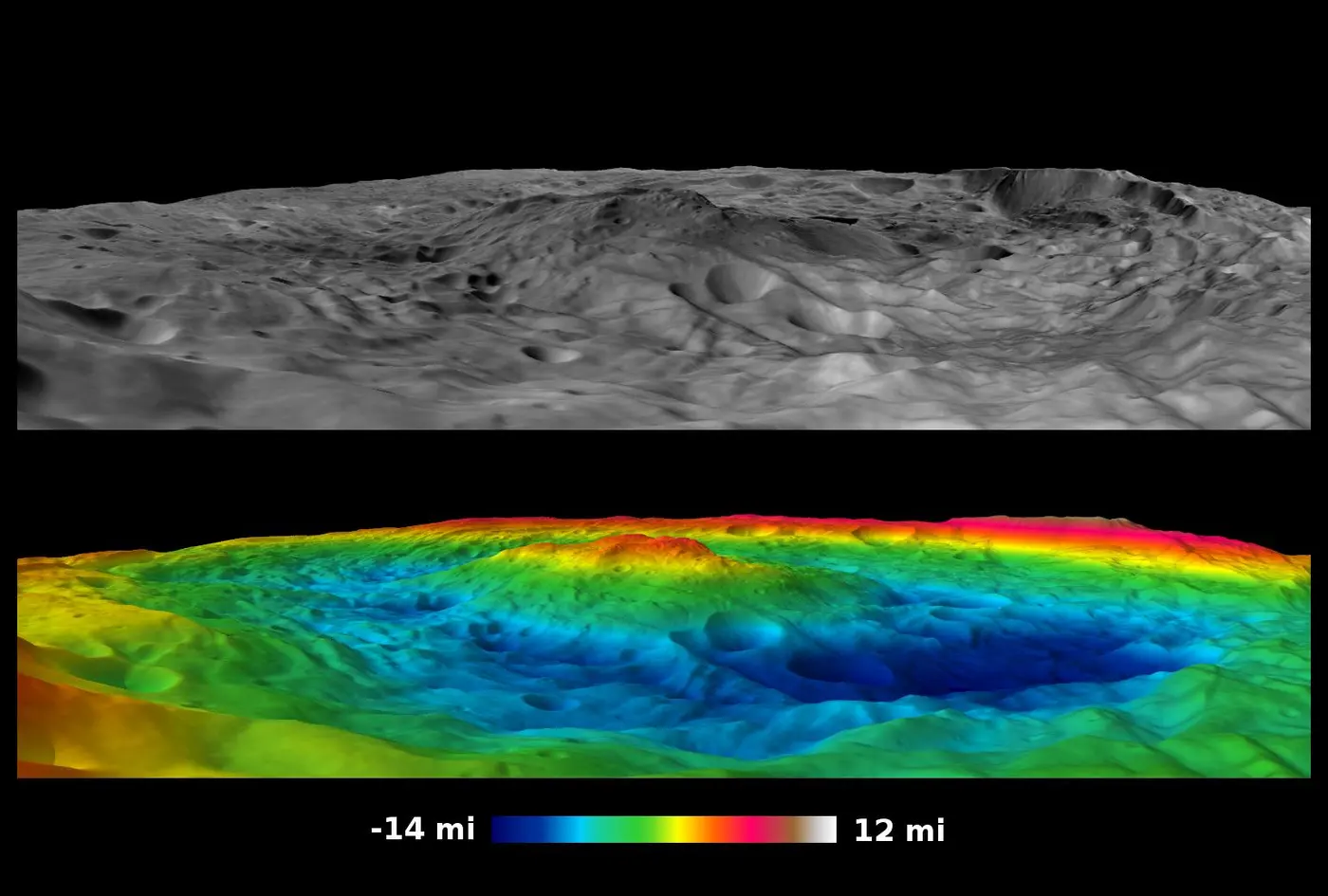

That puts it at about the same height as Olympus Mons. The numbers shift depending on where you place a mountain’s base and what reference you measure from, so the honest answer is that which is the solar system’s tallest depends on how you measure. Either way, it seems clear that Earth’s highest peak is a rather modest presence on the scale of the solar system.