Why is Uranus tipped on its side?
Its spin axis is tilted about 98 degrees. The leading theory blames a collision with a huge body.
98°
Earth’s spin axis is tilted about 23.4 degrees. That slight lean is what gives us spring, summer, autumn and winter. Mars is tilted about 25 degrees, Saturn about 27. Most planets tip their heads a little, but they still spin more or less “upright,” like tops.
Uranus, the seventh planet from the Sun, is a different story. Its axis is tilted about 98 degrees. It circles the Sun lying almost completely on its side.
A planet that rolls
Uranus was discovered on March 13, 1781, by the British astronomer William Herschel. It was the first planet ever found with a telescope, and Herschel himself is said to have thought at first that it was a comet.
It is about four times Earth’s diameter, and it is so far from the Sun that one orbit takes about 84 years. It spins once roughly every 17 hours, but because its axis lies sideways, Uranus moves around the Sun less like a top and more like a ball rolling along. And since its tilt is more than 90 degrees, its rotation is classed as running in the opposite direction to that of Earth and most other planets.
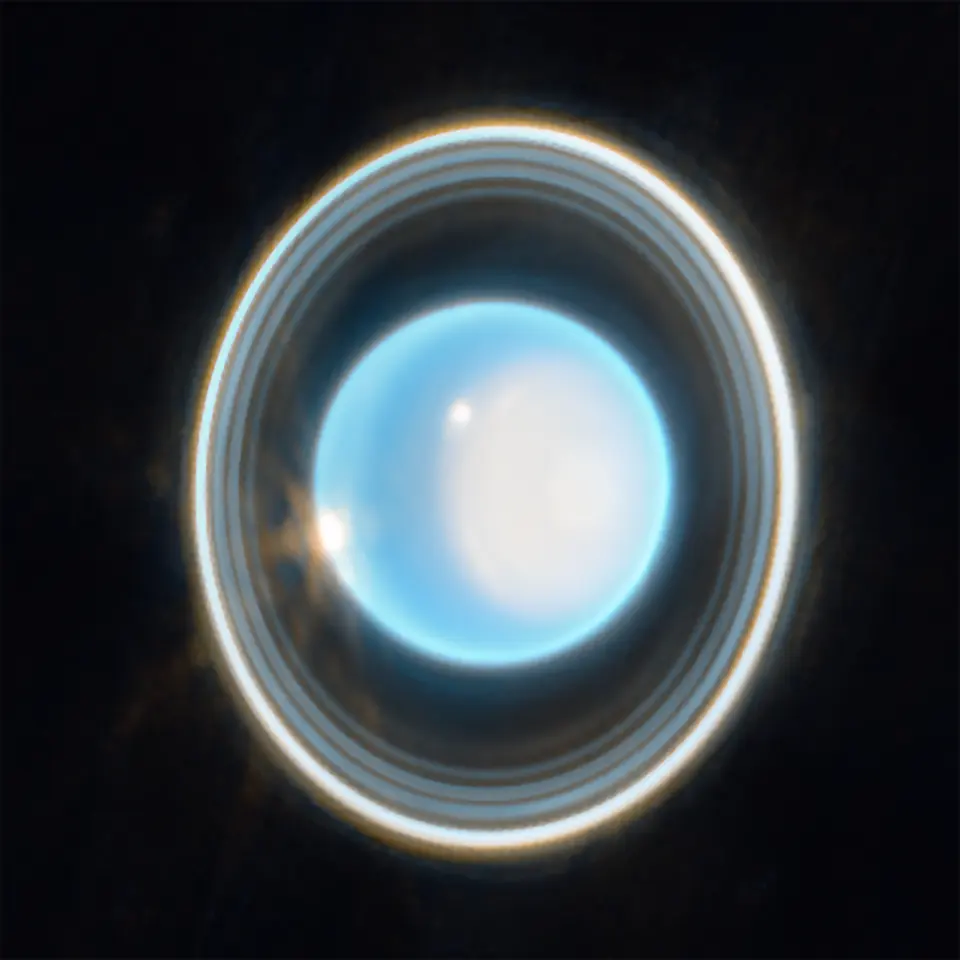

Days and nights that last 42 years
With an axis tilted this far, the seasons become extreme beyond imagining.
At one point in its orbit, the north pole points almost straight at the Sun. For years at a time, the Sun never sets over the high northern latitudes, while the high southern latitudes are locked in one long, long night. Half an orbit later the roles reverse, and the south pole faces the Sun.
As a result, the polar regions get about 42 years of continuous daylight, followed by about 42 years of darkness. In human terms, you could be born and reach middle age without ever seeing a sunset.
In January 1986, the Voyager 2 spacecraft became the first—and so far the only—probe to fly past Uranus. At the time, the south pole was pointing almost directly at the Sun. The equinox, when the Sun shines straight down on the equator, came in 2007, and the north pole will be tipped most fully toward the Sun around 2028.
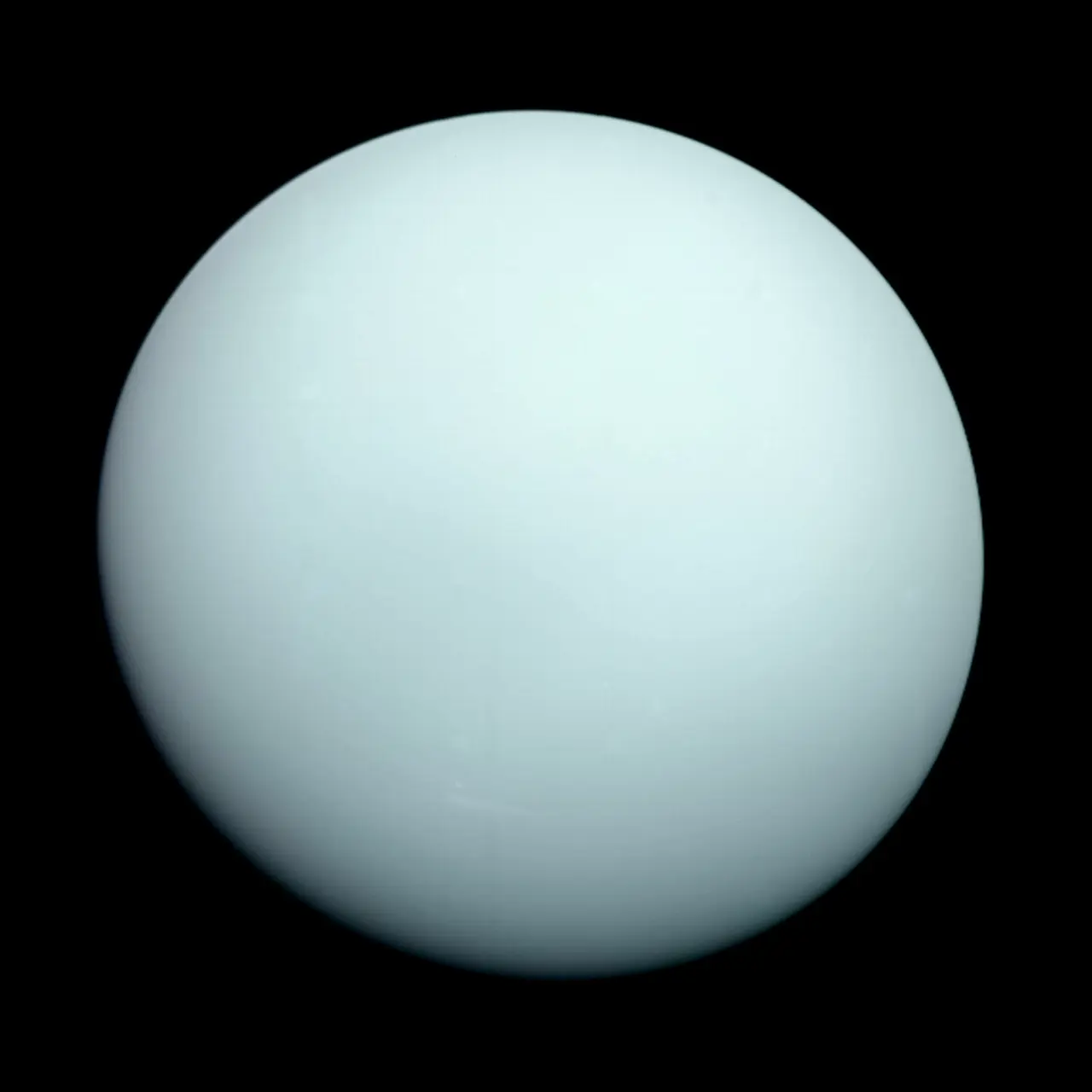

Was a giant impact the culprit?
So how did Uranus end up on its side? The most widely favored explanation is that, early in the solar system’s history, a large protoplanet crashed into Uranus and knocked its axis over. In 2018, a team at Durham University in the UK ran more than 50 collision scenarios on a supercomputer and reported that an impact by a body about twice Earth’s mass could account for the present tilt.
The theory has weak spots, though. Uranus’s moons and rings all circle neatly above its tilted equator, and some researchers point out that a single violent collision has trouble explaining how the moons are arranged and which way they orbit. That has led to the idea that Uranus was tipped over gradually, by several collisions rather than one. There is also its neighbor Neptune, just farther out, whose tilt of about 28 degrees is perfectly ordinary. Why only Uranus ended up this way, when its sibling grew up in much the same surroundings, is another part of the mystery.
In 2022, researchers at the Paris Observatory proposed a scenario that needs no big collision at all. Uranus once had a large moon, they suggested, and as that moon slowly drifted outward, a gravitational “resonance” gradually tipped the planet’s axis. Eventually the moon’s orbit became unstable and it fell into Uranus and was lost.
Which explanation is right has not yet been settled. Missions to Uranus are being considered, and one day this sideways planet may give us the answer itself.