What is the largest moon in the solar system?
Jupiter’s moon Ganymede. At about 5,268 kilometers across, it is even bigger than the planet Mercury.
5268km
A body that orbits a planet is called a moon, or satellite. Earth has just one, but Jupiter and Saturn each have dozens.
Our Moon is about 3,475 kilometers (2,160 miles) across, roughly a quarter the width of Earth, which makes it very large compared with the planet it circles. Even so, it ranks only fifth among the moons of the solar system. The biggest is Ganymede, which orbits Jupiter.
A moon bigger than a planet
Ganymede is about 5,268 kilometers (3,273 miles) in diameter. That is roughly one and a half times the size of our Moon, and larger than Mercury, the innermost planet, at about 4,879 kilometers. Compared with the dwarf planet Pluto, it is more than twice as wide.
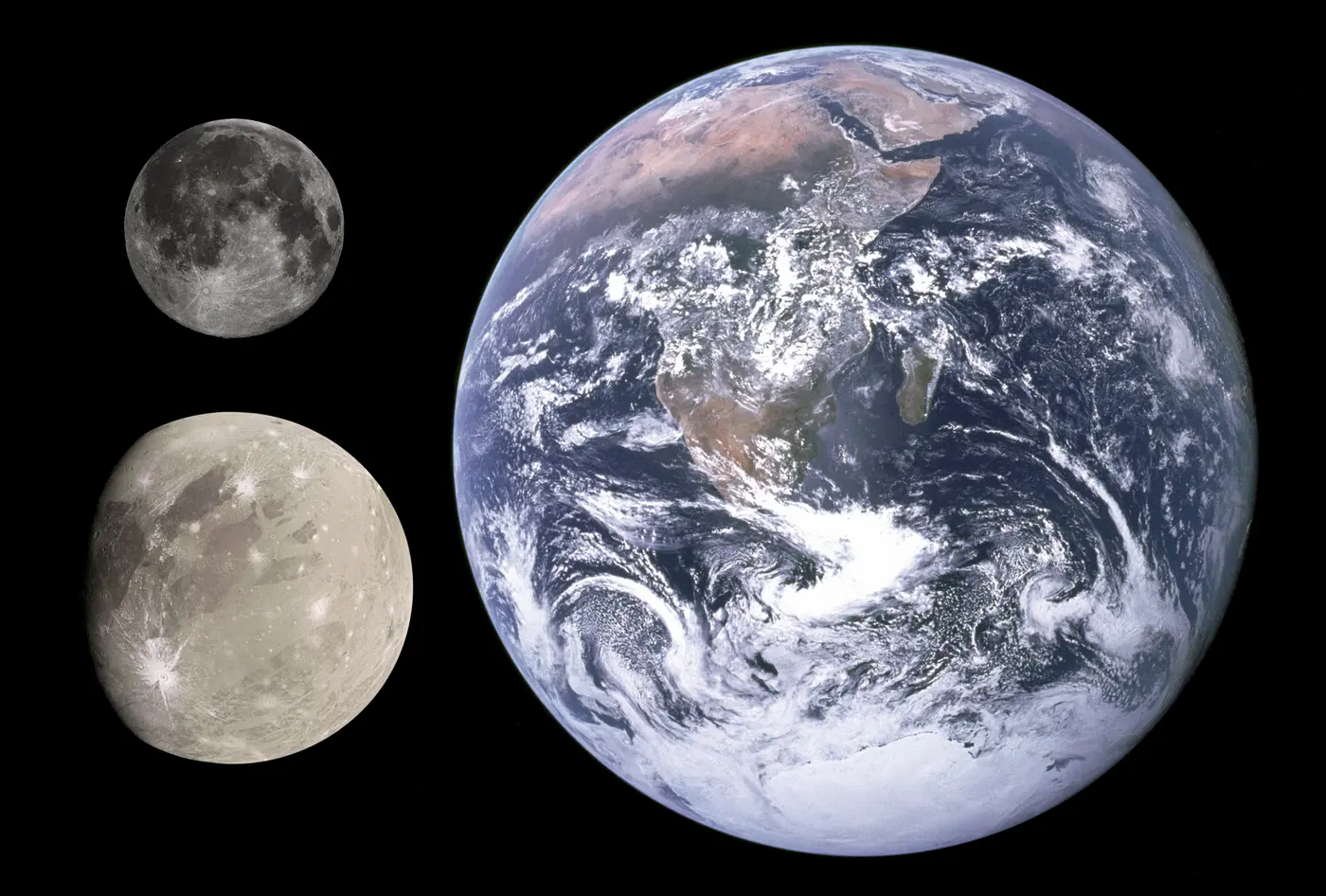

Size and weight are different things, though. Ganymede has less than half the mass of Mercury. Mercury is made of rock and iron, whereas Ganymede is a mix of roughly equal parts rock and ice, so it is much lighter inside.
The upset with Titan
For a long time, the title of largest moon was thought to belong to Saturn’s moon Titan. Titan is the only moon wrapped in a thick atmosphere, and telescopes on Earth saw it with that atmosphere included, so its size was overestimated.
The mistake was cleared up by NASA’s Voyager probes, which flew past Jupiter and Saturn in the late 1970s and early 1980s. They measured the solid surface beneath the haze, showing Titan to be about 5,150 kilometers across. Ganymede wins by a margin of only about 2 percent.
One of Galileo’s four moons
Ganymede is one of the four moons of Jupiter that the Italian astronomer Galileo Galilei discovered in January 1610 with a telescope he had built himself. The four are known as the Galilean moons. The name Ganymede, after a beautiful youth in Greek mythology, was proposed by the German astronomer Simon Marius, who observed Jupiter’s moons around the same time.
Ganymede circles Jupiter at a distance of about 1.07 million kilometers, taking around seven days and three hours per orbit. Like our Moon, it always keeps the same face turned toward its planet.
It is also locked into a curious rhythm with the two moons inside its orbit, Io and Europa. For every one orbit Ganymede makes around Jupiter, Europa makes exactly two and Io exactly four.
Its own magnetic field, and an ocean under the ice
Ganymede has a feature no other moon shares: a magnetic field of its own, discovered by NASA’s Galileo spacecraft in 1996. It is still the only moon known to have one.
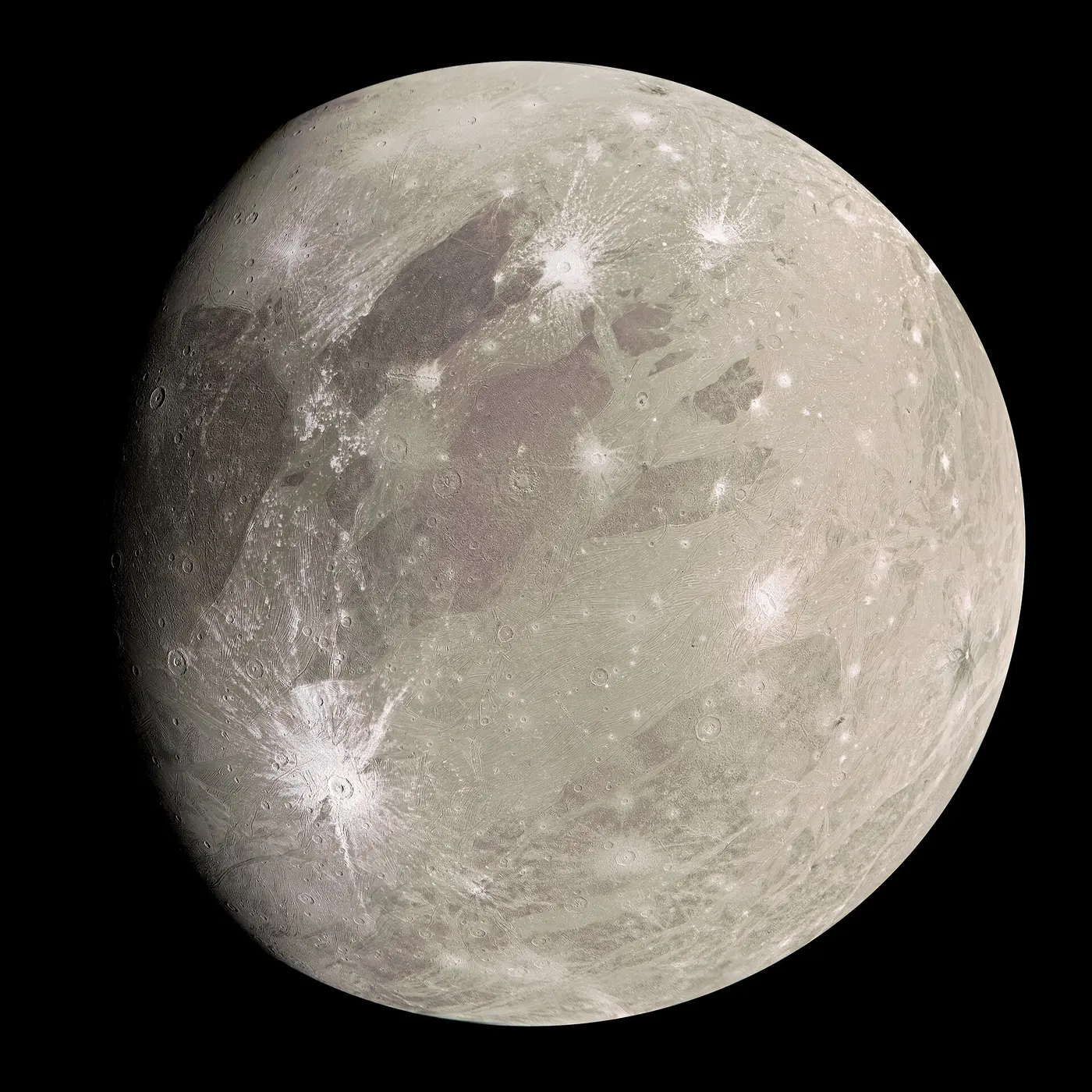

Its surface is split between dark, heavily cratered regions and lighter regions crossed by countless grooves and ridges, which cover about two-thirds of the moon. The dark regions are thought to be very old ground, dating back some four billion years.
Thanks to its magnetic field, auroras glow around Ganymede’s poles. In 2015, scientists used the Hubble Space Telescope to study how those auroras rock back and forth, and found that the motion is best explained by a salty ocean hidden beneath the icy crust. According to NASA, that ocean may hold more water than all the water on Earth’s surface.
To study this giant moon up close, the European Space Agency launched the Juice spacecraft in April 2023. It is due to reach Jupiter in July 2031 and to enter orbit around Ganymede in December 2034, becoming the first spacecraft to orbit a moon other than our own.